
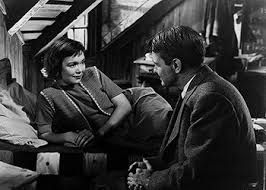
This film nearly dropped from my “I really should see this movie sometime” list, as it has seemed to drop from the film-goer’s consciousness over time. I remembered that lead actress Jane Wyman (Mrs. Ronald Reagan at the time) won the Oscar for her performance, but that’s pretty much all I recalled except for the basic plot outline. Digging a little deeper, it turns out that the film was nominated for 12 Oscars, including Best Picture, Best Director, and it two leading and two supporting performances. How could a film so well regarded at the time be so gone from the collective cinematic memory?
It’s not because of the performances. I thought Wyman won because she played a deaf mute, playing the kind of role that attracts nominations and wins, such as
- Patty Duke in The Miracle Worker (win)
- Elizabeth Hartman in A Patch of Blue (nomination)
- Audrey Hepburn in Wait Until Dark (nomination)
- Cliff Robertson in Charly (win)
- Sir John Mills for Ryan’s Daughter (win)
- Jon Voight in Coming Home (win)
- Tom Cruise in Born on the Fourth of July (nomination)
- Daniel-Day Lewis for My Left Foot (win)
- Al Pacino in Scent of a Woman (win)
- Leonardo DiCaprio in What’s Eating Gilbert Grape? (nomination)
- Holly Hunter in The Piano (win)
- Gary Sinise in Forrest Gump (nomination)
- Jamie Foxx in Ray (win)
- Eddie Redmayne in The Theory of Everything (win)
…and that’s not including John Malkovich, Alan Arkin, Marlee Matlin, Rinko Kikuchi, Samantha Morton, Woody Harrelson, Emmanuelle Riva, Joanne Woodward, Jessica Lange, Robin Williams, Jodie Foster, Brad Pitt, Billy Bob Thornton, Edward Norton, Sean Penn, Matthew McConaughy, Jared Leto, et al.
So yeah, that’s definitely a thing.
I mistakenly thought that Wyman’s win was simply in that category, and that this one strong performance had stood out in just an OK movie. I was very wrong. She’s certainly excellent in the film, with a soft performance that is beautifully calibrated. Part of a great performance, IMHO, is locking down on a specific character and staying in that character the whole time (see Sandra Bullock’s surprising work in The Blind Side). It’s not necessarily about big dramatic or emotional scenes, but about staying in character and being believable the whole time. I’d seen Wyman in other films (e.g., The Lost Weekend, Stage Fright) and hadn’t seen anything that prepared me for her work here. She also hides her keen intelligence, something most actors are loath to do. There was only one quick moment where I thought that her intellectual acuity shone through, and it made narrative sense if it was accidental.
The film is worth seeing for her alone, but then there are the other 11 nominations. The other three main actors—Lew Ayres, Charles Bickford, Agnes Moorehead—are all strong. Ayres in particular is surprising in a role that should be ripe for satire—the kind, perfect doctor—but who still manages to make his character believable in every scene, even by today’s cynical standards. (Factoid: He and Wyman had an affair during this time, which helped bring about the end to her marriage with Reagan.)
The other Oscar-nominated categories—Picture, Director, Best Writing/Screenplay, Art Direction/Set Decoration for Black and White, Editing, Music (by the legendary Max Steiner) and Sound—indicate what an all-around strong piece of filmmaking this is. But the other nominated category—Cinematography/Black and White—is something that stood out right away and continued to do so throughout the film. Cinematographer Ted McCord isn’t well remembered today, even though his films are: The Sound of Music, East of Eden, The Treasure of the Sierra Madre. His career went all the way back to 1921, but I noticed a strong similarity to the work of Gregg Toland (Citizen Kane, The Long Voyage Home, Wuthering Heights), with their rich blacks and whites and their many stunning low angle shots and arrangements in the frame. Johnny Belinda is an all-but-forgotten master class in black-and-white photography. (McCord pointed to the influences of the paintings of Rembrandt and the cinematography of Toland in his work.)

The film was controversial in its time for (spoiler alert) its depiction of a rape and the resulting pregnancy for an unmarried woman. (The Motion Picture Production Code had prohibited such a subject from being filmed until this particular film.) Even today, the key sequence is still tension-filled and unnervingly gripping. There is also a murder that somehow sneaks past the Code’s rules for murderers—sort of.
For its time, it was considered a bit of rough going to view Johnny Belinda. While nothing is handled crudely, the subject matter can even today make it a strong experience for some viewers. Not every narrative turn is completely believable, but the film’s technical strengths and solid performances make it a surprisingly enjoyable and satisfying watch.


 Film stuff by Mark