

Ridley Scott’s new film Napoleon can be compared in many ways to his Gladiator (2000). Some of the comparisons are helpful, but most show the newer film to also be the lesser film. Like Gladiator, Napoleon has artfully crafted and exciting battles, in which Scott excels. Unfortunately, this is where the positives end, but the comparisons can make for some good discussions.
The script was challenged by the opposing pulls of the grand scale of the history and battles on one hand, and on the film’s narrow focus on Napoleon’s relationship with Josephine on the other. According to IMDB, “Sir Ridley Scott and screenwriter David Scarpa rejected Stanley Kubrick’s [unproduced] Napoleon script as being underwhelming, but kept 80% of the structure, scenes, and development.” Of course we will never know what a Kubrick take on the French general’s life would look like, but the script here is one of the film’s biggest weaknesses. It doesn’t seem to know what story it wants to tell, and for whom. The current broad consensus for biopics is for them to choose a slice of a person’s life rather than trying to cover it all, and find meaning there beyond the events themselves. This film is not a cradle-to-grave biography and does stay within a tight timespan, but stumbles around issues of warfare, revolution, insecurity, love, obsession, ambition, and hubris without ever pulling these issues into a coherent whole.
The other helpful comparison with Gladiator and Napoleon is with its two leads, and it may well be a matter of casting more than direction. Of course, Russell Crowe won the Best Actor Oscar for Gladiator, and that was due in great part to the cinematic impression Crowe made, in general and in relation to the character of Maximus. And of course, there was a Best Supporting Actor nomination for Joaquin Phoenix for this role of Commodus. Both Crowe and Phoenix are excellent actors, but they can’t do everything (see https://film-prof.com/2013/01/04/les-miserables/). Crowe was terribly miscast in Les Misérables, and here Phoenix is miscast as Napoleon.
What Crowe brought to his role of a slave in Gladiator was great personal authority. Yes, we are meant to realize that Maximus has a royal heart, and is a great man stuck in a slave’s situation. But Crowe also tends to make his parts bigger and fuller than the character he plays, and that adds a level of power and grandeur to those parts. What made Phoenix so good as Commodus is that Phoenix tends to make his characters smaller than what they seem. His Commodus, while ostensibly the heir to the throne as the natural son of the Roman Emperor, is a small man, full of insecurities—petty and whiney. Unfortunately, that also describes his Napoleon.
This Napoleon is a far cry from the great leader seen in so many other films. Seeing his nervousness before his first major battle is one (good) thing. But Napoleon must have had some innate confidence to accomplish what he did, which you won’t find here. We’re left with the question of how he could have led so many and conquered so much in such a short period because the man presented here couldn’t have pulled that off. Not that the script is any help to the character here: “You think you’re so great because you have boats” has my vote as the most ridiculous and memorable line in the film, and a line likely to be quoted for a long while. And the “You are nothing without me” lines that Napoleon and Josephine say to one another are both cliché and far too quickly turned around to be anything but confusing or laughable.
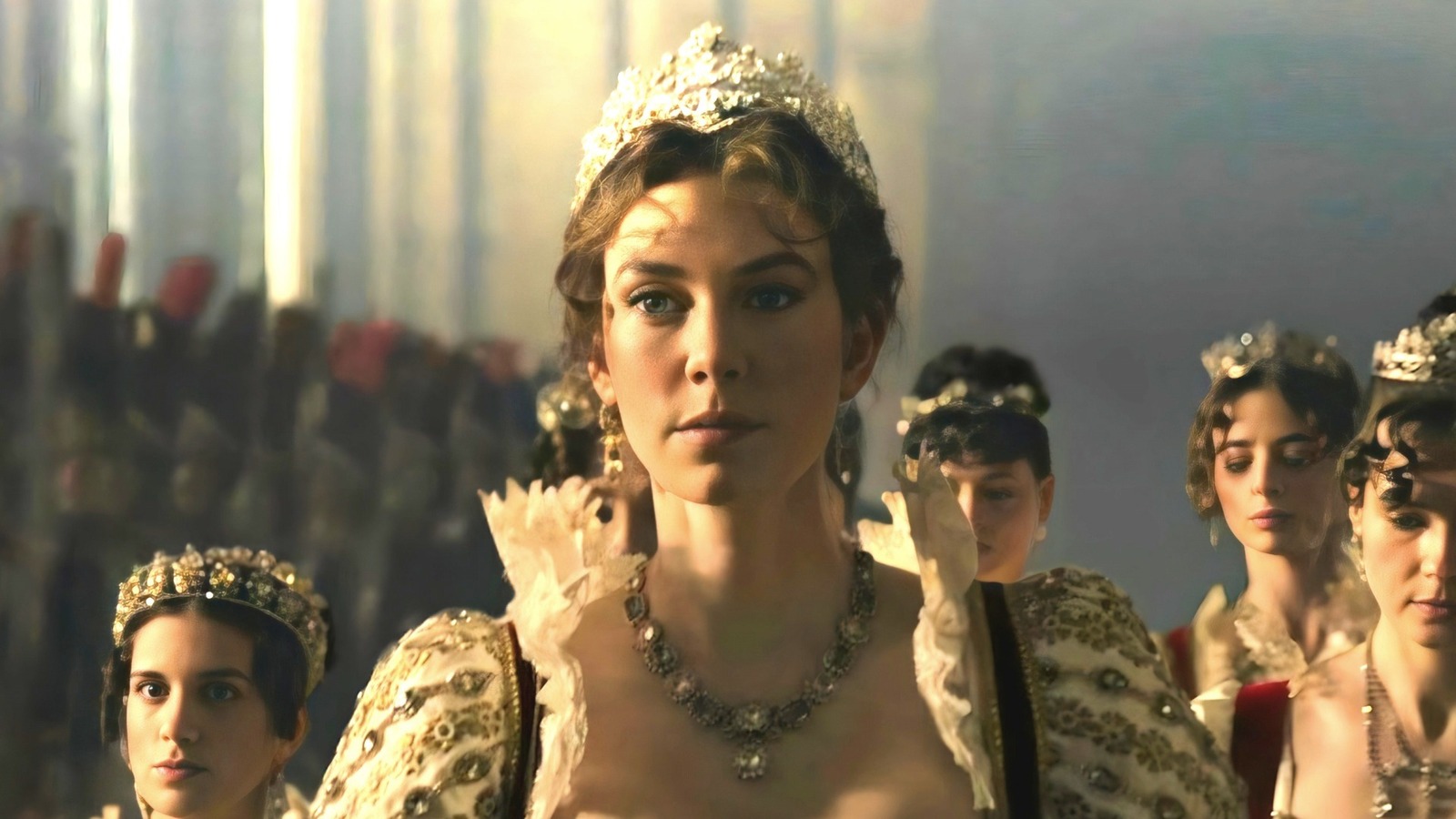
We don’t see the great military mind or the great leader, and we don’t see a relationship with Josephine that makes sense. Vanessa Kirby (“The Crown,” Pieces of a Woman) is an excellent actress, but her character is so enigmatic here that we never get a sense of what makes her special (or even what makes her tick), and certainly we can’t see what she sees in Napoleon beyond the power we know he is supposed to possess. One gets the sense of an actress of talent trying very hard to add life to an underwritten character that the film offers such little help to explain.
Part of the problem may be the positioning of the camera. We get great medium and long shots of battles, and some strong close-ups of Napoleon at the more dramatic moments, but the shots of him and Josephine together are often at a mid-distance that is more observational than interpretive. We see the two of them together. but don’t know them any better. And the so-called “lovemaking” scenes are uncomfortable and only serve to make the general seem smaller still. (Why would Josephine want to be with this man?)
The cinematography and CGI are also similar to Gladiator, but especially in comparison to Oppenheimer’s overwhelmingly practical effects, the special effects here seem tired, and render a kind of dull haziness to the film.
The film is at this point a box office failure, not even recouping its original budget. It’s too long in its current version, but the rumored four-hour version may turn out to be better. The two-and-a-half-hour version now in theaters is full of holes, and has a bumpy rhythm to it. Perhaps like the various versions of Griffith’s Birth of a Nation, where the longest version one can find is probably the best, the next iteration of Scott’s Napoleon may be an improvement.
This movie has been called the Napoleon film that no one asked for. True enough. For now and likely for quite some time, Abel Gance’s Napoleon (1927) at 5.5 hours is still the definitive cinematic version.


 Film stuff by Mark