

What!? You’re writing about Barbie now? Why?
Well, a couple of reasons. One is that I usually like to wait until the hubbub/brouhaha is over before writing about a film. This more than any film of 2023 was surrounded with so much noise that it would have brought a lot of signal interference with my writing about it near the time of its release. Also, I wanted to get this in before the Oscars, as Barbie will be very much yesterday’s news just a few days after this coming weekend.
Barbie is funny, stupid, beautiful, messy, and confused. Let’s start with the good: Its production values are wonderful. Director Greta Gerwig and the production team have created a fantasy world that is as believable as Barbie herself is; it’s a world of imagination—tough to do successfully—and consistently on the other side of anything realistic. The pastel colors are lovely to the eye and of a piece with Barbie’s world.
Margot Robbie, one of the producers and the film’s lead, is really excellent as Barbie. She didn’t receive an Oscar nomination, which was a disappointment to me (and many others). This may well be an actual snub (see https://film-prof.com/2024/01/26/oscar-nominations-2024-first-thoughts/ for my thoughts on that overused and abused word), and the reasons may be obvious, or not. Barbie is not a drama, which tends to draw higher raves; comedy is notoriously hard to do, as is staying consistent with a specific comic tone, which makes her performance a little less obvious and of a whole with the film itself; and yes, there might be a little jealousy and sexism here. It might be because Robbie is one of the beautiful actresses currently making films and the film highlights her physical appeal, and it might be because she is playing a doll. So there might be some understandable jealousy mixed in with not playing an actual human.
The actor who did receive an Oscar nomination is the very talented Ryan Gosling as Ken. This could have been disastrous for another actor, but Gosling gives himself over completely to this “living doll” who is equal parts insecure and is not the sharpest knife in the drawer. Gosling is neither a dancer nor a singer (yes, I saw La La Land), but he has the moves and the notes to distract us from this fact. In fact, a real dancer or singer would have been distracting in this world and for this character. Kudos to one of best young (and intelligent) actors in taking this role and leaning into it so much.
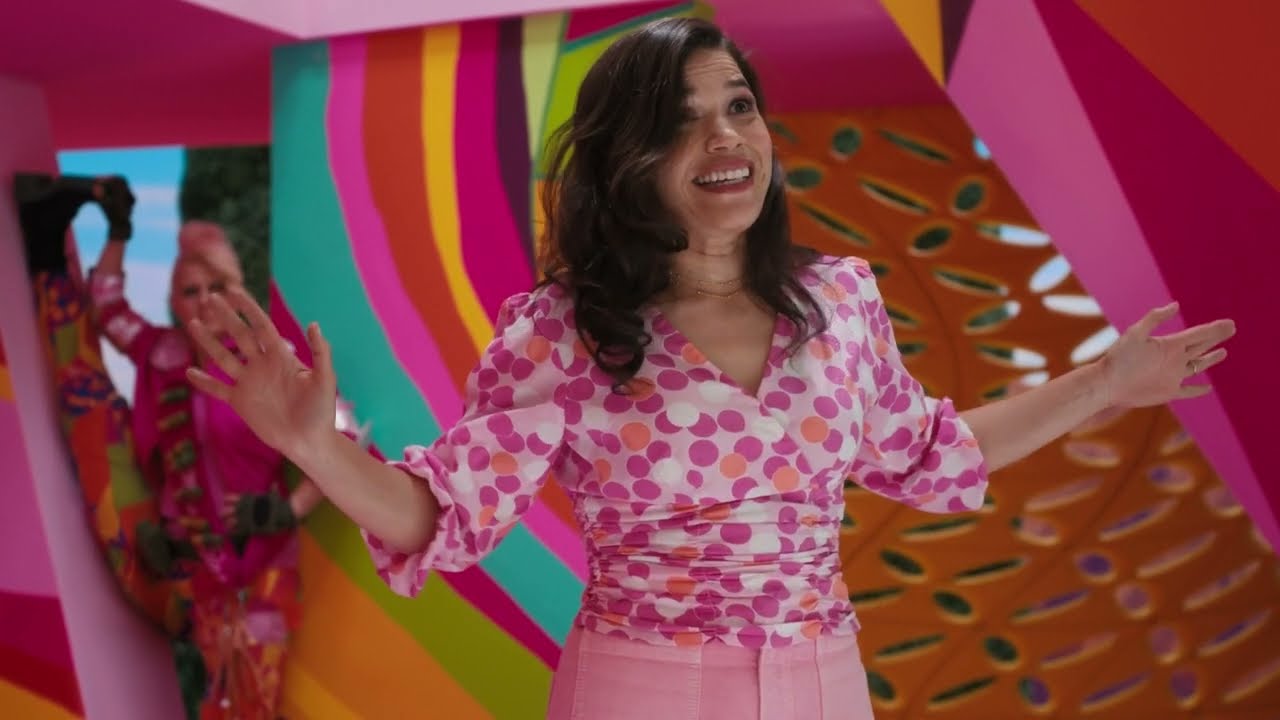
The other strong points are the performances by America Ferrara (also nominated in the supporting category) and Michael Cera. Ferrara made a speech for the ages about the challenges of being a woman, but her performance is much more than that. That speech is her “moment,” but she brings a lovely strong realism to her character that is essential to the film. (It reminds me of the talk that Luise Rainer’s phone call in The Great Ziegfeld was the sole reason for her nomination and win back in the 1930s, when her performance was so much more than that moment.) She is the connection between Barbieland and the real world that helps hold the film together (an element much needed, and well exploited).
The other actor who should be mentioned is Michael Cera, who brings in an understated yet hilarious performance as Allan, the friend of Ken’s who was introduced after Ken was but pulled from the shelves a few years later. Cera is humbly and ably playing up his blandness compared to Gosling and the other Kens, all of whom are good looking and in great shape. Cera never once “winks at the audience” to let him know that he is in on the joke, but sacrifices himself as an actor for the part.
What’s NOT good in Barbie? A lot, but I’ll go to the beginning for what I believe to be the worst part. There is an admittedly clever takeoff on 2001: A Space Odyssey, with Strauss’s “Thus Spake Zarathustra” blasting behind a recreation of the apes scene. Barbie herself becomes the stand-in for the monolith, all of which could be referentially cute except for the narrator’s message. Apparently, little girls who play with dolls only did so after a while because it was forced on them and they were criminally limited to baby dolls. So we see a group of miserable children stuck with playing with baby dolls, obviously practicing for the inevitable “servitude” of motherhood. Instead of just offering another alternative to the baby dolls, Barbie’s arrival leads them not to add an adult doll to the mix, but to destroy the baby dolls with diabolical force, sending the film’s first message about motherhood. For us film historians, it’s all very clever. But it’s also a horrific scene in its images and implications. (There are a lot of other film references throughout the film, most of which are amusing: The Matrix, Love Actually, Monty Python and the Holy Grail, The Sixth Sense, The Shining, Top Gun, Zack Snyder’s Justice League, etc.)
Yes, the picture is “woke,” whatever that means anymore. But its feminism seems old-fashioned and its adherence to the Academy’s new rules for inclusion and representation, whether intentional or not, is funny in its own right. We have a bit of gay representation (actually, more of a suggestion), a trans Barbie who simply looks like a long-haired male, an overweight Barbie, and a Wheelchair Barbie, and of course, black and Asian Barbies and Kens to beat the band. On one hand, expanding the Barbie universe is legitimate, as it reflects the gradual development of the brand and the new Barbieworld the filmmakers envision. On the other hand, the characters often seem shoehorned in rather than arising naturally from Barbieland, which, let’s face it, is essentially and historically white and middle class. While we get “one from each underrepresented group,” the one unwanted Barbie is Midge, who is the pregnant Barbie. So again the appearance of a baby is highlighted as being unwelcome and ultimately rejected. And the only time motherhood is presented as a possibly “OK” option—as best as I can remember—is with Ordinary Barbie, and the line is a throwaway at best.
There is a great deal of clever humor in the film. When Barbie steps out of her high heels and her feet remain on tiptoe, that’s a delightful joke to anyone who has seen Barbie’s feet. The fact that there is neither water in the shower, not tea in the cup, again resonates, and is used well in the second half of the film. “Hold my ice cream” is a great substitute for “hold my beer.” Of course, role/gender reversal is a key part of the story, and that’s where the film is funniest and weakest. Having male cheerleaders for an all-women’s athletic team is a great sight gag that can hit home philosophically, but does so with a light touch. The narrator’s (Helen Mirren) remark about the casting of Margot Robbie at a certain point of Barbie’s journey of self-discovery is on the nose and charming. Guys playing their insipid songs ad nauseum for girls—great! Men still needing help with the remote—priceless. And when the head of a corporation talks about the patriarchy, and says that they still believe in it and work with it, but just hide it better—that may be the best dark line in the film.
Yet, the film isn’t exactly sure what the patriarchy really is. Is it simply the historical taking of roles that should be shared? Is it sexual oppression, pure and simple? Is it a rather disturbing love of horses, which are explained as “men extenders”? Is the darkness of it revealed finally in the statement, “I wanna push you around”? It seems the idea is more “men vs. women” here in than other films exploring the idea in more subtlety, and it also seems the end result of patriarchy in this film is a parade of stupid men (a redundant phrase in this film?) in power by default. There seems an attempt to “be fair” in helping Ken come to his own sense of identity, but his journey of self-discovery is awkward and lacking in logic. All the Kens (and Allan, of course) are presented as being stuck in a larger oppressive construct at a few points, but mostly they are just insecure jerks.
Perhaps the weakest aspect of the entire film are the presence and actions of the corporate Mattel group, headed by a misused/miscast Will Ferrell. The presence of Ferrell should have provided a great side trip for the viewer, but he seems cast only so that we don’t completely hate or dismiss such a repulsive character. Corporate America is taken down a few humorous pegs in the early courtroom scene, where a strong socio-political statement about the role of corporations in the legal world is sharply criticized but is quickly candy-coated with a strong truth about the legitimacy of being both emotional and logical. The corporate criticism is quickly eclipsed by the truthfulness and humor of the fact that logic and emotion can legitimately co-exist. It’s a great way to hide a strong statement inside of a distracting humorous context that happens to contain another strong statement about wrongful criticism against some women. It makes its points while being deft enough to exist in the film about a doll. But the corporate side story, even with Ferrell at the lead, just doesn’t work, and I was happy when he and his cohorts disappeared.
Finally, the film contains some “pearls of foolishness” that continue to endanger young minds and ultimately society itself. For example, to paraphrase, “If Barbie can be anything, you (a young female) can be anything.” Sorry, we can’t do or be anything, and while having vision and being encouraging are always in order, we can’t be “anything” we want. Also slipped in is the idea of reality being created by feeling, which is a mental scourge of the age. (I personally keep feeling like a billionaire who looks like Brad Pitt, but that hasn’t gotten me anywhere….) “Feeling” is how the film presents Barbie as being able to become “real.” Sorry, feeling alone can’t create reality, as much as some individuals and groups are pushing the idea, and I was disappointed to see the film present simply feeling as something that has the power to create reality. And lastly, the great and most famous quote that will probably outlive the film is this: “By giving voice to the cognitive dissonance required to be a woman under the patriarchy, you’ve robbed it of its power.” Great line, if a little overly optimistic. But in a film that relies on this as a theme, even if in the make-believe worlds of dolls, the line loses much of its power when Barbie acts surprised that the words came out of her mouth. It’s like when the Scarecrow in The Wizard of Oz says that “The sum of the square roots of any two sides of an isosceles triangle is equal to the square root of the remaining side.” What’s funny about that 1939 statement is that it’s true, but surprising and funny considering its source, who remains untaught and clueless. Same with Barbie and her comment here. It’s wise for a comedy to say the loud part quietly instead of the quiet part out loud, but any possible reverberations of that idea throughout the film are lost in Barbie’s (and hence our) surprised reaction at what is coming out of her mouth, even if bypassing her head.
Barbie is ultimately cotton candy—very pretty, delightful to look at, and tasty at first bite. But it’s full of useless calories, can provide a sugar rush followed by a swift carb crash, and eventually ends up providing unhealthy ingestion.
Note: Yes, I know Barbie is “just” a movie, and about a doll that’s not real and works with the imagination. But there is finally no such thing as “just” a movie.


 Film stuff by Mark