

Conclave is a beautifully directed, stunningly gorgeous, carefully sound-designed, very well acted production, and is also an ultimate disappointment. For those that were curious but haven’t yet decided to see the film, it’s the story of the death of a pope and the machinations behind the process to elect the new one. Simple plot, and the film leads us to be more invested in the process than in the final result. The joy of the story is the push and pull of the politics of the Catholic Church leaders, and watching the actors doing the pushing and pulling.
Directed by Edward Berger, director of the highly regarded (and well-rewarded) 2022 version of All Quiet on the Western Front, Berger brings the same combination of cool detachment and occasional intensity to the proceedings here. The sound in the theater that I saw the film in had the sound level set at 11, which sometimes painfully allowed the viewer to hear every door closing loudly, every lock reminding us of the closing of a prison door (not subtle but legitimate for the film), and every step taken on the floors as the characters move from one clandestine meeting to the others.
I was raised Catholic, but I can’t account for the accuracy of procedure and costume. Other more in the know, however, say these things are generally on the nose. Sloppiness in these areas can detract, of not completely undermine, the credibility of what we are watching. But this isn’t a documentary, and the slow pace associated with Berger’s style occasionally puts the emphasis on procedural and sartorial accuracy to the expense of the drama. I’m all for a slow build, but the focus on ecclesiastical and historical specific sometimes drains the film of its accumulating power.
The film has gotten attention for its actors and its acting. It’s a stellar cast generally operating at the top of their game. Starting from the bottom of the four leads, my beloved Stanley Tucci is simply, well, Stanley Tucci. Tucci is an actor I have extolled as always lifting and improving every film he is in. Here, he brings nothing new or shaded, and it seems as if the director told him to be himself. It’s a disappointing and regrettable performance.
Isabella Rossellini, the daughter of director Roberto Rossellini and the great Ingrid Bergman, looks breathtakingly like her mother at this age, and this viewer felt as if Bergman had risen from the dead to take on this role. Fortunately, Rossellini is as excellent here as her mother would have been, and her role and her performance shake things up, even if it is ever so slightly within such a monumental and unyielding context.
Then there is John Lithgow, perfectly cast. He tends to play himself here as well, but it works. No one can express questionable sincerity as well as Lithgow, and he is just what the film needs in that role. Does he mean what he is saying? Is he plotting every moment? Does he go back and forth in intention? What, ultimately, does his character want? Part of the heart of the film is our changing view of people and their objectives, which applies more and more to all the church leaders—except Lithgow’s. We question him from the very beginning simply because of his performance, not because of anything he says or does, and that opens the door to the slow reveal of the hidden desires and covert machinations of the rest of the key players.
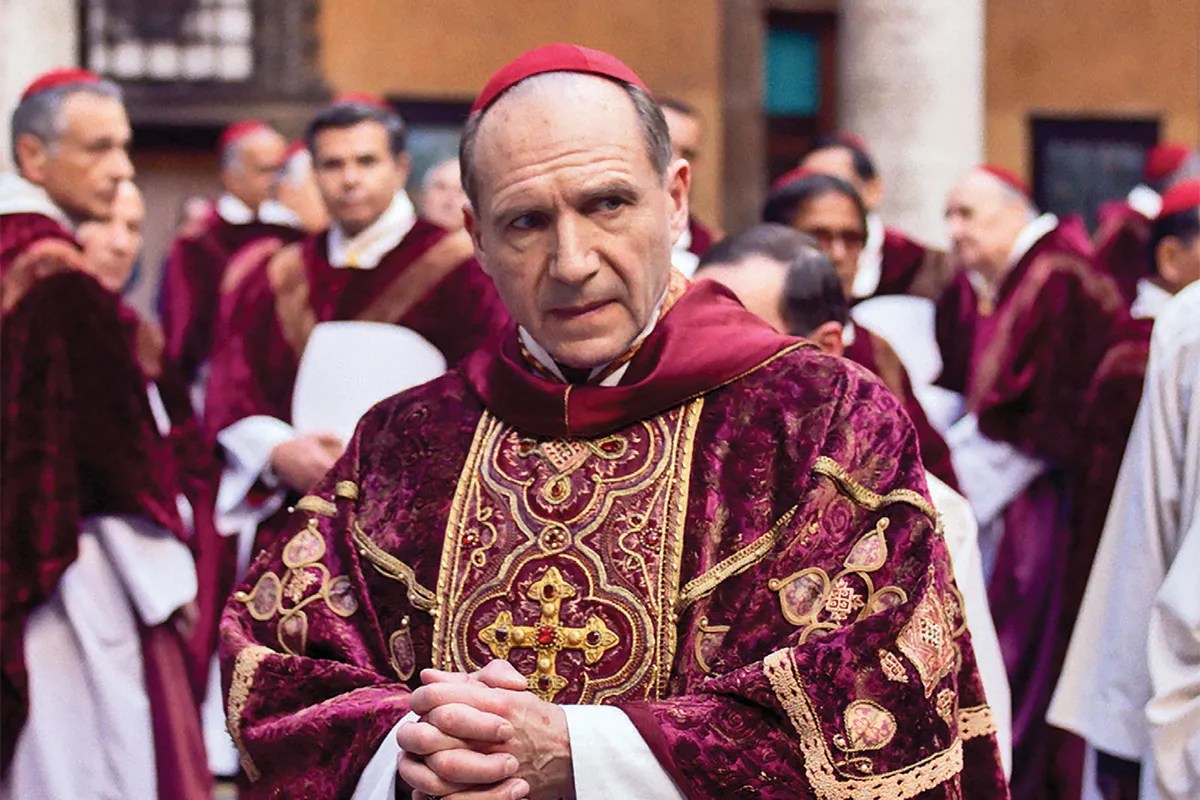
Lastly, and wonderfully, is the great Ralph Fiennes, who carries this film from the beginning through the labyrinthian pathways and side roads, to holding together a so-called “twist ending.” Fiennes may well win his overdue Oscar for this, and right now, I hope he does. There is a lot riding on his wide thespian shoulders, and this is easily among his best performances. We have a strong initial impression of this character, and he essentially doesn’t change. But Fiennes allows us to see cracks in his beliefs and his outward sense of calm authority. The film is ”almost” worth seeing for his work here.
The theme of certainty and uncertainty is woven throughout the film, and it works to add tension and thematic depth to the film. But the film isn’t close to Rashomon or Doubt in this area; it’s just a slightly-under-the-surface topic that breaks through every so often.
Finally, and whatever-ly, we have the so-called twist ending, which many involved in the film are now downplaying. The film has been marketed as a kind of thriller, which the slow pace and focus on (the occasionally too measured) process and ever-changing vestments tends to undercut. So when we get to the end, it doesn’t come off as powerfully as it could have. It’s presented cinematically as a “wow” moment, but we haven’t had the lead-up for that kind of wow—it’s more of an “oh…”
If you want to see the film, please don’t read the following paragraph. After all the plotting, back-stabbing, and legitimate soul-searching, we end of up a new pope that is…wait for it…intersex. Not gay, not trans, but intersex, which is as confusing at times as it is unexpected. The film presents this as a wondrous moment that brings on a new era of light and freedom, especially for women. But in 2024, it all comes off as somewhat tired and, to use a word even more tired, sadly and unworkably woke for a film released right now. Perhaps with the different director and a date before the 2020’s, the film might have had a serious punch. Now it comes off as more of a good-looking, stately, well-acted film that leads to an unexciting, surprising, but ultimately humdrum (and ho-hum) conclusion.


 Film stuff by Mark