

La Bohème is a silent film from 1926 starring the luminous Lillian Gish and the overactive John Gilbert, and is directed by King Vidor (Oscar nominations for directing The Crowd, Hallelujah, The Champ, The Citadel, and War and Peace). Note: Vidor is listed in Guinness World Records as having “The Longest Career as a Film Director,” beginning with 1913’s Hurricane in Galveston and ending with 1980’s The Metaphor. He may be best known to modern audiences as the uncredited director of the sepia-colored Kansas scenes from 1939’s The Wizard of Oz. Coincidentally, Gish has the career record as an actress, beginning in 1912 and ending in 1987. Gilbert, unfortunately, was not so lucky.
Just watching the three of these legends converge is fascinating enough. Gish was working to free herself from the constricting roles she had under her mentor D.W. Griffith, and was here stretching out her acting wings making her first MGM film. Gilbert was peaking as a star and actor, having hit his height with 1925’s The Big Parade (https://wordpress.com/post/film-prof.com/747), a great silent film and the one Gilbert will likely be best remembered for. Of course, what Gilbert will be most remembered for is not one film in particular, but the ones he made with Greta Garbo, with whom he had a tempestuous and (for him) frustrating affair.
Watching early Vidor is fun, as he was clearly experimenting with the medium. There was an unexpected forward tracking shot in the picnic scene, and his use of superimposition is both striking and emotionally resonant. There is a lot of the usual silent film framing, with a static camera capturing whatever is happening in front of it. But what happens in front of those static cameras can be lovely. There is a “declaring our love” dance between Gish and Gilbert that is exhilarating and romantic as “Shall We Dance” in The King and I. But there are also close-ups as effective as those of Griffith, though there is a distinction between Gi’s soft focus and the sharp focus given to Gilbert.
The story is based on Henry Murger’s novel Scenes de la vie Bohème, which was also the basis of Puccini’s opera of the 1890s. And for more modern audiences, it is also the basis of Jonathan Larson’s Rent, which debuted on Broadway in 1996. In this film, it is wildly of the Romantic era and romantic at the same time. The story is either full of wild love and great passion, or just overly melodramatic. So is the acting, which isn’t all a bad thing.
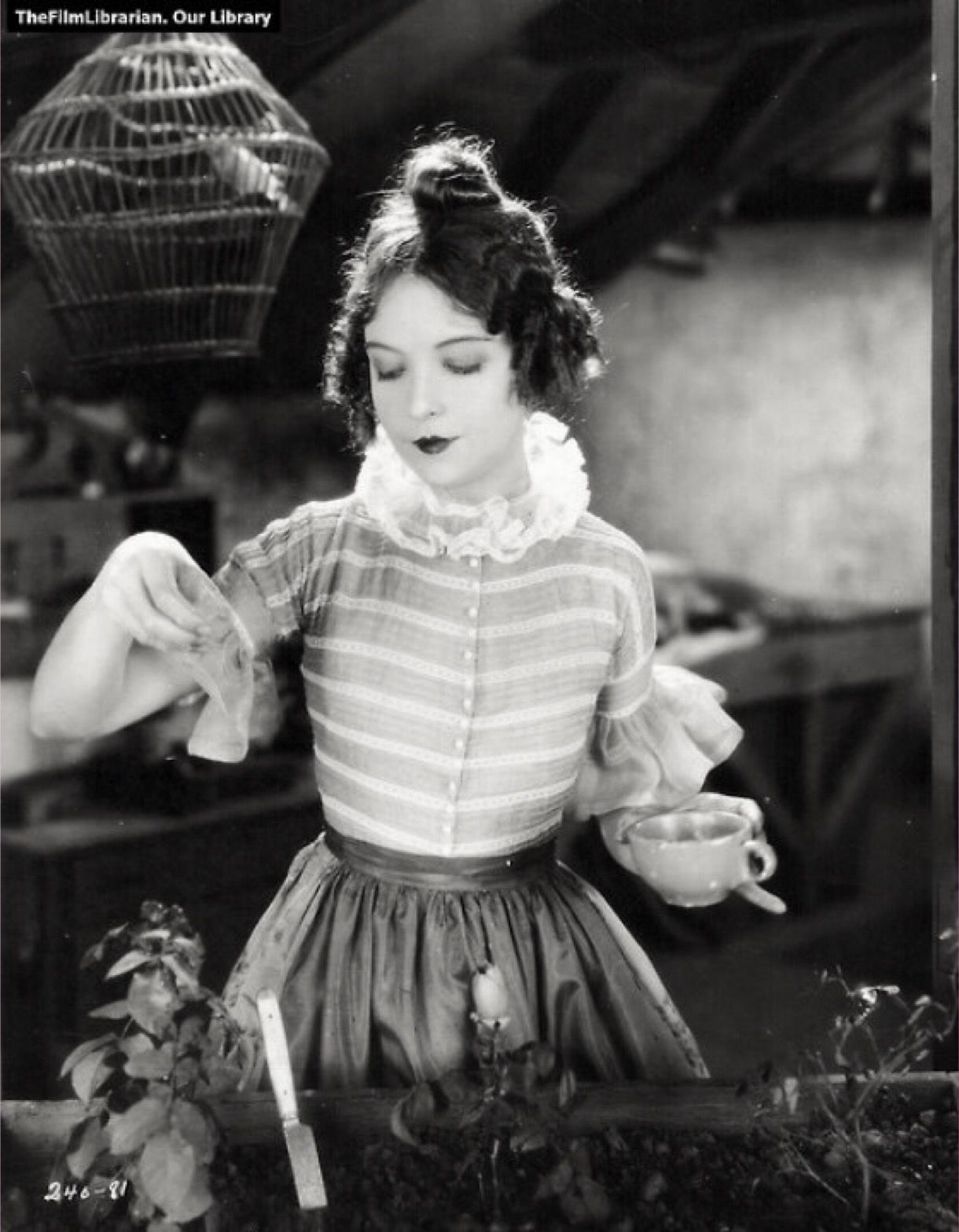
Gish, as a silent actress, was greatly skilled in the art of silent acting, which consisted of a combination of internal emotional connection and learned gestures inherited from the theater. Gish was much more naturalistic than many of her more histrionic peers, and her acting here includes those gestures, but also includes many, many scenes of subtle, lovely work. If you look for those moments in the midst of the older fashioned acting styles, you will be well rewarded. She also has a scene where she is acting out the remainder of a play being written by Gilbert’s character that could have easily won her a Best Actress Oscar if the film had been released a year later. And if that weren’t enough, she eschewed liquids for three days before her death scene, rivaling the sacrifices that Bette Davis would make years later in Of Human Bondage.
Gilbert is more problematic, in a number of ways. He is over the top here, which may be due in part to the difference in speed from the 16 frames per second to the 24 frames per second of modern films, which has the effect of speeding things up, which doesn’t help Gilbert’s hyperactive performance. His use of gesture can be read as exhausting today, as is the habit of jumping around when he and his homies have something to celebrate. (Note: One of those homies is Edward Everett Horton, well before his career as a fey supporting player in the 1930s). But when he is still, and captured in close-up, his eyes can burn through the film. There is an intensity here that obviously helped make him the romantic follow-up to Rudolph Valentino.
Which bring us to the other reason that Gilbert is remembered. He is emblematic of those that, for one reason or another, couldn’t make the transition from silent to sound films. Unless we can exhume Louis B. Mayer’s brain and find out his thoughts, we will never quite know. The two big reasons given are that his voice didn’t sound right, or at least wasn’t consistent with his image as a romantic leading man. The second is that his melodramatic gesturing, which Gene Kelly satirized so effectively in Singin’ in the Rain, couldn’t tapped down in sound films. Rumors that Mayer had Gilbert’s voice tampered with so he could get rid of him are both understandable (from L.B’s perspective, as Gilbert was a huge expense with little to show for it) and just not true. Gilbert had a fine voice, if one not quite equal to his romantic leading man persona. https://www.youtube.com/watch?v=bbxBwDhAbEI

But Gilbert had other issues than trying to make it in talkies. His on-again, off-again romance with Garbo and his alcoholism and mental struggles conspired to lead him to an early death in 1936. Aside from the tragedy of a young person’s demise, cinema may well have lost an excellent sound era actor. Even in his silent films, Gilbert had a modern energy that rivaled that of James Cagney. He could clearly act, and act well. If that energy had been properly directed, and Gilbert had been more thoughtfully guided into a career in sound film, he might have turned into one of the great studio actors.
As the date of the film reveals, we are at the end of the silent era, and these are two of the great silent actors at the top of their game, even if that game is overly-gesticulated at times. But we are also at the relative beginning of a great directorial career with a person continuing to discover, after the successes of The Big Parade and The Crowd, what he could do with the medium. As a time capsule, it’s well worth the visit.


 Film stuff by Mark