
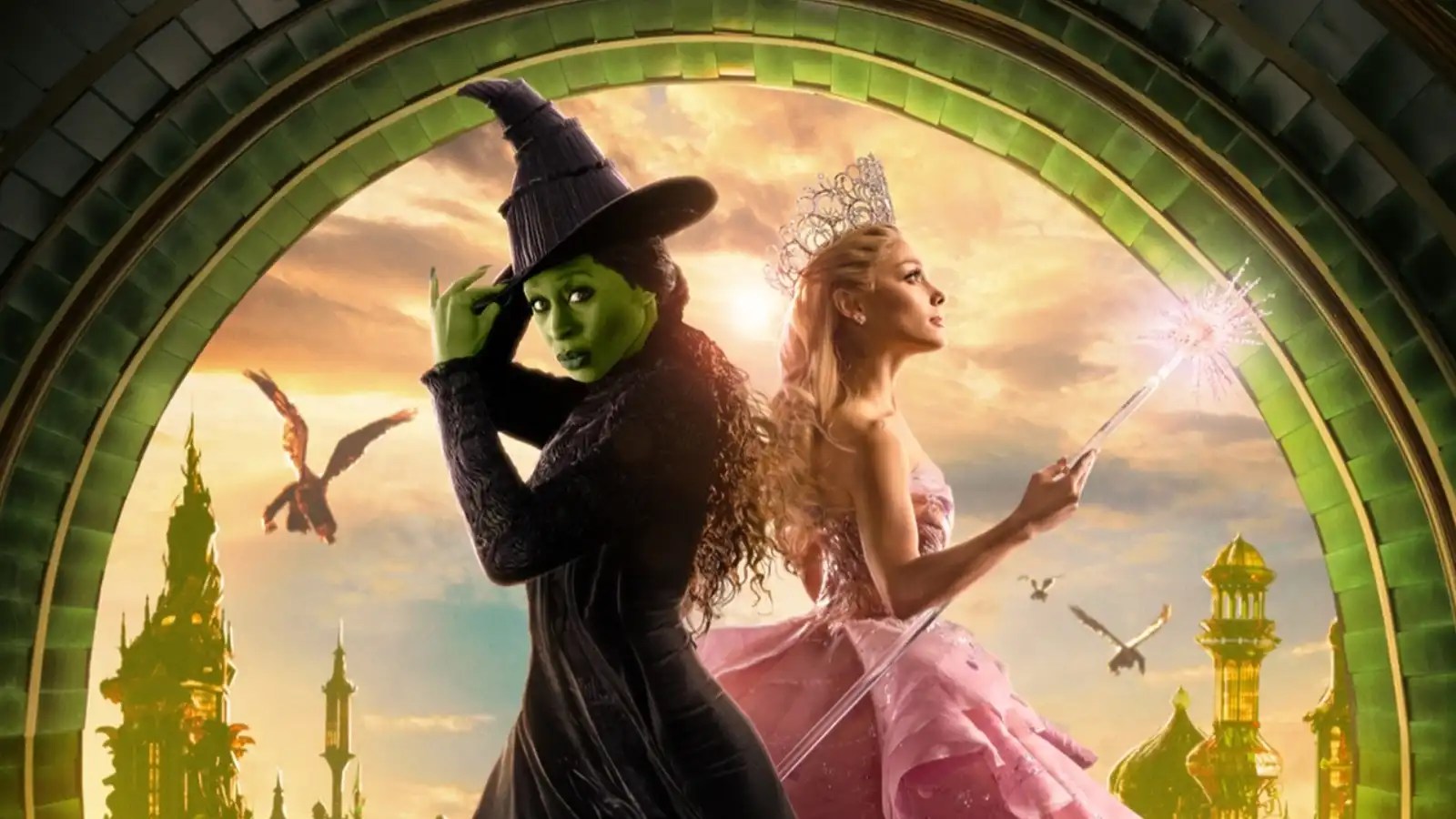
Seeing Wicked (a.k.a. Wicked Part 1) brings up old-fashioned terms, such as “movie-movie,” “beautifully mounted,” and “lovingly produced”. All are true, and all are doubled-edged swords, meaning simply that many of the film’s great strengths are also some of its weaknesses.
But first, its many strong points. The performances are uniformly excellent, especially from the three leads. The film starts off concentrating on Ariana Grande’s Galinda/Glinda, but eventually shifts to Cynthia Erivo’s Elphaba, and this first part climaxes with a full demonstration of cinematic artistry and one great set of pipes. Oriva will probably win a Best Actress nod, and I expect she’ll win the Golden Globe for Best Actress in a musical. This is a performance that grows in expression and power—emotionally as well as vocally—throughout the film, and she is probably one of the few actresses who could conquer this role as well as she does.

That, however, is no surprise. Her turn in 2019’s Harriet alone is enough to place her in a special category. What was the surprise to this author was Ariana Grande, whom I’d only known as a singer, and a singer with a voice I wasn’t familiar with Not only does she have an easy coloratura soprano. She might be accused of channeling Kristen Chenowith, the original Glinda), but her acting is every bit the equal of Erivo’s. (The two singers have incredible vocal placement throughout.) Could there be a double nomination? Both Erivo and Grande nail every scene, and I didn’t detect a wrong note anywhere.
The fact that the two big leads are great would be enough. But the supporting roles are as solid as the leads. Michelle Yeoh (a deserved Best Actress Award for Everything Everywhere All at Once) is perfect as the strong leader that oozes matronly authority. Jonathan Bailey as Fiyero doesn’t have a voice of the two leads, but his is pleasant enough and more than does the job. He’s not a dancer, but you’d never know it. Ethan Slater plays a Munchkin with as much heart as possible, and Marissa Bode as Elphaba’s sister Messarose, while not rising to Slater’s heights as his love interest, is nevertheless very solid.
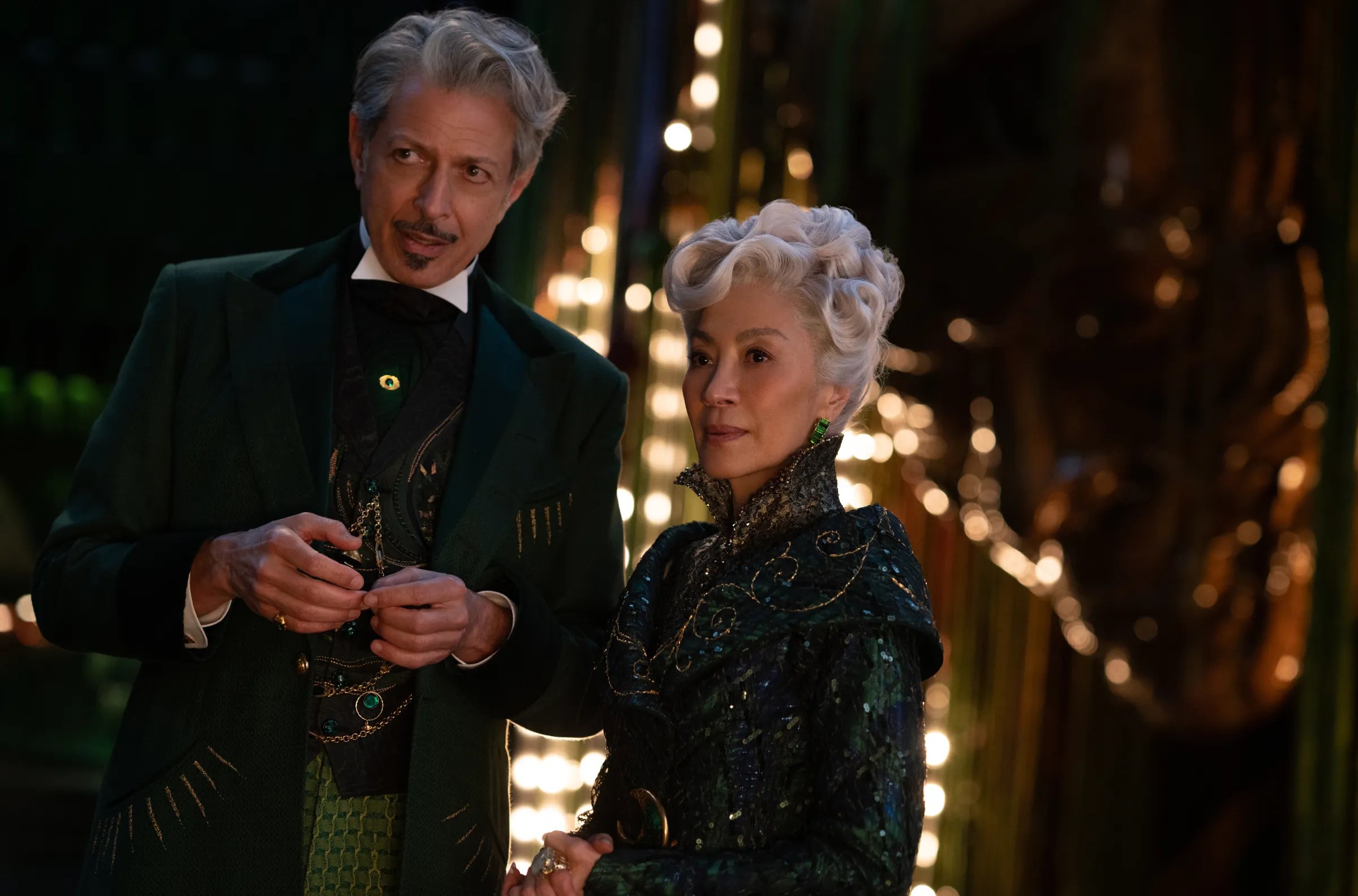
What I was slightly dreading but didn’t need to was the arrival on screen of Jeff Goldblum as the Wizard. All of that manic and undirected energy of some of his earlier performance (pick one—any one) has been internalized as charm and joy (spoiler alert: until there’s a shift). It’s a wonderful (pardon the pun) performance that also demonstrates a serviceable singing voice.
Other strong points include the dazzling world created for the film. It’s a visual wonder that dazzles without distracting, and wows while remaining of a piece with the central characters and plot. Director John M. Chu (In the Heights, Crazy Rich Asians) has balanced a nearly innumerable set of elements (performance, editing, sound, cinematography, production design) into a cinematic whole that blended into a near-perfect whole.
However…the film suffers slightly from the problem faced by Phantom of the Opera, Les Misérables, and other famous musicals with memorable scores. The problem is that instead of becoming a cinematic entity, these films become a visualization of the stage play, with full respect, even obeisance, being given to the numbers. The numbers, probably due to contractual agreements, are presented in their entirety. That works on the stage, but can be detrimental to a film. Phantom suffered greatly from it, and to a lesser extent, Les Miz. Wicked suffers less so, but the film is too long and loses some dramatic power occasionally because of it.
For example…check out this paragraph from Wikipedia about the cast album recording:
“Popular” was the first musical number shot for the film.[11] Schwartz, Wells, and Oremus proposed modifying its rhythm from the stage musical version and “hip-hop[ping] it up a little bit”, but Grande insisted that the song stay true to the original.[12][13] The song features an extended ending with additional key changes.[14][15]
It’s that respect for the original that is the issue. Chu fortunately has the talent to make each elongated moment sound good and look beautiful. But the bottom line is that the film is too long by a good half-hour, and could easily have been punched up cinematically and dramatically if the director had been allowed judicious cuts. More examples: “Dancing Through Life” takes too much time to get going and goes on too long, and even the iconic “Defying Gravity” didn’t need to be stretched out as much as it did; the ending of that song, though, almost makes it worth the wait.
According to research, the film was originally conceived for a 2016 release, and then this new version was supposed to be a 2019 release. I say that because certain elements that parents might not be wanting their children to see are present, but seem almost woke-retro and a bit stale today. Fiyero is presented as an object of admiration and even lust by both men and women, which comes across as tired and not cute in 2024. Also, and perhaps more seriously for those watching out for impressionable young ones, there is a strong blending of the genders in Oz. Women are dressed as men, men as women, and everything in between. Again, for someone like this author that believes that (dare I say it!) there are only two genders, while also acknowledging a full spectrum of expressions within those two genders, it seems like old-school progressivism in the most tired Disney style (and yes, I know it’s a Universal film).
For some, that will be the poison pill that keeps you and your young ones away. For everyone else, this is an incredibly beautiful and beautifully produced film, and only suffers from the slightest case of Famous Song Over-Respect Syndrome.


 Film stuff by Mark
Sadly, super popular film for many reasons cited in review. But normalizing gender change and witchcraft is not OK! Disappointing movie knowing children are so easily deceived.