
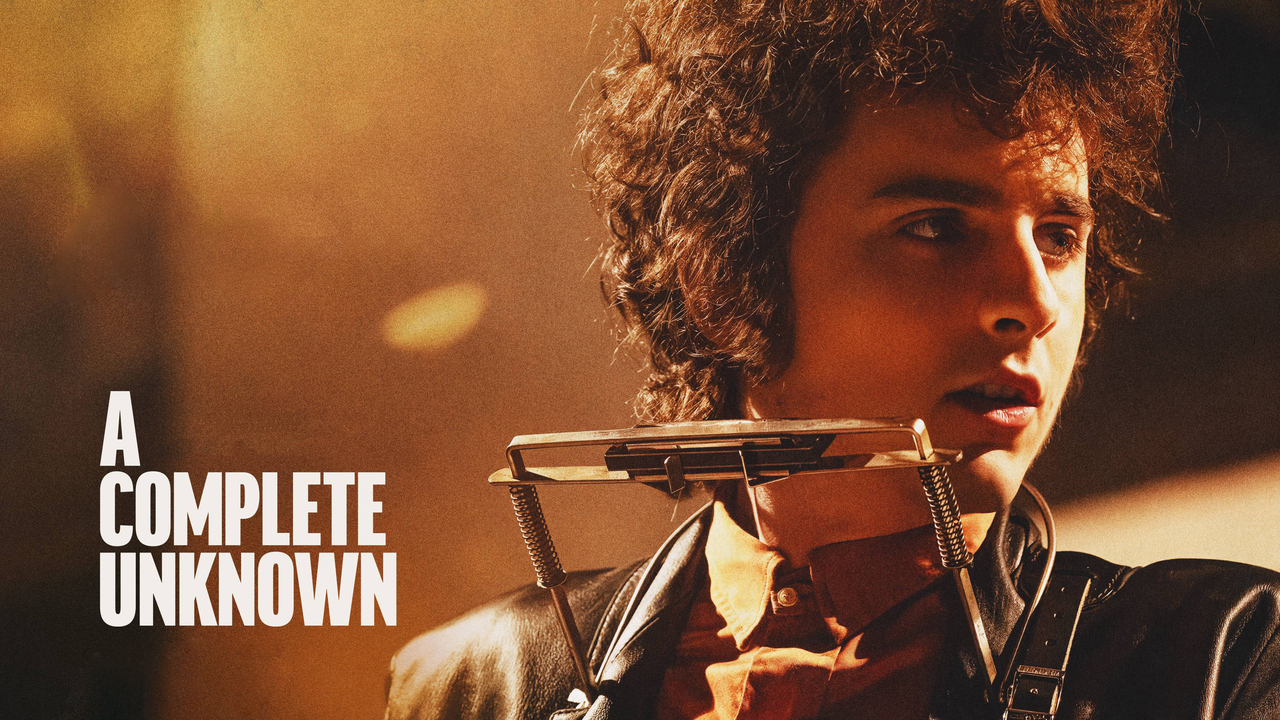
A Complete Unknown, which covers the very young Bob Dylan from his arrival in New York at 19 to his ground-breaking electronic performance at the 1968 Newport Folk Festival, does a few things very well, and its central performance is extraordinary.
Director James Mangold (Indiana Jones and the Dial of Destiny, Ford v Ferrari, Logan, The Wolverine) seems to be picking up and running with his approach in Walk the Line, the much better-than-average film about Johnny Cash that included two great performances and a lot of singing and playing by the lead actors.
A Complete Unknown is a perfect title for the film, as it is the name of one of Dylan’s biggest hits and at the same time reflects the film’s approach to the central character. This film’s Dylan is an cenigma, which in other hands could be a negative, but which here is a glorious positive, and one of the film’s great strengths.
This Dylan is never pinned down, never clearly defined, and almost never explained—again, a weakness or complete failure in other hands. Yet, yet, we are pulled in at the beginning and are never allowed to disconnect. This is due to the film’s approach (screenplay, direction), which has as its goal presentation without interpretation: we see and hear Dylan as he moves through space and time, yet we are as confused about who he is and what he wants as the characters around him. But like those characters, we are fascinated.
And here is where we must speak of Timothée Chalamet, who in his twenties has become a national treasure and already a kind of institution. This is an extraordinary performance on several levels. One is simply technical: Chalamet plays the guitar and sings. We knew he could sing from Wonka, but getting Dylan down vocally and then performing his singing scenes live, while also playing the guitar live, is astonishing.
Aside from the technical prowess demonstrated, Chalamet’s calibration of the various phases of Dylan’s growth physically and psychologically is a master class in growing older in a film. Just the shift from being 20 to 21 was evident in his face, his energy, and his body language. Then he did it again and again over the relative few years the film covers. One would expect that someone as young as Chalamet might just kick back and do what the script and director dictate in terms of speech and action. But it was exciting to watch a young man we’re not really allowed to understand still grow and change—not always for the better—slowly and almost imperceptibly before our eyes in a series of subtle and precise acting choices. It’s probably not Chalamet’s year for the Oscar, but I wouldn’t have a problem with his winning this year. The film is worth seeing just for him.
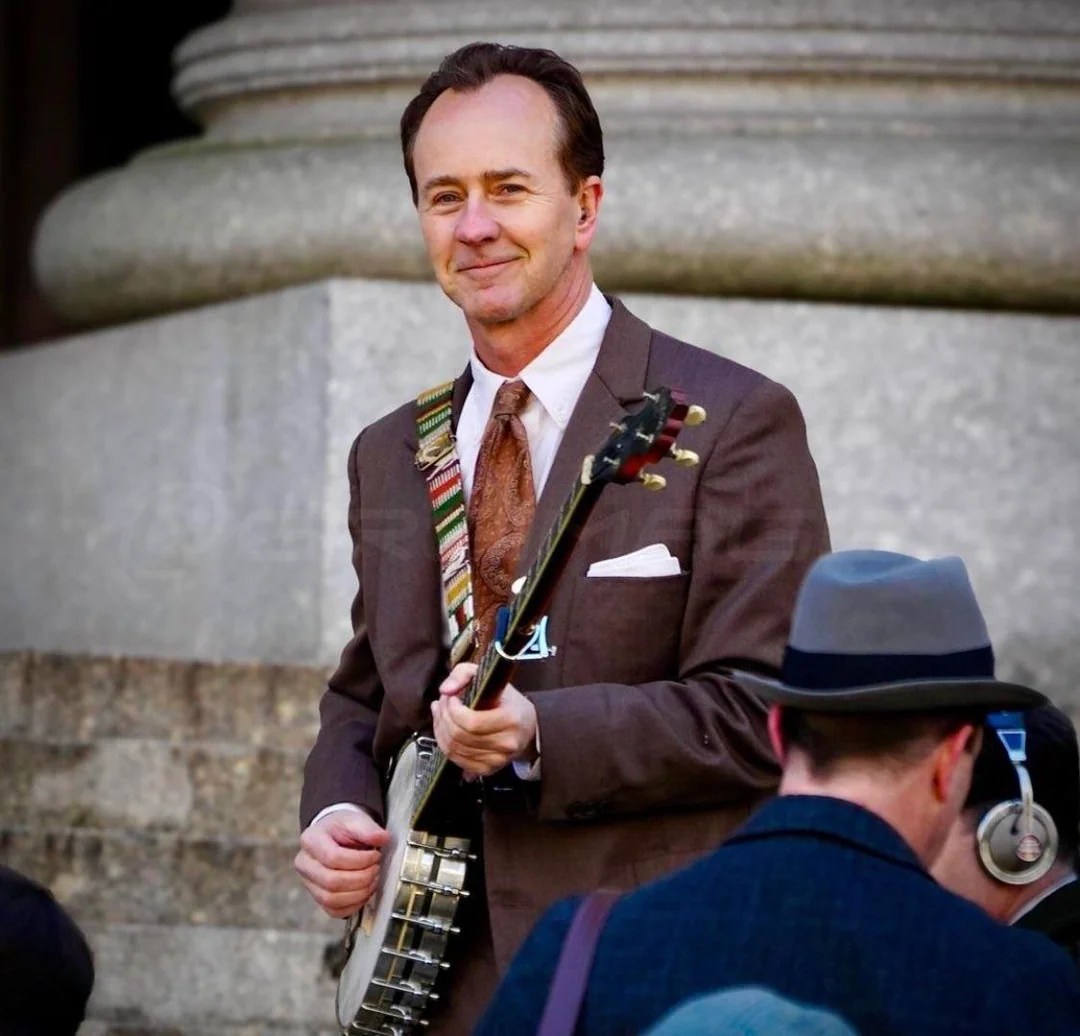
But there is another unexpected and award-worthy performance, and that is from Edward Norton [Fight Club, American History X, Birdman or (The Unexpected Virtue of Ignorance), who completely transforms himself into Pete Seeger. Norton has a reputation for not being the easiest actor to work with, and sometimes his intensity can be a bit much for the character. But here he is the strong but also laid-back folk singer and writer (“Where Have All the Flowers Gone?”, “If I Had a Hammer,” “Turn, Turn, Turn,” etc.) that the film claims connected him with Woody Guthrie on one hand to Dylan on the other. Norton proves again that he is a great actor, yes, in doing all his own singing and playing, but also in completely losing his own persona in that of a completely different character. Again, not going to be his year for the Oscar, but I wouldn’t be unhappy with a win here as well.
Following a character through years of revolution—in music, taste in just about everything, politics—is tough here. The early to mid-sixties was a wild time, and the film almost veers into Forrest Gump territory at times with all that is happening around Dylan, but ultimately succeeds in placing him in the middle of it without losing either him or the times around him that were a-changing. The film loses its focus on the middle a bit, as his behavior becomes a bit more inscrutable. Yet at the same time, we get to see the battle for creative expression as it begins to accelerate inside as much of the world around him wants to keep him in a box.
Capturing the creative process visually is a challenge for any film about an artist. A Complete Unknown presents glimpses of the creative process here and there without making bashing the viewers over their heads with overemphasis. We never get a “Look, watch the genius begin to create that Great Work!” Would that there were more films that could approach demonstrating creativity so well.
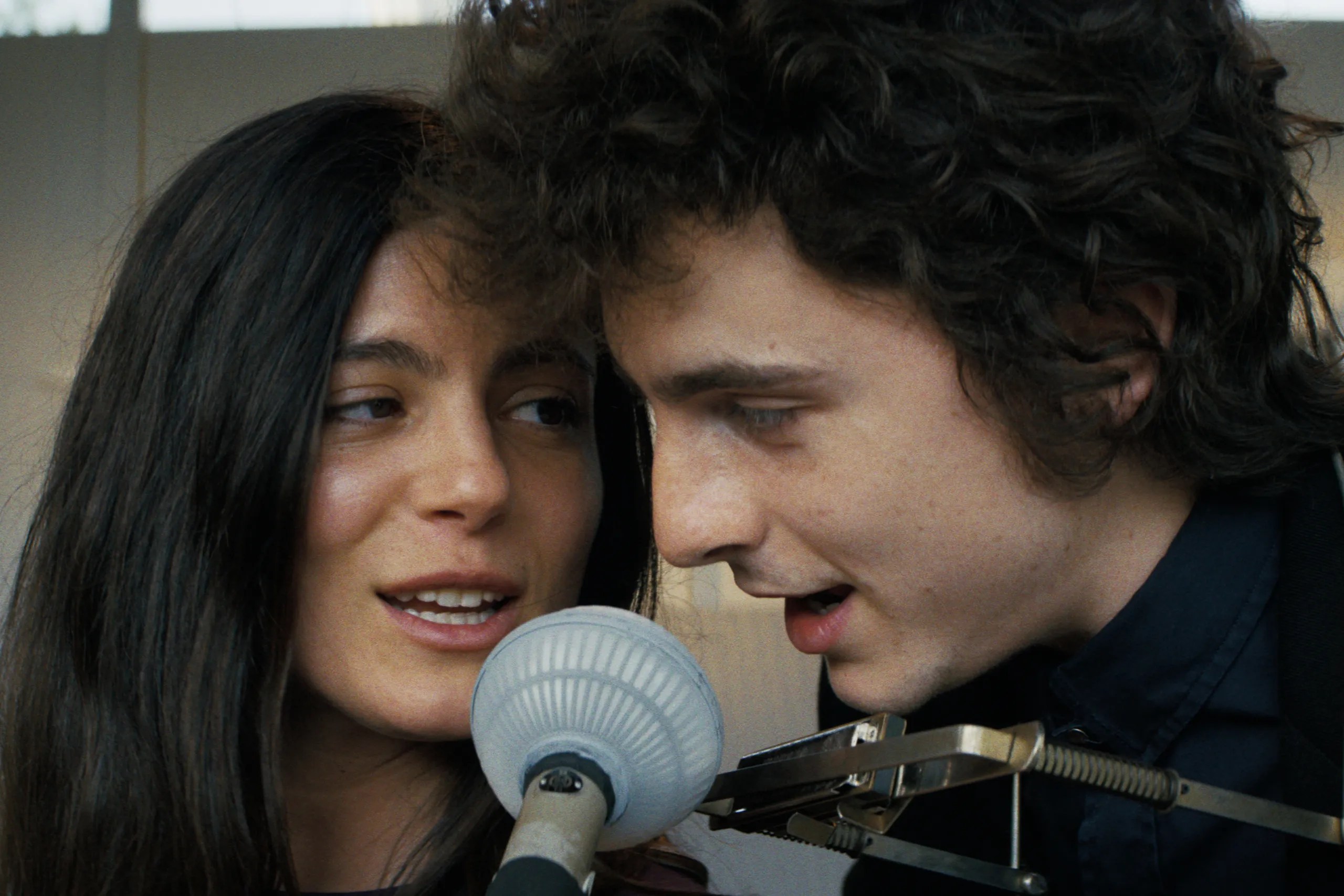
The film doesn’t completely know what to do with Joan Baez, who had such a profound influence on Dylan, relationally and professionally. Monica Barbato plays her here, and her crystalline voice works beautifully on its own, and especially, singing with Chalamet in their songs together—all high points of the film. We’re left with the impression of the importance of her in Dylan’s life, but it isn’t the clearest impression. Elle Fanning plays the other woman in Dylan’s life, here called Sylvie Russo, ostensibly a composite character but who is mostly based on the real-life Suze Rotolo. Fanning is a talented actress with a significant list of films behind here, and will continue to have a big career. But could have used a lot less of her looking forlorn and trying not to cry.
Continuing the comparison to Walk the Line, A Complete Unknown doesn’t have the celebratory moments of sheer joy that helped lift up the Johnny Cash biopic. That isn’t its goal. It is cooler in tone and attitude. It’s also one of the best of the year, with a breakout performance by Barbato, and two great performances by Norton and Chalamet. Lastly, keeping the central character at a distance from us while keeping our interest the whole time is a feat. For those interested in seeing how a film can present an enigmatic character you never want to turn away from, and in experiencing great acting within a very good film, try A Complete Unknown.


 Film stuff by Mark