

Don’t let the date of the film put you off. This is a delightful dramedy about England’s most notorious king and his six wives. While creaky and primitive by today’s standards, the film itself is a riot and very enjoyable. It moves along briskly, has a sharp and intelligent sense of humor, and is delightfully pre-Code in its sensibilities.
But the main reason to see it is to enjoy one of the great performances in British film—and of all time, IMHO—one which won Charles Laughton the first Best Actor Oscar given to a non-American. It’s riotous and overflows with humor and life. His take on the king can’t be considered historically accurate, but what a characterization! Laughton’s Henry is funny, angry, selfish, childish, ribald, and occasionally tender. The performance is well-rounded, and Laughton doesn’t miss a beat; there isn’t a false or lazy note here. It’s such a rich, full, and life-filled showpiece of acting that it might be considered over the top, but Henry was a huge man in all respects. Laughton was known for chewing the furniture at times, but if he can be found guilty of it here, it nevertheless works and is of a piece with his depiction from beginning to end. The film looks great for being made on a small budget, with excellent camerawork, tight editing, and a direct address at the end that is surprising even now.
All six wives are dealt with, and the mention of his first wife, Catherine of Aragon, sets the tone of the film: “Henry VIII had six wives. Catherine of Aragon was the first; but her story is of no particular interest – she was a respectable woman-so Henry divorced her. He then married Anne Boleyn. This marriage also was a failure-but not for the same reason.” Yes, this deftly evades Henry’s first long marriage, his reprehensible behavior toward her, his earth-shaking break from the Roman Catholic church, his infidelities, and his terrible treatment of his second wife, Anne Boleyn. But it quickly sets the tone and lets the viewer know that this is a tongue-in-cheek ride through the personal and generally apolitical side of Henry’s “love” life.
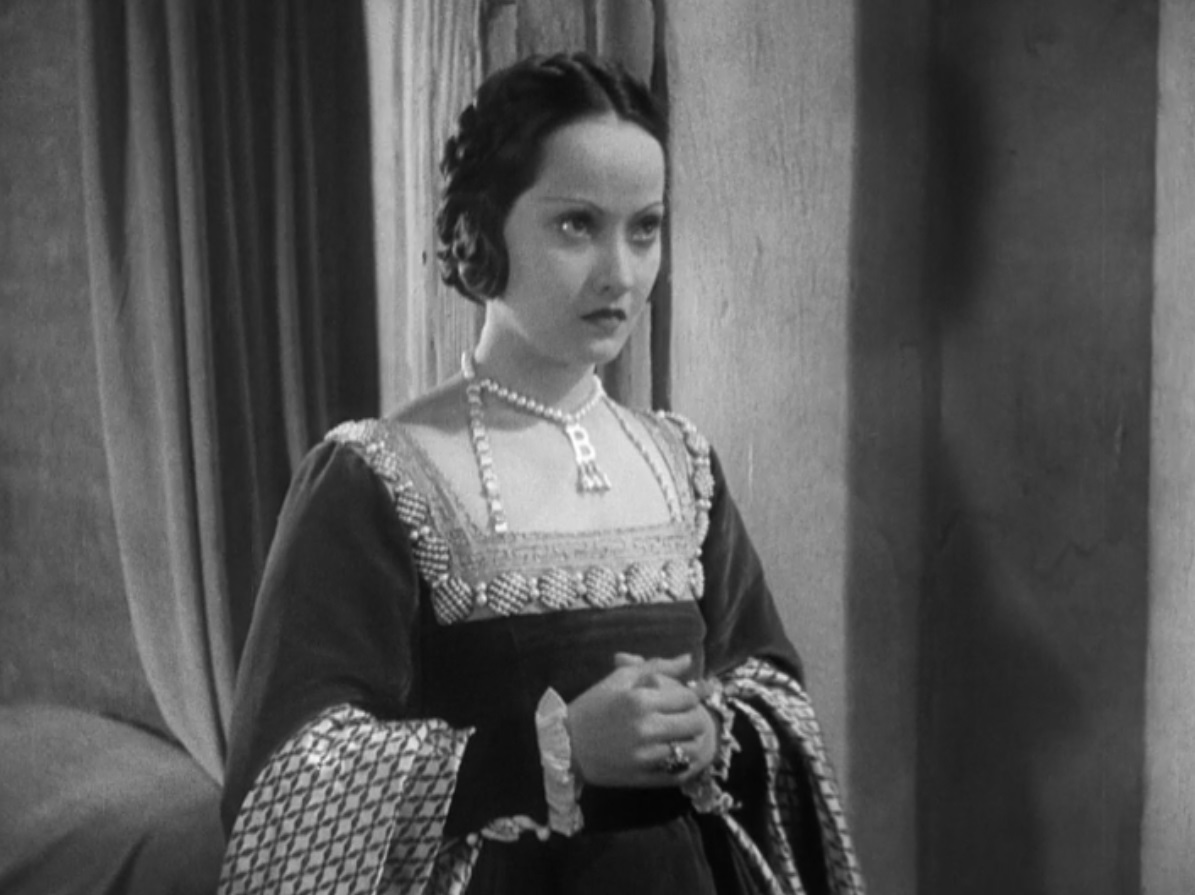
The parade of wives features some fascinating actress and unusual performances. Stunning Merle Oberon has a quiet role as Anne Boleyn in one of her first films, and her first as a significant character. Apparently, her beauty struck audiences when she first appeared (as someone basically unknown at this time), but her few minutes in the film preparing for her beheading are precise and surprisingly moving.
Wendy Barrie, who had a career spanning into the 1960’s, played his next wife, Jane Seymour, who gave Henry a son but who died in childbirth (and the son died at 15). Of course the most fun is had in the film with Anne of Cleves, who is reputed to have been so unlke her lovely introductory painting Henry sent her away without consummating the marriage.
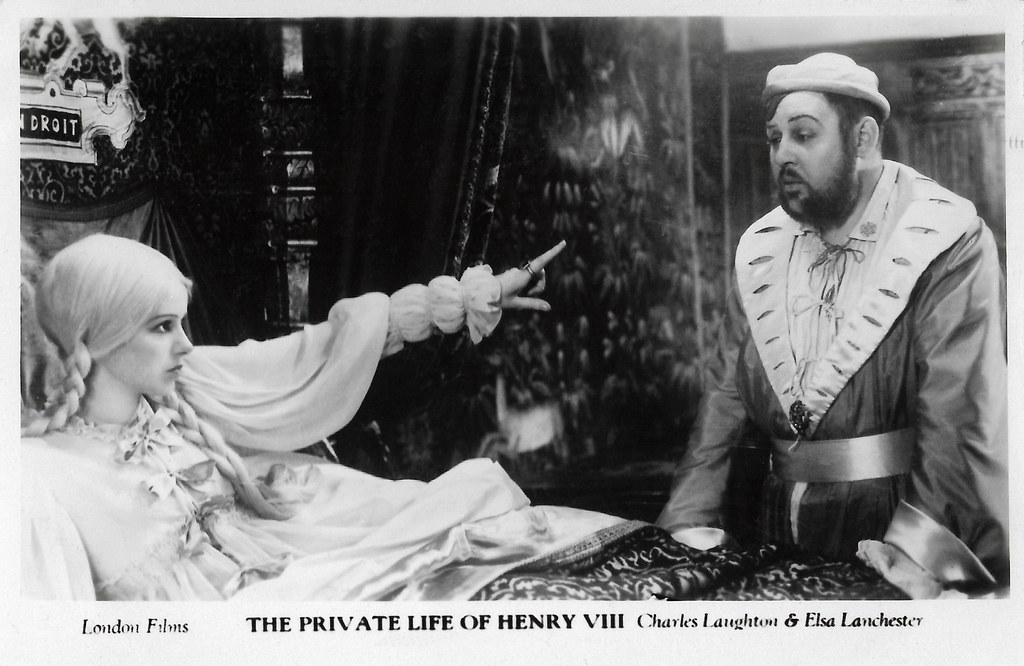
This German princess is played the hilt by Laughton’s won wife, the wonderful Elsa Lanchester (Best Supporting Actress nomination for Come to the Stable and Witness for the Prosecution, though most will remember her as the Bride of Frankenstein in the film of the same name). If any performance can be considered over the top, it’s Lanchester’s though many still revel in its humor. For me, the jury is still out. Lanchester and Laughton have great comic chemistry, however, and their scenes together are the highlight of the film. Aside from the performances of the married-in-real-life couple, these scenes break up the threatened monotony of the parade of wives and provide a relaxing and joy-filled break from the disappointments and beheadings.
Binnie Barnes (The Trouble with Angels, The Last of the Mohicans, Broadway Melody of 1938) played Katherine Howard, who was actually a very young woman but is portrayed as a more mature and intelligent woman who understood the risks of an adulterous affair. Then there’s a highly inaccurate portrayal of Henry’s last wife, Katherine Parr, who is presented in the film as a nag but was known as an articulate and gentle companion to Henry in his last years (and yes, Henry had three wives named Katherine.) Parr is played in her film debut by Everley Gregg (Pygmalion, Brief Encounter, Great Expectations, known for playing anything but gentle souls.
The largest male part other than Laughton’s is played by a wonderful British actor who would wrongly win the 1939 Best Actor Oscar. The actor is Robert Donat, and the 1939 film was Goodbye, Mr. Chips (but that is for another article at another time). He plays Thomas Culpepper, who was in love with Katherin Howard, but when that relationship began is contested. In any event, they apparently were head over heels in love with one another, ending in losing those same heads to the executioner’s axe.
The film can be read politically as a reflection of its time, between the World Wars, but aware of the tensions between present-day Germany and Britain. Those familiar with British history at that moment will find occasional grace note references to then-modern sensibilities.
This was Hungarian director Alexander Korda’s breakout success after years of film work in Austria-Hungary, Vienna, Berlin, Hollywood, and France. His story is complicated, covering many countries and studios, and featuring three wives, including actresses Maria Corda and Merle Oberon (this film’s Anne Boleyn). He also opened the doors for film directors Michael Powell and Emeric Pressburger, David Lean, and Carol Reed, and actor Laurence Olivier.
I’ve often equated seeing older films with traveling, in this case, back in time. Older classics are always worth the viewing, but Laughton is the single greatest reason for seeing the film. He pulls everything together, and delivers as fresh and enjoyable performance as anything available for viewing today. Do yourself a favor, find this film, and sit back and enjoy.


 Film stuff by Mark