
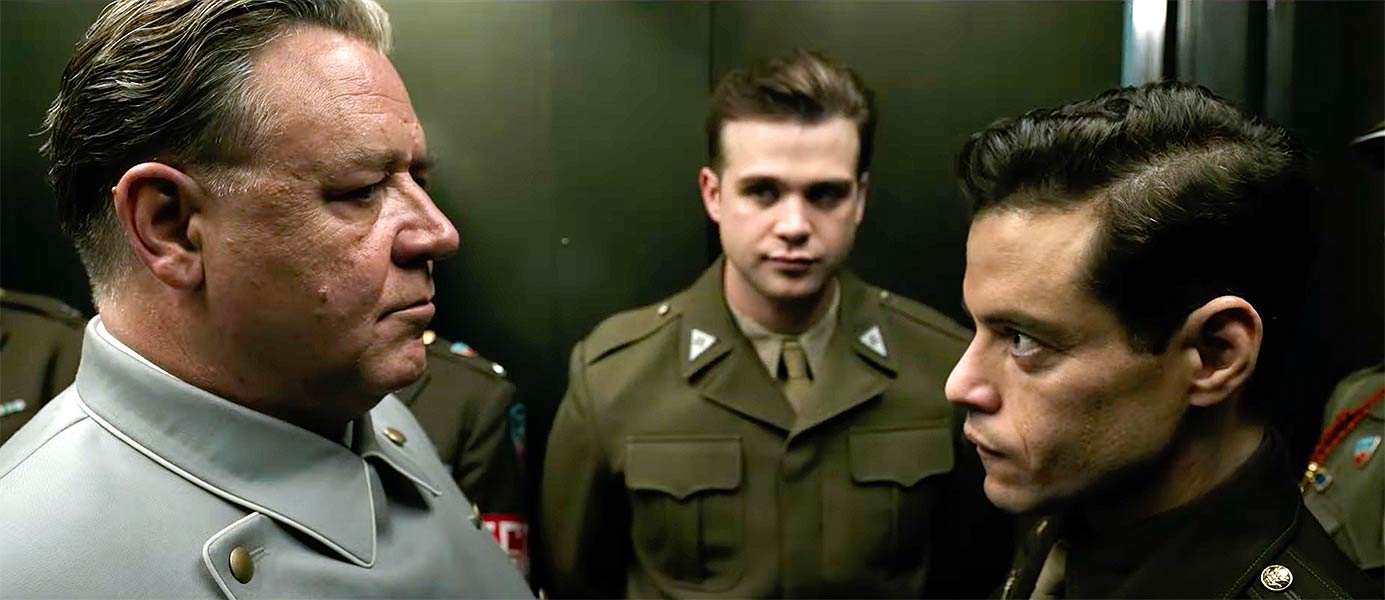
Anything that presents the horrors of the Nazi regime is welcome in today’s history-averse world. In that context, I’m glad Nuremberg was made. IMDB succinctly states that the story is that of “[a] WWII psychiatrist [who] evaluates Nazi leaders before the Nuremberg trials, growing increasingly obsessed with understanding evil as he forms a disturbing bond with Hermann Göring.” It’s much more than that. That brief description simply describes the dramatic arc in a film that involves Nazi leaders, international judgment, the horrors of the concentration camps, and obsession.
Since we as viewers are apparently too many years away to assume knowledge of the war, the horrors of that war, and the international response to those horrors (sigh), the filmmakers have assumed that we need a great deal of exposition throughout. There are many moving parts in the film, and some explanation is necessary, but they are too detailed and too many. The film has also been accused of being preachy, an accusation that is deserved, especially as it heads near the end.
The film walks the line between serious and almost documentary drama and flat-out entertainment, often with awkward results. There is a jarring cut from an emotionally intense scene with a senior Nazi to a woman singing an energetic song in a club that I have yet to get over. That is the common weakness of the narrative. The central story is perhaps considered too dark and severe, and in need of lightness and even comedy. Along with the several story lines that don’t always flow together, this back-and-forth between dark and light makes for an occasionally bumpy viewing experience.
What carries the film, fortunately, are the three central performances, and the two secondary performances. Rami Malek (Oscar for Bohemian Rhapsody) and Russell Crowe (Oscar for Gladiator) are at the heart of the drama, with a fascinating and occasionally confusing relationship that has us questioning motives and who is using whom. Crowe is an incredible screen presence and has times of showing that to an almost overwhelming effect. You can’t take your eyes off him, especially in the courtroom sequences. Crowe introduced a new level of strong male authority into the film world with Gladiator, and here he turns that authority on its head playing a brilliant, articulate, calculating, charming, evil and powerful man. I’m not sure who else could play Göring so intelligently and so bursting with arrogance, self-assurance, and manipulation.
His opposite, at least at first, is Malik’s psychiatrist, who is as active and intense as Göring is eerily quiet and settled. The movie is his story, not Crowe’s, and we are more than willing to follow him throughout most of the film, which makes our discomfort with some of his eventual decisions and statements even more uncomfortably palpable. It’s a carefully crafted performance and has a range and depth that his Oscar-winning performance didn’t possess.
There is another almost-lead performance that surprised me, and that is Leo Woodall (“The White Lotus”, “One Day)”, who begins slowly with a very background performance as Malik’s character’s interpreter. He is a sensitive and accessible performer and quickly gains our attention and allegiance. He eventually makes his way to the front of the film in a deft move, and we find ourselves relating to him more than Malik’s character, and appreciating his work as much as Crowe’s. It’s the film’s biggest surprise in more than one way (no spoiler alert here).
The supporting performances from Michael Shannon and Richard E. Grant are as professional and accomplished as we would expect. They do solid work in roles where that solidity is needed.
The other supporting character is played by a miscast John Slattery. Slattery has a certain authority of his own, but not the kind his character here needs. It’s a combination of not rising to the level of power needed for the character, trying too hard to convey the necessary power, and a continual missing of the flavor and commanding authority needed in the scene.
The music has the challenge of working with the bumpiness of the narrative but generally manages to work well with the narrative without calling too much attention to itself.
One of the biggest misses in the film are its loose ends. For instance, we meet “the girl” on the train, and we can figure that she will become Malik’s character’s romantic interest. She is then shown here and there, and in a great twist (spoiler alert here!) they hook up to disastrous effect. I prefer when films skip over sex scenes, but here we are led to one, and the all-important talking (that we assume comes afterward) is not even shown or heard. A great dramatic moment missed.
Then there is the confusing scene following the trial, with Malik’s character on the radio. It can be read as his opinion after his experiences, an anti-Trump tirade (which it is unlikely considering when this was written and filmed), a warning against antisemitism (completely on the nose right now), or a prophetic look into the dangers of radical Islamists. With those possibilities, you can see why it might come off as confusing.
Then we are given the tradition script on the screen that tells us what happened to them all. What happened to Malik’s character might better off been left off.
For the Malik and Crowe completists among us, this is a must-see. For the move from TV character to quietly riveting performance, check out Leo Woodall, who seems to have a very bright future. For those intrigued by WWII and/or the Holocaust, it should probably be seen, though not necessarily any time soon.


 Film stuff by Mark