
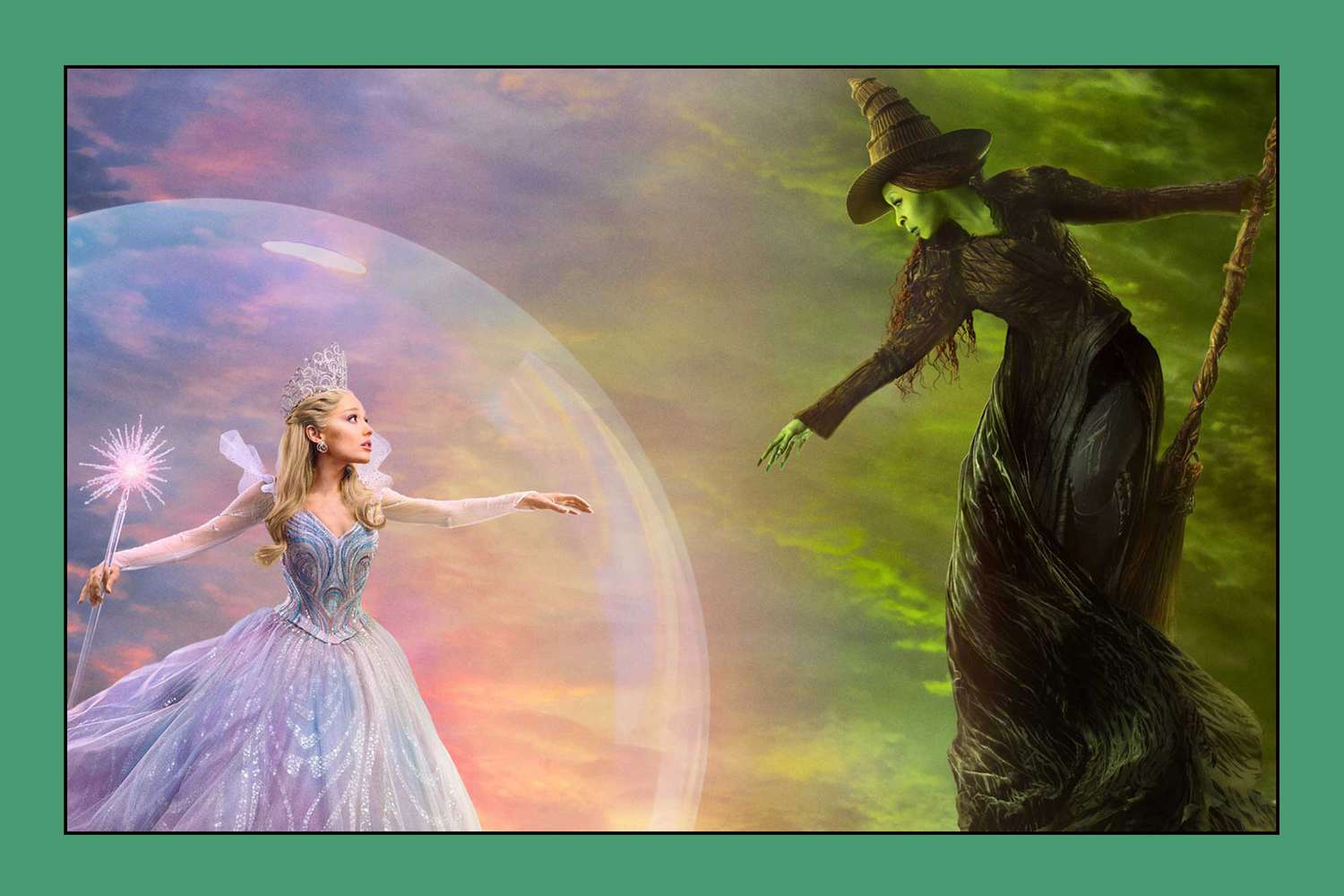
The second half of the two-parter was never going to be better than the first. The first had the element of freshness with its two leads, the joy of creating its world, and of course, that showstopper among all showstoppers, “Defying Gravity”. The title of Part Two reveals, as if we weren’t going to guess, that “For Good,” the big number of the second act, was going to be where the film was headed.
The strengths of For Good (the film) are of course its leads, Cynthia Erivo and Ariana Grande. Both are excellent singers, and their blended voices, to quote a phrase, are “like butter”. Every moment that either or both are singing are the high points of the film. What they are singing around, however, is more than their superior vocal chops compensate for. The film simply asks us to do too much.
Of course, there will be many who are so familiar with the Broadway musical that they will rightly enjoy the singing and just slide along with the familiarity of the story, even if there are a few twists, omissions, and second-rate song additions. But there are also too many implausible situations, plot twists, and awkward attempts to shoehorn this back story into the main story (otherwise known as 1939’s The Wizard of Oz).
But first, the size and breadth of this enterprise have to be taken into account. The film is the epitome of over-production, from the hordes of townsfolks singing so fully that it’s hard to pick up all the words, to the multiplicity of sites and rooms that tend to overwhelm whatever cast member/s find themselves in and what the narrative is working to do at those points. After an overlong and overdone ending to Part One, this film needed a tightening that would help us accept the declaration of friendship that the film keeps dancing around until we finally heard the nearly overproduced version of that famous duet.
Instead, we are tossed into too many subplots that take too much time to unravel, and which don’t need the attention the film grants them. The fact that two new songs (“There’s No Place Like Home” by Erivo and “The Girl in the Bubble” by Grande) were added to the film indicates that the concept of Part Two had been heading in the wrong direction. What the film needed wasn’t a fleshing out but a lessening and a contraction. The film may have suffered from the The Phantom of the Opera and Les Misérables effect, where every darned song had to be fully inserted into the film at the cost of cinematic freedom. Yes, there is irony that to the fact that “There’s No Place Like Home” is sung by the Wicked Witch of the West/Elphaba. But it just adds to the ever-increasing pileup of contradictory elements that are both the basis of the play/film and that ultimately don’t come together by the end.
There will be endless dissections of where the film deviates from the book and the play, but the film is the film, with all its own issues. Here are just a few:
Who is really wicked, and what caused it? What seems a lofty philosophical issue is germane to the film, and the further we get into the film, the more those questions become muddy. Glinda’s move from self-deluded shallowness to some kind of maturity is clear enough, but what of Elphaba? She goes from poor little different child to guarded young adult to attitudinal grownup who chooses evil, and then backs off from that, and then goes back to that, and then…I couldn’t keep track. (Spoiler alert) The film presents her at the end with a somewhat loving partner, a somewhat repentant spirit, and a view of her future life on the set of Dune (both parts).
Then there is Nessa’s journey as the other witch, and that is just as confusing in its shifts.
Aside from the whiplash-inducing changes of heart and character, there are some other puzzlers. We can see from Part One that Fiyero and Elphaba are at the core of the romance here despite the Ken doll/Barbie symmetry of Fiyero and Glinda when they are in the frame. But what was delightfully obvious in Part One as Fiyero and Elphaba discovered each other is here stretched to its logical but not believable conclusion. Their first meaningful glances and growing love worked when they kept their distance from one another, but the “night of passion” scene crashes and burns. For one, we don’t need it in a film like this, and two, what worked at a distance between two accomplished actors doesn’t work when you press them together. It doesn’t help a viewer aware of Jonathan Bailey’s and Cynthia Erivo’s very public gay identities to have to work to accept them as a legit couple. But good actors are good actors, and they both give it their all. But bottom line: There is as much chemistry between them as Julia Roberts and Nick Nolte in I Love Trouble (or more recently, Gemma Chan and Richard Madden in Eternals). The longing looks from the first film were convincing and worked much better at establishing and building their relationship.

There isn’t a weak performance in the film, but there is a distinct difference in how we relate to each character. We connect with Glinda at first based on her joyful silliness and Grande’s acting and singing, but her journey to a level of self-awareness is fraught with so many bumps that it’s hard to stay on her side. We connect in the same way with Elphaba, but her journey is the most confusing. We’re on her side as the outcast at the beginning, but her next series of decisions eventually erodes our connection with her. The same with her sister Nessarose (AKA The Wicked Witch of the East), whose journey is confusing and bizarre.
Then there is the issue of how this film’s world and characters dovetail into the original 1939 film, and this is where the wheels pretty much come off. Nessa’s death, which we all are familiar with as Dorothy’s first experience in Oz, comes to Elphaba in a dream or premonition, which makes as much sense to us as it initially does to her. Nessa’s romantic interest/slave Boq, played by Ethan Slater, who is by far the most accessible and likable character in this whole enterprise, (big spoiler coming), does an inexplicable turnaround so that he can eventually become…someone from the 1939 film. The monkeys have no idea who they are supposed to be working for, and the “wonderful wizard,” playing along with the good/bad reversal, is revealed in his fullness as a tyrannical and fascist dictator, which doesn’t exactly connect with the original.
The two most evil characters are played by Jeff Goldblum as the Wizard and Oscar-winning actress Michelle Yeoh as Madame Morrible. Goldblum brings a level of quirkiness that is at first endearing (Part One) and then confusing in Part Two as we segue into the Wizard that we all know from 1939, who really wasn’t that bad. Yeoh’s character is just bad as this film’s Wizard and stays that way, and we have no problem accepting that wickedness from such an authoritative performer. Unfortunately, they have also been tasked with singing, and neither can manage it despite being trained in every trick a singing coach can pull out.
Minor points that drove me just a little crazy: Elphaba goes on a rampage about Dorothy’s shoes, not because of their power, which makes sense, but because (huh?) it’s the only way she can remember her sister. Then, in a moment only a handful of grammarians would notice, Elphaba makes a cute reference to “the wizard and I,” which is the name of a song in Part One, but which should have been “the wizard and me” here. I know, that’s nothing, but a cute Easter-eggy reference at the expense of good grammar is borderline…wicked.
This film is going to make a lot of money because of Part One, but it’s already losing its steam, and for several good reasons. It should have been a single film with less pretension, more focus, and a couple of fewer songs.


 Film stuff by Mark