
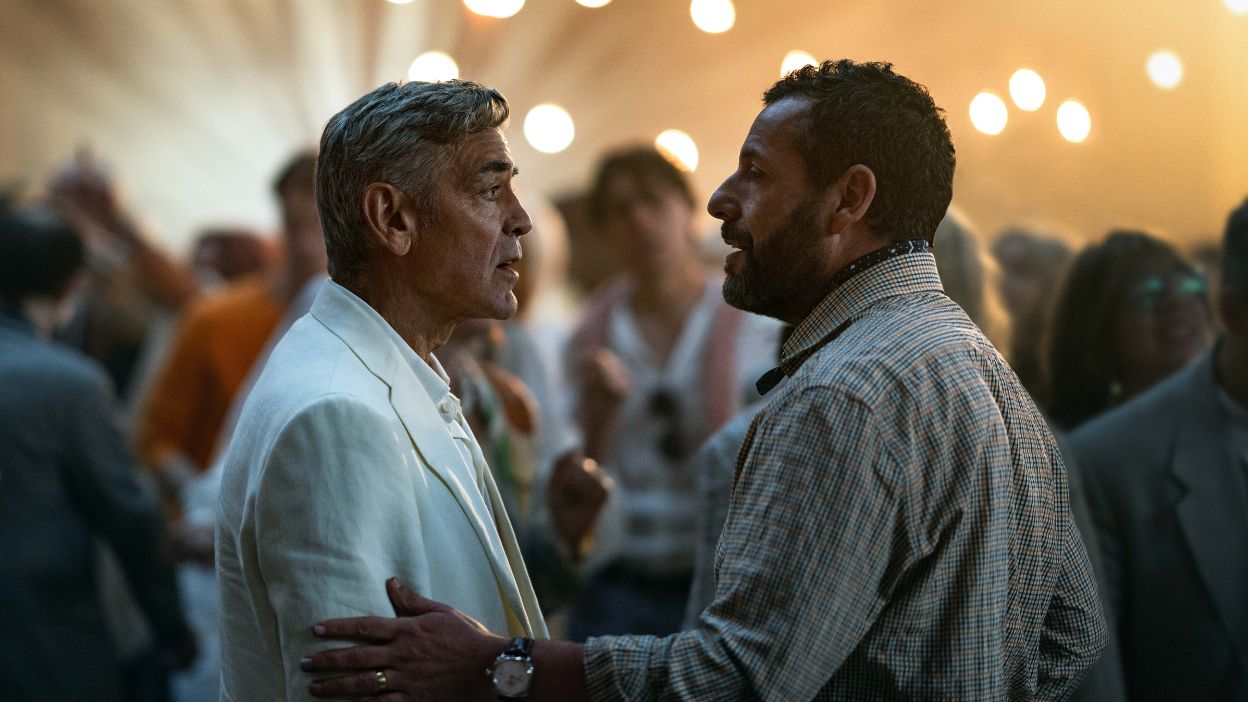
Jay Kelly is the newest film starring George Clooney. It’s directed by Noah Baumbach (Oscar nominations for best adapted screenplay for Barbie, and for best original screenplay and director for Marriage Story). The story is written by Baumbach and actress Emily Mortimer (Lovely and Amazing and Lars and the Real Girl). That, despite the fact it was produced by Netflix, had the shortest of theatrical runs, and is now streaming on that streaming service, it should still be considered a “real movie.” That’s a term that is in danger or at least in flux right now, especially with the Warner Bros. kerfuffle. But this movie should be put in the category of a real film with a very good director, a thoughtful script, beautiful cinematographer by Oscar-winning Linus Sandgren (La La Land), and an excellent crew of accompanying players, including probable Oscar nominee Adam Sandler, co-writer Mortimer herself, Greta Gerwig (Mrs. Baumbach and the director of Barbie, Little Women, and Lady Bird), Laura Dern, and Billy Crudup, the strongest thing in the film. So no, it’s not a streaming offering they call a movie, but it’s a real film.
There are a lot of things to respond to. It’s beautiful to look at, has deeply moving themes (especially to older folks), a lot of plot points—too many, in fact. But it’s essentially three things: a buddy/bromance film between Clooney and Sandler, a look at Hollywood stardom and how it affects everyone in the orbit around the main star, and an occasionally poignant look at regret. There’s a lot to dissect here—too much, in fact. There are ex-roommates, ex-wives, disaffected children, career choices by everyone, trips to France and Italy, train sequences, fans of every stripe, and in the center, a star who may be as hollow as his fame has proven to be.
Where the film settles on these many issues isn’t always clear. The bromance between Jay Kelly and his long-time manager (Sandler) is first cousin to that of Bill Nighy’s character and his manager in Love, Actually, though that earlier film resonates more strongly than here. Once we get past that central pair, things get uneven. Kelly has had two daughters who harbor a great deal of resentment toward a father that was mostly missing from their childhoods. The older has found a life for herself that isn’t filled with resentment; it’s just that any space Jay might have created in her life has long since been filled up with other things. The younger daughter has our sympathies as Jay (spoiler alert) tries to connect and “make it all better,” but she is at the age between finding a full life like her sister’s and that age where the very existence of a disconnected father—especially a world-famous one—is intrusive and embarrassing.
The many side stories don’t work together. Too much time is spent on the daughters, though one gets far more time than the other. Sander’s character is happily married, though fully aware of the loss that Jay has taken with his choices, which he shares as his manager. Then there is Laura Dern playing “Laura Dern lite” in a role that makes little sense being in this film, especially as it relates to Sandler’s character. Her eventually withdrawal from the film is first surprising and then quickly forgotten.
Sandler, who ironically has the bigger career than Clooney if one counts cash, takes another major step away from his comic past to being considered a serious actor. It’s quite a trajectory from The Hanukkah Song and The Waterboy to Punch-Drunk Love and Uncut Gems, and now this. He enters the battle between having such a strong and comic persona and working to be a serious actor here, and the serious actor is winning. As expected, his line deliveries are often right on the money, and perhaps as not expected, he has moments of great depth and feeling.
Then there are two men standing: Clooney and Crudup. Clooney is the lead and wears his age and weariness well. He is still a grand movie star in the Great Hollywood Tradition, which this film addresses in an almost transcendentally meta way. It’s a brave step for him to take given the many similarities in age, stardom, and the possibilities of regret. It’s a good performance, too, one of his strongest in a while. He still has that head shake that seems an integral part of his acting style, and there are moments where we don’t know if we’re seeing Jay Kelly acting like the star people expect, or Clooney doing his charming thing—even if we know that the charm is fake. Can be confusing at times.

Clooney’s acting style is soft around the edges, and that is no more apparent than in his scenes with Crudup, who would steal the film if given more time. Crudup has an edge to his acting style, and that works well with Clooney’s softness in their scenes together. As we quickly learn, Crudup’s character knew Kelly back in the day, and their scene as they catch up is riveting, especially as it takes a turn. Crudup does a quick masterclass in acting, even as we are watching what we know is acting. His edgy charm bounces off Clooney’s in a lovely character dance. (I chose to ignore the obvious age difference between the two men who were supposed to be roommates at one time. Clooney is seven years older and looks it, and Crudup looks younger than his actual age.) Once Crudup leaves the film, which happens too quickly, he is greatly missed.
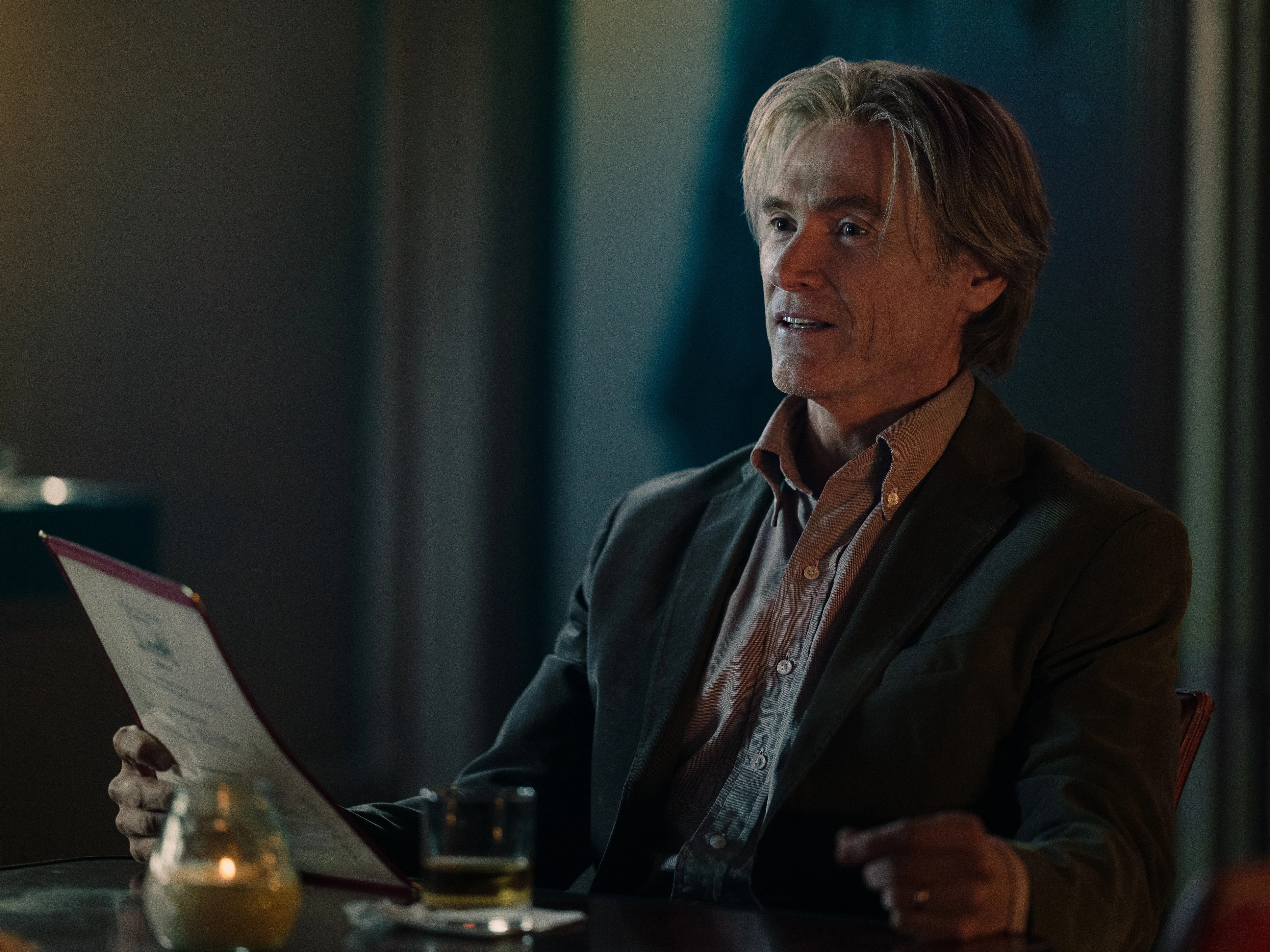
There are many directorial and script elements that are delightful, though it doesn’t all coalesce as well as it might. One lovely moment is when Kelly meet’s Crudup’s character again after decades. He at first has a hard time recognizing him and walks on to his next appointment, and then looks back to connect with him, a lovely foreshadowing of the role that Crudup’s’ character will play. It’s a lovely cinematic touch.
Then, perhaps because of my age and place in life, there is a character trait that Kelly has as a younger actor, where he (big spoiler alert) wants to do a scene over again. That is a story and personality element that is played well through to the end, when it hits the hardest of all. It leaves the film hanging on a poignant note that is revealing, deeply affecting, and subtly heartbreaking at the same time.
Jay Kelly may be remembered as a Clooney film that follows him din a bold and meta way as he ages, or a Sandler vehicle that moves him along as an actor, or a cinematic chimera that comingles classic cinema with the often frightening rise of modern streaming services production. (In a world where a classic Hollywood studio is going to end up being a branch of a streaming service, we can all be afraid, very afraid.) For many, however, this should be remembered as a solidly made film that entertains and yet touches on more than a few haunting memories and regrets.


 Film stuff by Mark