
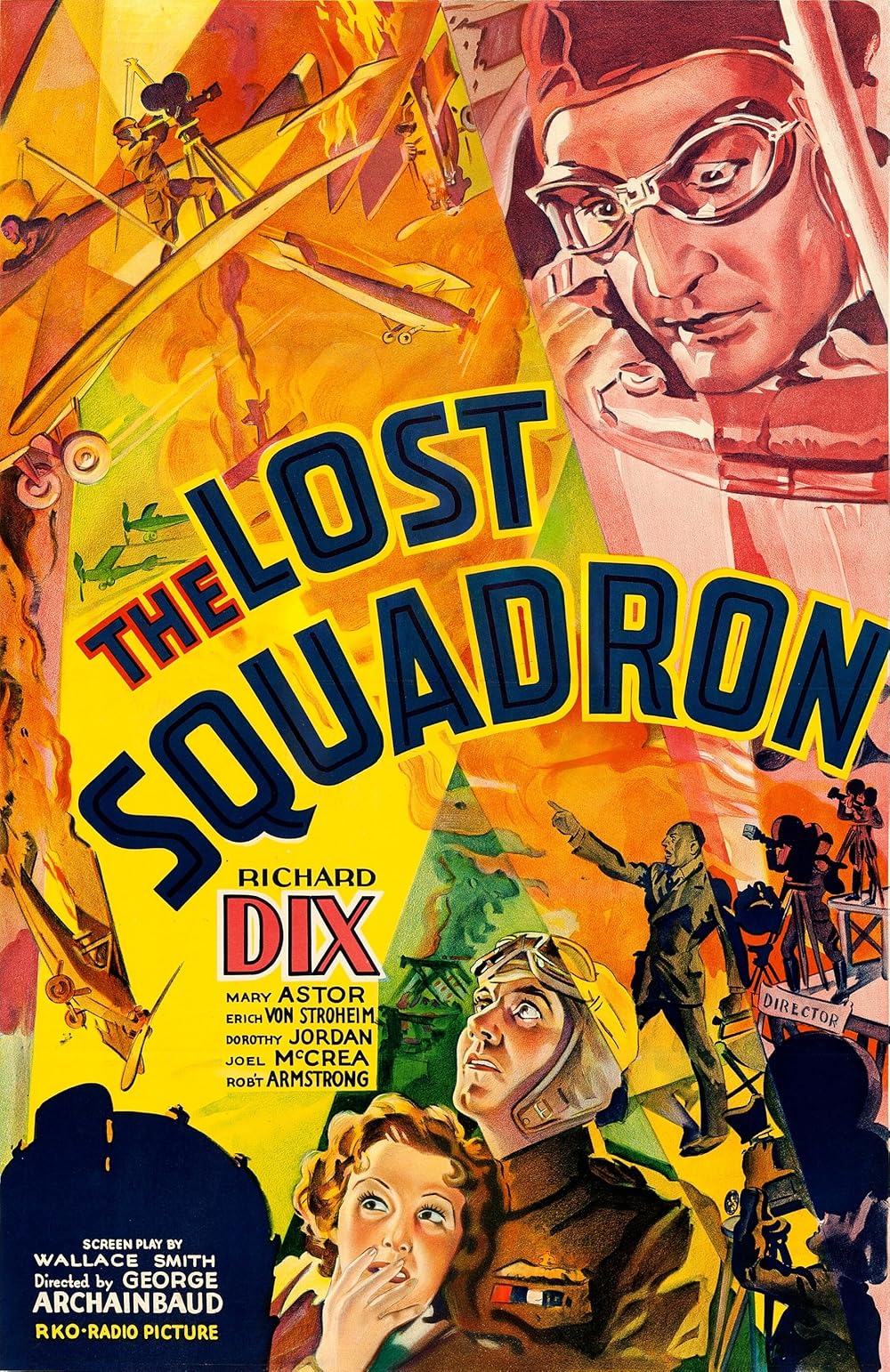
The Lost Squadron is a pre-Code* melodrama/buddy movie/action film/romance/murder film, and yes, the film is as pieced together and strange as that description sounds. The plot is an easy and straightforward one at the beginning but then it takes some fascinating twists and turns. Three World War II fighter pilots return as heroes to the States. Not all that surprisingly, especially if you’ve seen other films with a similar set-up (The Big Parade, The Roaring Twenties, The Best Years of Our Lives, Coming Home, etc.), they run into unemployment and a world that has changed, and not for the better, in their absence.
They decide to take their talent as war pilots and make some money doing airplane stunts for movies. Great set-up, and then the film goes in several different directions, all of which create a cornucopia of plot changes, major diversions, distractions, commentary, and of course, romance. The film, the first produced by David O. Selznick as production chief at RKO, may well be best known for its aerial sequences, which are first-rate for the time. The film was right in the wake of similar flying films such as Wings (1927, and the first Best Picture winner) and 1930’s Hell’s Angels and Dawn Patrol.
Aside from the aerial sequences, film historians will enjoy the tension in the film’s time and place. Lead Richard Dix, nominated the year before Best Actor for Cimarron, brings a silent film style stolidity to his already passive acting style. He locks down the film, and not in a good way; he seems a remnant of the silent era. Then there the fresh face and energy of Joel McCrea, who crashes into the film’s acting styles with an uneven but exciting sound film energy. Even in a supporting role, he brings more dynamism than the rest of the cast combined. Roger Armstrong, who would gain attention in the next year’s King Kong, falls somewhere in between. He’s solid, but rather wooden, even when playing the drunk.
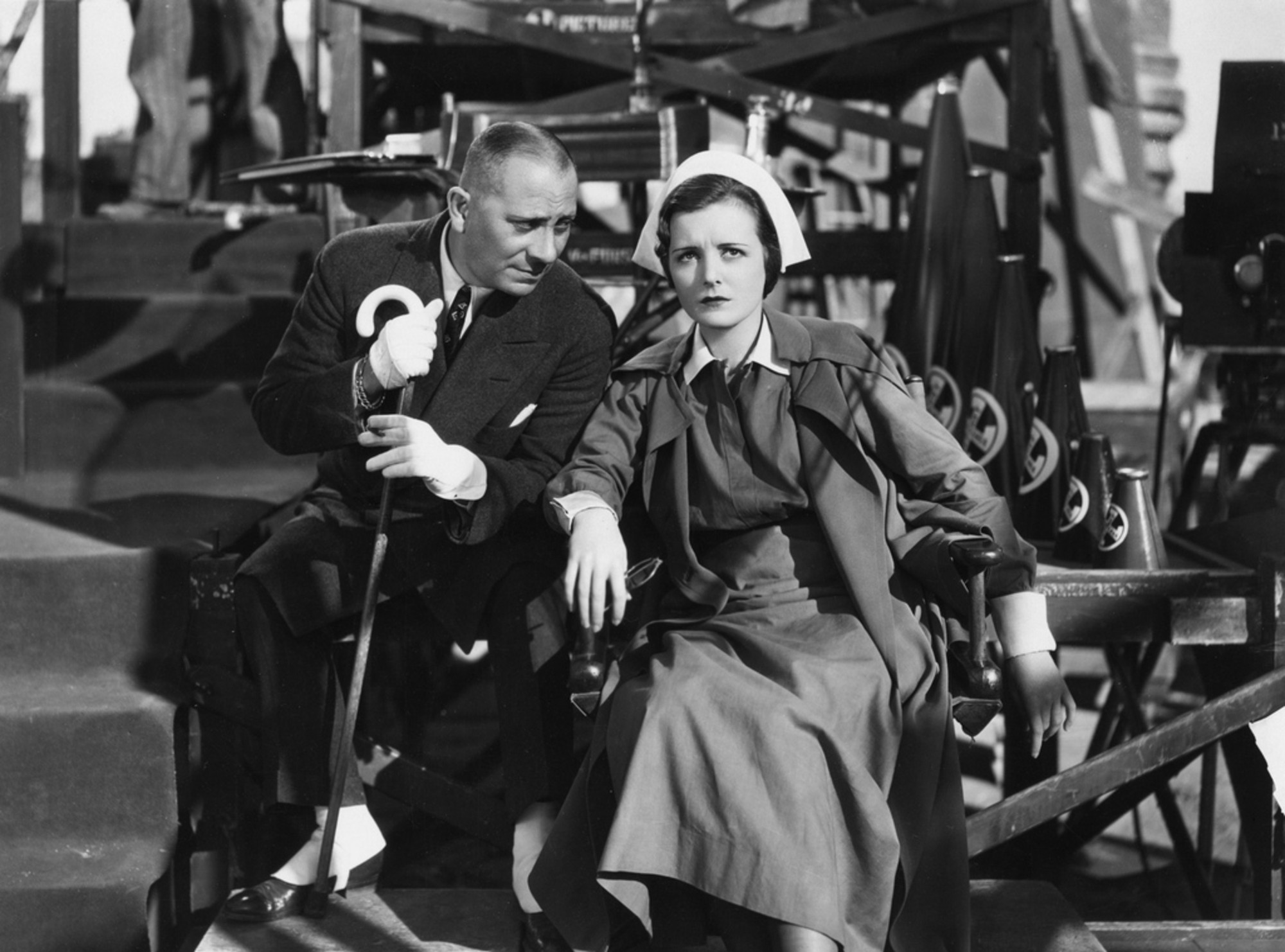
Then there are the two legends. One is future Oscar-winner Mary Astor (The Great Lie, 1942) (above, with von Stroheim) in a role that begins with some drama and interest, but which fades into virtual nothingness as the film goes on. It’s too bad, as she plays the bad girl whose broken emotional state is evident in her many poor decisions. That glorious speaking voice is on full display as a woman whose elegance and intelligence rises above everyone else in the film. When she slips off the film in a disappointedly unresolved way, we miss her.
One subplot that we don’t see coming until we’re in the middle of it is the creation of the film-within-a-film that the famed diabolical German director is trying to make. It’s a fine subplot, and one that almost turns this into a precursor to that same year’s What Price Hollywood?, released a few months later. Astor’s character Follette, who has dumped two lovers/husbands on her way up, is the unhappy wife of said director, who has made her into a big star over the years. The director is played with scenery-chewing panache and fierceness by silent film acting and director legend Erich von Stroheim. He’s the very essence of the hardheaded control freak he was rumored to be in real life. (Some saw this as perfect typecasting.) Stroheim was generally a better director than an actor, and he needs a tight controlling hand to give his best. Under the direction of French-born George Archainbaud, who began directing films in 1917 and was busy with television work until his death in 1959, there isn’t a nuance to be found in von Stroheim’s performance. He’s that perfect clichéd combination of Prussian directness and German roughness.
The film takes a grim and curious turn toward the end, and it seems rushed and less coherent in the final scenes. Even the action scenes are messy. Stories rush toward conclusions that aren’t properly supported, and some plot lines are rushed into completion while others are dropped completely.
The Lost Squadron is less than the sum of its parts. But its many parts can be greatly entertaining—the wildly conflicting acting styles of Dix and McCrea, the presence of Mary Astor before she became a major star, and a view of von Stroheim between his earlier Greed and his upcoming La Grande Illusion and Sunset Boulevard.
Historic note: This is thought by some to be first sound film to include a man giving the finger. But it was briefly seen in The Miracle Woman the year before.
As always, this is a time capsule demonstrating the tensions between silent and sound acting and directing. It’s also a good place to watch famous actors as they plateau (von Stroheim) and begin their ascent (Astor). All films reflect their time, and there are many shifting various styles and personalities to enjoy here.
* Pre-Code films are American motion pictures produced between roughly 1929 and mid-1934, characterized by risqué, subversive, and frank subject matter before the strict enforcement of the Motion Picture Production Code (Hays Code). This era, starting with the advent of “talkies,” featured themes of sexual freedom, drug use, interracial romance, and cynical crime.


 Film stuff by Mark