
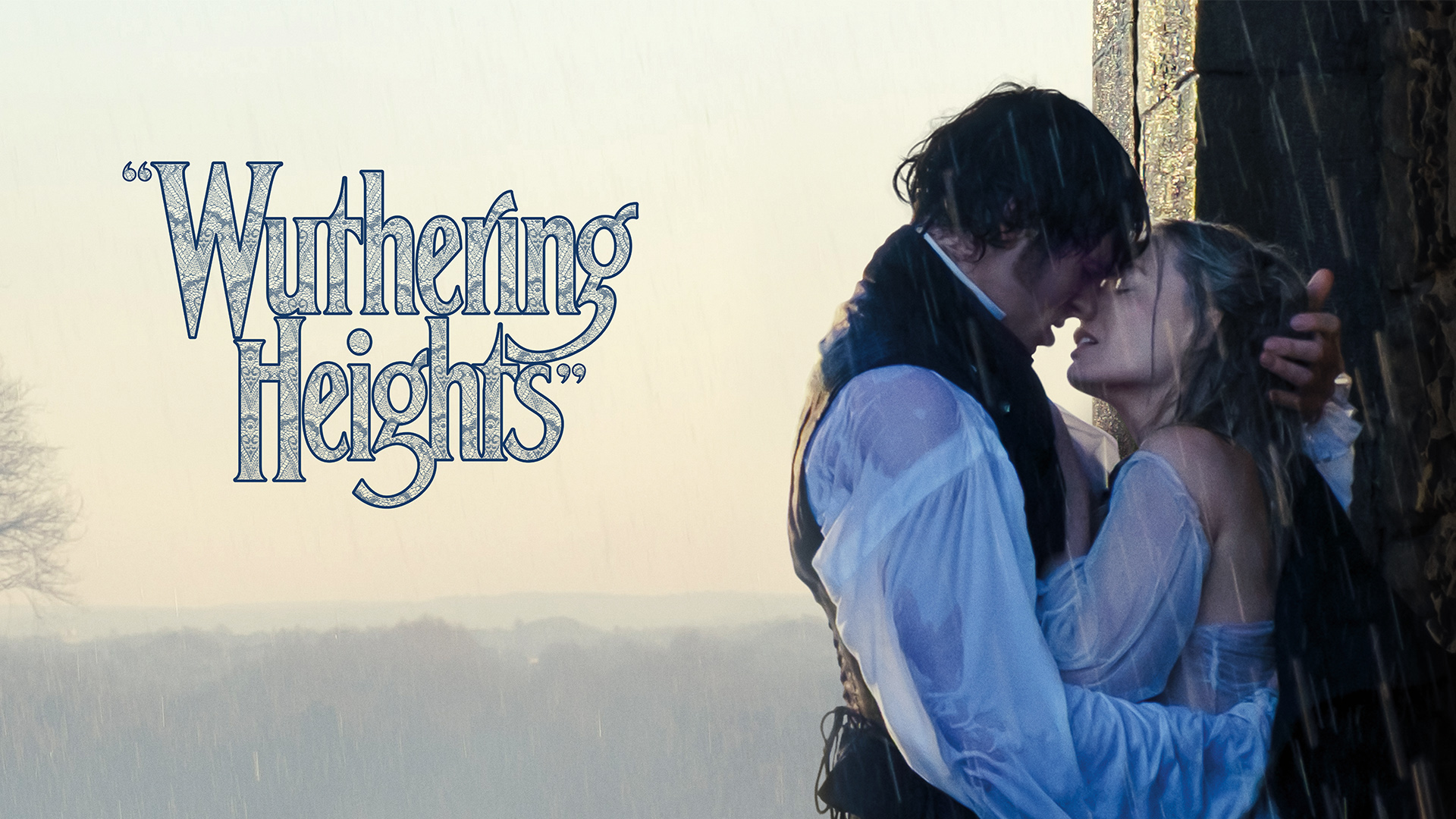
“Wuthering Heights” is a gorgeous looking fetid fever-dream that takes one too many turns toward the twisted and perverse in a story already full of darkness. It’s a spicy paperback come to pulsating and regrettable life. Think gilding the lily, but with darkness, hate, and degradation instead of gold.
Much has and will be written about how it is faithful or not to the novel. The hint that this isn’t an aim is found in the pair of parentheses around the title—a bit affected but telling. This is co-writer/director Emerald Fennell’s take on the famed story of two doomed lovers, and she sure takes it. It’s best to come into the viewing of this with no thoughts, or especially no particular affection to the novel.
The film is a wild ride, almost as wild as Heathcliff’s mad gallops among the moors. Everything is in italics, starting from the rocky, isolated Wuthering Heights farmhouse to Martin Clunes’ performance as Cathy’s father, Mr. Earnshaw. His journey is from mean dad (very mean dad) to out-of-nowhere adoptive father to a miserable drunk living in squalor. The vehemence of his anger in the beginning isn’t explained well, and his introduction of Heathcliff into the family makes even less sense. Why would a selfish, nasty person suddenly reach out to an orphan and make him a (second-rate) part of the family? His journey downward to his degenerate state just makes him of a piece with the rest of the film.
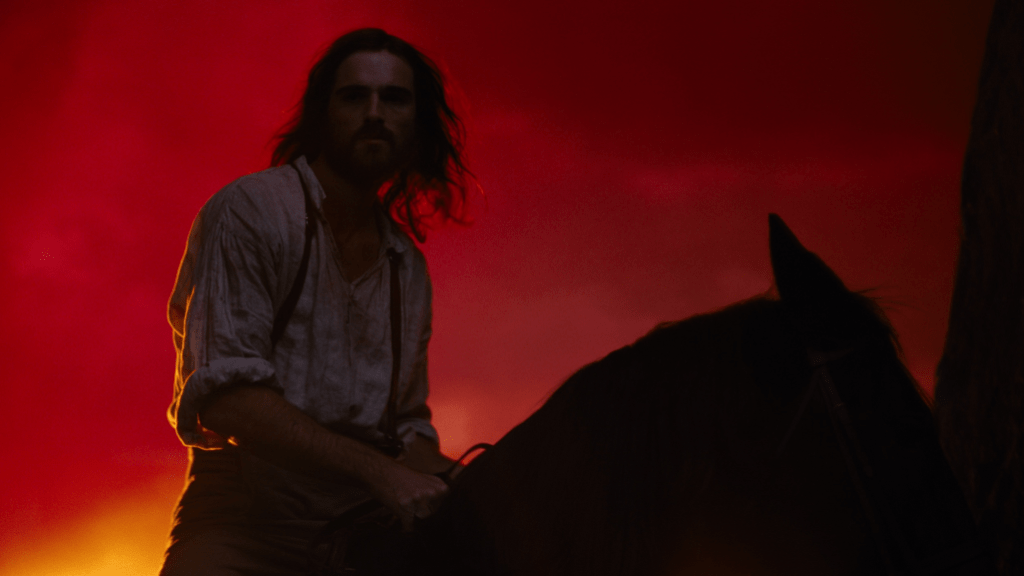
There are two great elements of this film. One is the slightly overwrought but dazzling cinematography. It’s anything but subtle, and it’s hard to forget the Gone with the Wind red-drenched where Heathcliff escapes his pain. Photographing beautiful people in stunning surroundings in beautiful homes is helpful, but the film’s look is far more than that, and it already has a guaranteed Oscar nomination for next year.
The other highlight is Hong Chau (Best Supporting Actress nominee for The Whale), who gives the best performance in the film. It’s quiet and often completely internal, which stands in great contrast to all the yelling, heavy breathing, and pearl-clutching of the other characters. But still waters run very deep here; she anchors the film and provides the only and very welcome moments of sanity in the film. She is missed every moment she is not on camera.
Of course, all the attention is being paid to its beautiful lead actors, Margot Robbie and Jacob Elordi. If all one wants is great-looking people, then go no further. But there are significant problems even here, and unexpected ones. Robbie is a favorite of mine, but she is miscast and can’t lock her character down. She is seven years older than Elordi and looks it. That’s not a criticism; she might be the most beautiful actress working today. But she looks much more mature than Elordi when they are supposed to be the same age. And then there is the performance itself. Yes, Cathy is supposed to be 16 when her first big fight with Heathcliff drives him away and drives her finally into the arms of the wealthy but (of course boring) Edgar Linton. There were clearly directorial and thespian attempts to present an age-appropriate Cathy. But I kept hearing a middle-school spoiled brat in a performance that was artistically inconsistent and out of alignment with the lovely mature woman (who is technically old enough to be Cathy’s mother) we see on the screen. I was reminded of Norma Shearer in 1936’s Romeo and Juliet, where Shearer was 38. (Of course, Leslie Howard as Romeo was in his early forties, and John Barrymore’s Mercutio was 54. Of course they were all teens in the original play.)
Elordi fares better. He’s able to better lock down on his ultimately unpleasant character, giving it his all as his character goes from intriguingly dark to pitch black to revolting. He is also able to navigate the aging degrees more easily.
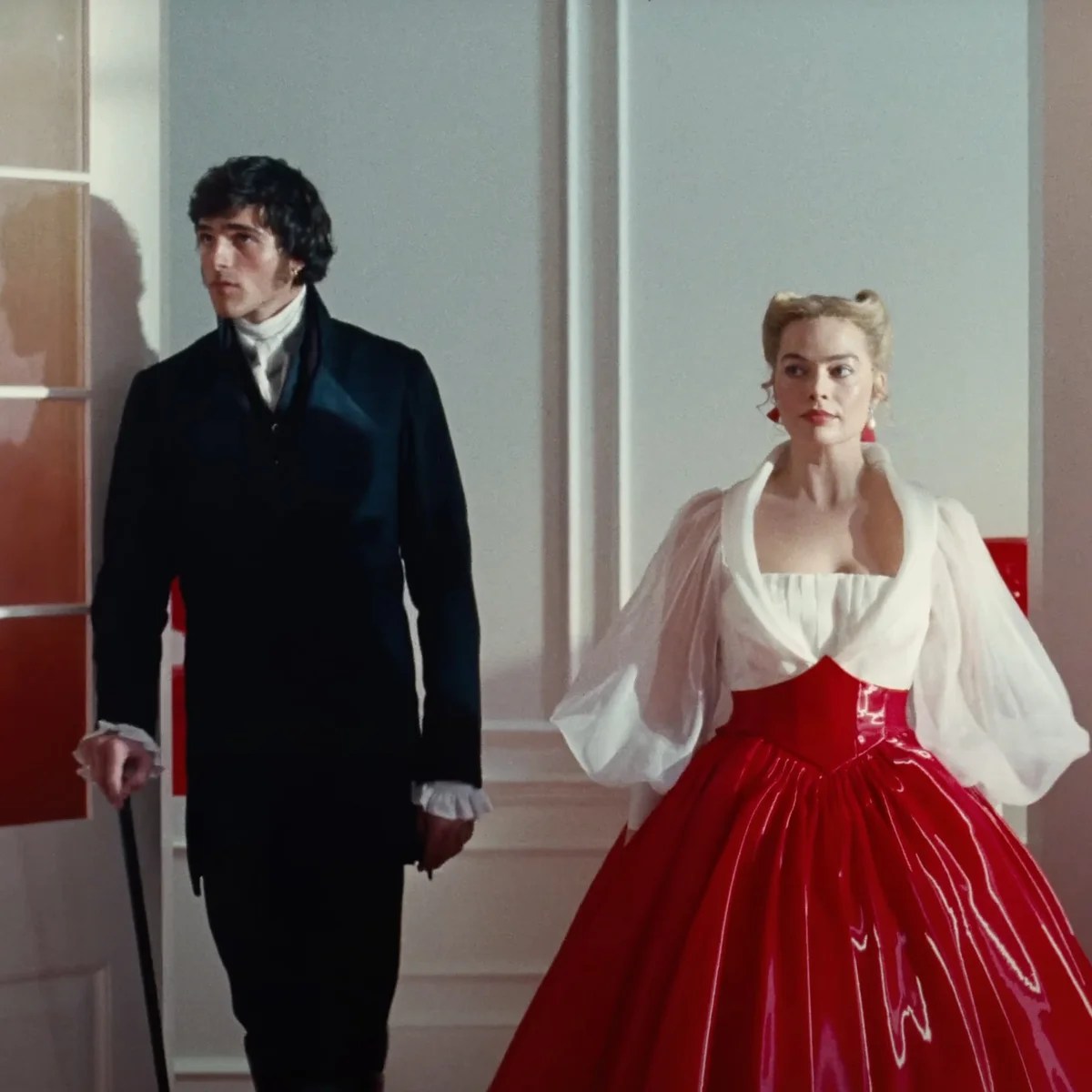
Costumes and design are as extreme as the emotions here. Wuthering Heights is smaller, darker, and drearier than it needed to be; why Heathcliff would want to go back there is a mystery, one they try to explain to no avail. When Cathy leaves to marry Linton, her new house is more grand(iose), more pink, more sparkly, and unrealistically colored than is believable; at times it bordered on the phantasmagorical. (The dollhouse metaphor is just too on the nose.) It reminded me of a more adult version of what Sofia Coppola was doing with 2006’s Marie Antoinette, sacrificing authenticity for the sake of dreamlike teenage fantasy.
Fennell has a way of darkening what she writes and directs. Promising Young Woman ended on a rather shocking dark and hopeless note. Saltburn took several perverse turns before its bizarre final scene. Here she has a dark and twisted novel that gets darker and more twisted in her hands. What is suggested and therefore more powerful in earlier versions is made explicit, hence less powerful here. What happens with Isabelle (Alison Oliver) literalizes the phrase “treated like a dog,” and unnecessarily so. Fennell creates and then mercifully undermines an earlier BDSM scene (again, unnecessary) by having Heathcliff clasp his hands over Cathy’s eyes so she can’t see what’s going on. A good move by director and the character. I foolishly thought that this might provide deeper insight into Heathcliff’s protective affection for Cathy. It did, but only temporarily.
It’s hard to make a film where nearly every character is terrible. Only Hong Chau’s Nelly remains unscathed, while Isabella moves from a likable but naïve young woman to an obsessed victim of her own horrible choices. Linton is pleasant but in that thankless, sexless role assigned to the second male lead who in every way has to make the male lead looks great…OK looking, ill-defined as a personality, and with only half a backbone.
While the story of Wuthering Heights here is about repression, this film explores that only for a while, and when Heathcliff and Cathy connect sexually, they become fully clothed Yorkshire rabbits; the only skin is a shirtless Elordi earlier in the film. We are supposed to applaud the great sex between beautiful people, but everyone is making bad decisions that ruin themselves and others.
There is a small story in the film that works, however, and that is of the young Cathy and Heathcliff, played expertly by newcomer Charlotte Mellington and Owen Cooper (TV’s “Adolescence”). Their story is more touching and believable than their grown counterparts’, and the tenderness and complexity of even their young relationship ends up being the most interesting in the film. If only the film had built on that….
The classic story is nearly impossible to be made into one film. There is too much to cover, from the central “love” story to class structure to possible racism to the role of nature to the dark recesses of the human heart. This film covers that last two themes in strongly contrasting ways. The moors have never looked more wildly beautiful, and the people inhabiting this story have rarely looked this selfish, cruel, and perverse.


 Film stuff by Mark