

Maestro, the film directed by, starring, and co-written by middle-aged wunderkind Bradley Cooper, is one of the most anticipated films of the year. Coming as Cooper’s sophomore effort after his wildly successful A Star is Born with Lady Gaga, it arrives with great fanfare (pun not really intended), but may unfortunately fade away soon. This is for several reasons, the obvious first one being that one can only see this beautifully shot film on Netflix. That limits availability plus the opportunity to see this on the big screen.
The other reasons are the subject of the film itself—composer/conductor/performer Leonard Bernstein, and the film’s decision on what exact story to tell. The film wisely chooses not to tell a whole chronological biography of the genius, and instead focuses on one slice of his life—his relationship and marriage to the highly intelligent and accomplished actress Felicia Montealegre. This approach will have the same effect on many viewers that the subject of the film had with his friends and colleagues. The film makes clear that one of Bernstein’s major struggles, both internally and externally, was the question of what he wanted to be and do. A conductor only? A composer only—and if so, what genre: chamber music, orchestral music, individual and choral pieces, opera, ballet, musical drama, musical comedy? Or a performer (he was an excellent pianist)? Or how about just a music teacher, and if so, teaching what exactly—piano lessons, conducting, something else? And then there’s the issue of sexual identity.
By focusing the film so structurally on his relationships and marriage, much of Bernstein’s life must be put on the periphery. That is going to frustrate, and has already frustrated, many critics and viewers who want their own Bernstein film—complete with more visible successes (West Side Story, etc.), more gay sex scenes (there aren’t any), more emphasis on his affairs with men, more emphasis on his affairs with men and women, more conducting sequences, more focus on his groundbreaking television work, more lecturing, more scenes at Tanglewood, more time spent with all the famous people either buzzing around or genuinely connected to him, and on and on.
But this is not Cooper’s film. What those disappointed in this film are often dealing with is the frustration of Bernstein himself…his own internal frustrations and the non-stop attempts to pigeonhole him, even if the pigeoning was for his own supposed good. Bernstein wanted to be and do everything musically, and that was anathema to some: ”You could be the first great American conductor.” Since his almost fairytale arrival to the top of the orchestra conductor world at the age of 25, it was assumed that this pathway was going to be his life.

But then there was the world of theatrical performance. Though the film doesn’t go into this, Bernstein played for the Revuers, in the late 1930s, a group featuring Adolph Green, Betty Comden, and Judy Holiday (then Judy Tuvim). If Green and Comden sound familiar, it is because they wrote On the Town, Wonderful Town, and Bells are Ringing (among others) for the stage, and Good News, The Barkleys of Broadway, Singin’ in the Rain, The Band Wagon, It’s Always Fair Weather, and Auntie Mame, among others for the movies. That’s a lot of standard mid-century musical theater and film work. But those didn’t represent “serious music” to those around him, echoing the stage world’s disparaging of the arrival of “movies,” and the movies’ disparaging of television in TV’s earliest decades.
Bernstein clearly couldn’t lock himself down to any one form of musical expression. He did the film score for Best Picture winner On the Waterfront (1954) and was nominated for an Oscar, and then never did the score for any dramatic film after that. Even his work in the theater was unlike what anyone else was doing. His Candide strives toward opera, and is even listed as an opera by some. What it is is one of the most glorious musical theater creations ever, even though the book has issues.
The creation of West Side Story is the story of the tension between great musical theater with a soaring musical score and the demands of a form that wanted a stricter adherence to a more traditional musical theater sound. (West Side Story on Broadway ended up casting Carol Lawrence, Larry Kert, and Chita Rivera as Maria, Tony, and Anita respectively, all possessed with splendid but non-operatic voices—even in spite of Lawrence’s amazing range. Bernstein apparently “corrected” this error by re-recording the music in 1984 with opera greats Kiri Te Kanawa and José Carreras. IMHO, lovely, but a mistake. The music was meant to be sung by traditional musical theater singers with glorious voices. The 1957 original cast recording is a classic for a reason. But apparently Bernstein was always conflicted on what was a worthy endeavor for his time and talent, and couldn’t simply be content that he was great in so many categories, even if some of those categories were denigrated by those outside the field.)
Interested as we all seem to be about folk’s sex lives, it’s not unusual that many expecting a focus on his sex life or sexual identity struggles are disappointed. Even the reviewers of the film and those describing Bernstein’s personal life don’t know whether to call him gay or bisexual. Mentor (and lover?) Aaron Copland used the word “homosexual” in describing Bernstein, but would he have even used the word “bisexual” back then? Again, Bernstein defied categorization.
I have read more than once that Bernstein was giving in to societal pressure when he married, so that he could move up in the conducting world—even as he held on to his Jewish identity and never changed his last name in spite of pressure to do so. The film holds a greatly different perspective. The film presents a loving, stormy friendship and marriage between two highly intelligent and talented people. All of this challenges today’s viewers who want to put everything into a previously labeled box. For those who feel that Bernstein was hamstrung by society to be his “authentic self” (whatever that means), and that this was a lavender marriage, the film and the facts seem to contradict that. And for those who feel that if it weren’t for that pesky same-sex attraction thing, Bernstein would have preferred a quiet marriage and family life, well, the film doesn’t suggest that either.
We live in an age where we don’t want to be stretched in mind and heart, where we feel we have the right to plug our understanding of an event or person—even one outside of our current understandings—into a previously existing compartment of our making, and woe be unto anyone asking me to stretch and either enlarge our own conceptions or create a new compartment. That’s the challenge Maestro makes on us, whether we asked for it or not. This may be the film of the year “that everyone asked for, and that no one was ultimately happy with.” So ultimately, and ironically, a great deal of the trouble some people are going to have with this film is that it reflects the conundrum that was Bernstein himself—not sure of who he was, or what he ultimately wanted, and the calls inside and outside of himself working to place a specific narrower identity on him.
There is also another element of Maestro that will likely work against its popularity. It inhabits the world of theater, classical music, ballet, and opera, among other things, and works very hard to create a believable world for Leonard and Felicia to inhabit. Their rapid-fire dialog when they first meet can seem too cool for school, but it genuinely reflects the kind of extroverted and energized conversations of those in the arts, especially when they encounter an intellectual and verbal equal. The joy of finding someone that one can go back and forth with like that is a joy for those that have encountered it. But the thinking of these two, their joyful verbal jousting, and the artistically creative world they live in can be a turn-off to many Americans who just can’t identify with that world; it’s like All About Eve on steroids at times. I recalled showing my film classes the film Capote (during the week we studied acting) to see the incredible performance of Philip Seymour Hoffman. I had to give a heads-up to a class largely made up of engineering and computer students to relax while the film sets up its world of talky intellectual New York Upper West Side artists, which it so aggressively does in the beginning, and let the film settle down to something more accessible, which it also does. Maestro’s world can seem many things but relatable to a lot of people. Again, think Bernstein.
Now to the film itself. It’s gorgeous to look at, with stunning black-and-white and glorious color shot on 35mm film by Matthew Libatique (Black Swan and A Star is Born). Much has been made of its differing color palettes and aspect ratios, but it’s best to just experience it, not to think about it too much. Yes, the black-and-white reflects the past and a golden age, etc., but this aspect of the film should be enjoyed more than analyzed.
The script, by Cooper and Josh Springer (Spotlight, The Post, First Man) is as intelligent as its protagonists, but suffers slightly from an attempt to include, even just in passing, more of Bernstein’s interests and successes than one film can hold. It namedrops to an almost embarrassing degree, but all these many famous people should be mentioned. (Shouldn’t they, or is that part of the problem here?)
As you might expect, the music and the sound do justice to its subject’s work, and give viewers/listeners at least a taste of the beauty and power of his music. As someone familiar with a lot of Bernstein’s work, I experienced that disappointment that comes with not hearing enough of his music, though the Candide rehearsal scene is spine-chilling in the best way, and the incredible long take of Bernstein conducing Mahler’s Resurrection Symphony is breathtaking sonically, cinematically, and in terms of performance.
Speaking of long takes, one feature of the cinematography, aside from the color and aspect ratio, is the surprising use of very long takes. This isn’t common in most of today’s films, and can suggest that Cooper and Libatique are replicating Old Hollywood here. But many of the more modern scenes are shot this way as well. Note: There are as many shots of doors and people seen through doorways as in a John Ford film and The Godfather, seeming to suggest the limiting and/or pigeonholing elements of the lives of both Bernsteins.
Last but certainly not least are the performances. Cooper is extraordinary as Bernstein, as an over-the-top personality, a creator, a performer, a conversationalist, and of course as a rather flamboyant conductor. That’s not always the most likable of traits for a film character, but Cooper’s energy and solid acting choices (whether you might agree with his choices or not) are mesmerizing for those willing to be drawn in.
More of a surprise is comedienne Sarah Silverman, who disappears into the role of Leonard’s sister Shirley. She demonstrates nothing of the eager-to-please comic actor, but gives a sharply defined, very credible performance.
And that leads us to the real main character in the film, by the actor giving the best performance. For those paying attention, Carey Mulligan is given top billing over Cooper in the end credits, who certainly could have done otherwise. But the time the film is done, we realize (perhaps adding to the disappointment of some?) that Felicia is the real center of the story, and that Mulligan does the best work here. I admit my prejudice, as she is one of my favorites. But this is a stellar performance, starting right from her first words on screen, and carrying through the many ups and downs of her life, with and without Leonard. Mulligan’s eyes might be the most expressive of any actress of our time, and she shows more depth and emotional conflicts without saying a word than most actresses can manage in a scene filled with crying and yelling. If it weren’t for Lily Gladstone and her work in Killers of the Flower Moon (and the tendency of the Academy to self-congratulate by being as “inclusive” as it wants us to perceive them), Mulligan would be a shoo-in for Best Actress. (Of course I’m not saying that Gladstone wouldn’t deserve the award, but just sayin’ that there are a lot of elements that can go into an Oscar vote.)
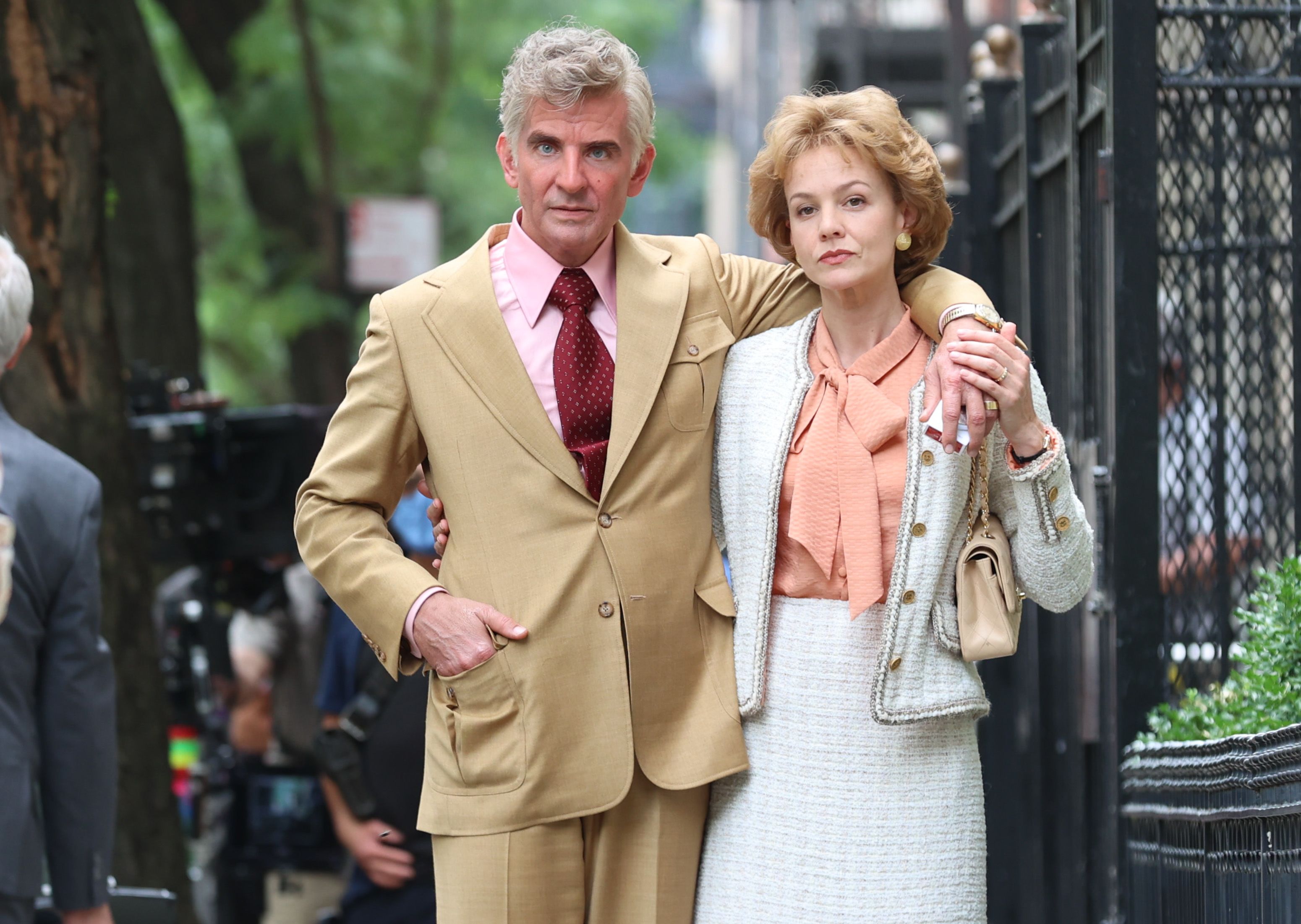
Cooper swings for the fences as a director, daring to be bold in terms of his visuals, and the back-and-forth between realist and formalist elements (e.g., Bernstein temporarily “joining” the cast of his ballet with Jerome Robbins, Fancy Free, which later was lengthened and redone as Broadway’s On the Town, which was then gutted and redone to become a film musical of the same name, which I still love). But perhaps the biggest swing of all is keeping its focus on the marriage in the middle of a couple of extraordinary lives during some extraordinary years, sidelining or seeming to give short shrift to the many other elements of the rich and full lives presented here, and to the frustration of those viewers that come with expectations that the film has chosen not to meet. But as I usually told my students in the first class of a semester, let the film take you on its own journey, and don’t judge it until you’ve experienced the whole thing. Let Maestro take you on its own bumpy journey, and you’ll engage with an audacious film by one of our most talented actors and directors.


 Film stuff by Mark