
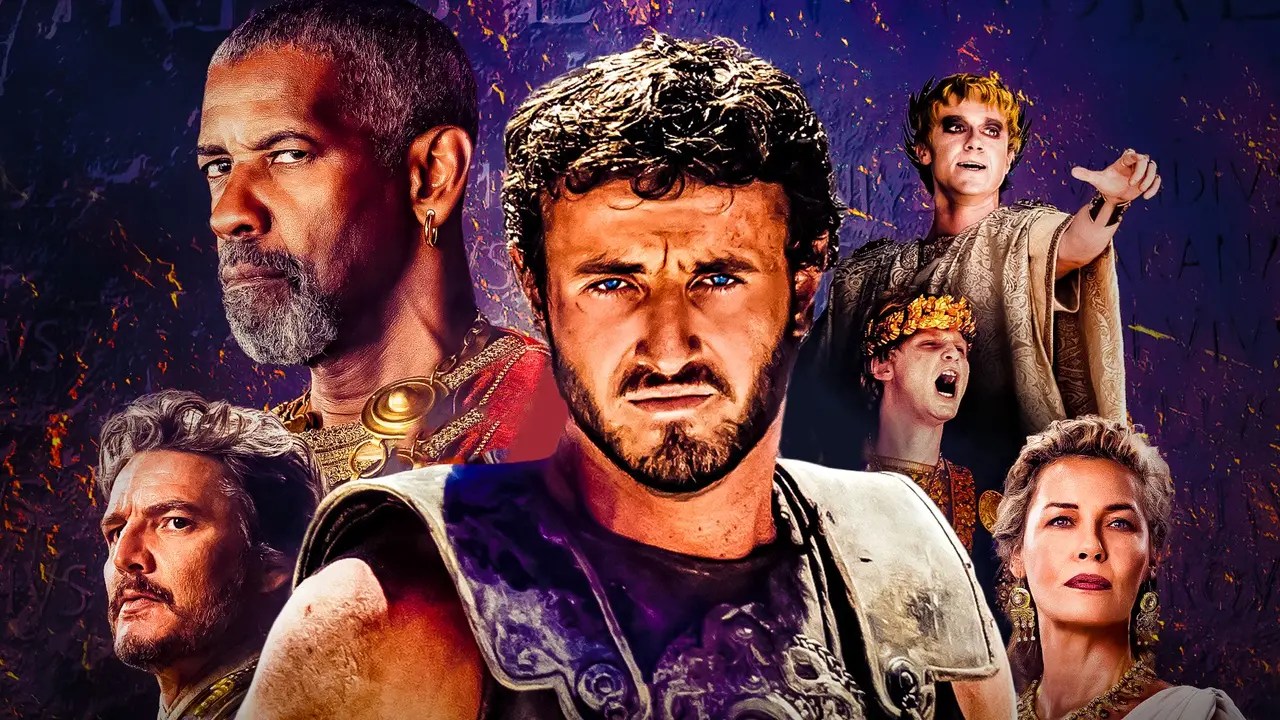
So the big question of course is, “Are you entertained?”, which was the famous quote from the original Gladiator. For the sequel, the answer is basically yes. But being an entertaining movie is not the same as being a great one. Briefly, the film is brighter, louder, more violent (yes, really) and for all its lauded efforts to combine the film with its predecessor, shallower than the original. It’s fun, and it might end up with some technical awards at the Oscars, but I wouldn’t be in favor of a nod in any other category.
Director Ridley Scott, also director of the first Gladiator, knows how to film a battle scene and a more personal one-on-one. But this time around, the violence is both more intense and gory, as well as more ridiculous as the film progresses, sending the film at times into eye-rolling category. Deadly arrows, for instance, seem to find their way directly into the center of the victim’s chest, which is as artful visually as it is preposterous. The other problems with the violence will be addressed later.
Cinematographer John Mattieson, who shot the original, is back for this film. But the dark and moody look that worked well in the first Gladiator is replaced by alternately rich and sometime garish colors. There are moments of quieter and subtle beauty, but too many scenes have colors that pop and end up cheapening the film.
The story is a direct follow-up that simply puts us about 20 years into the future, where (serious spoiler alert ahead—be warned) the son of Maximus (Russell Crowe) and Lucilla (Connie Nielsen) faces the same gladiatorial challenges faced by his father. He is played by well-respected young actor Paul Mescal (Oscar nomination for Aftersun), who simply can’t match the power of Crowe’s presence or performance.
Sometimes it’s instructive (and yea, even entertaining) to see the differences between a film and its very similar sequel. Some may protest that a too-close comparison is beside the point and irrelevant. But the deliberate similarities between the two films here raises the issue of how well the changes work. Unfortunately, most of them don’t help the film. For instance, part of the power of the original was Maximus’s love for his wife, which was ratcheted up later when he found out about her fate. Here, young Lucius loses his wife (again, with a perfectly placed deadly arrow) right at the start. But other than the passionate kisses between the two in the first shots, we don’t really have a sense of the depth of their relationship. Plus, there are no children to mourn. Hence, the pain isn’t as deep, and his so-called “rage” isn’t as powerful.
The story itself is also not as powerful and seems to go into too many side trails. The simple and straightforward enemy in the first film was Commodus, played so wonderfully by Joaquin Phoenix, whose character was continually developed and deepened in the original film. This helped to hold the story together and built emotional momentum. Here the first enemy of Julius later becomes his friend, (another spoiler alert ahead) and even his stepdad, General Acacius, played by “The Mandalorian”s Pedro Pascal (in a serviceable performance). Between Julius’s discovery of who he was, the machinations of the Roman Senate, the switch from friend to foe for Julius, the two emperors and their plans, and the whirling dervish named D. Washington, there is a lot going on here.
Then there is the final scene, a cinematic cliché if there ever was one. Apparently, the fate of the entire empire is coming down to the showdown between Julius (having survived untold near-death experiences in the Colosseum), and Macrinus (Washington), who has succeeded in his plans to take over the leadership of all Rome, except for this pesky gladiator who happens to be Emperor Marcus Aurelius’ next-in-line. But without going into detail, it’s not just a contest between two people that happens to be hold the future of an empire in its outcome. It’s also that most tired chestnut that could have been intoned in the trailer over the fight: ‘THIS TIME IT’S PERSONAL!” The fact that the empire is at stake, and that this also a payback kind of deadly brawl, doesn’t make this a more powerful clash as much as a tired dramatic scuffle that while powerfully presented is rather silly and worn out.
To say that the film “jumps the shark” is just too easy. But really, it does. Between the CGI baboons (fiercer than anything in real life), the rhinoceros, and yes, the sharks, the creatures fought by the gladiators are so unrealistic and over-the-top that it’s hard to take these scenes seriously.
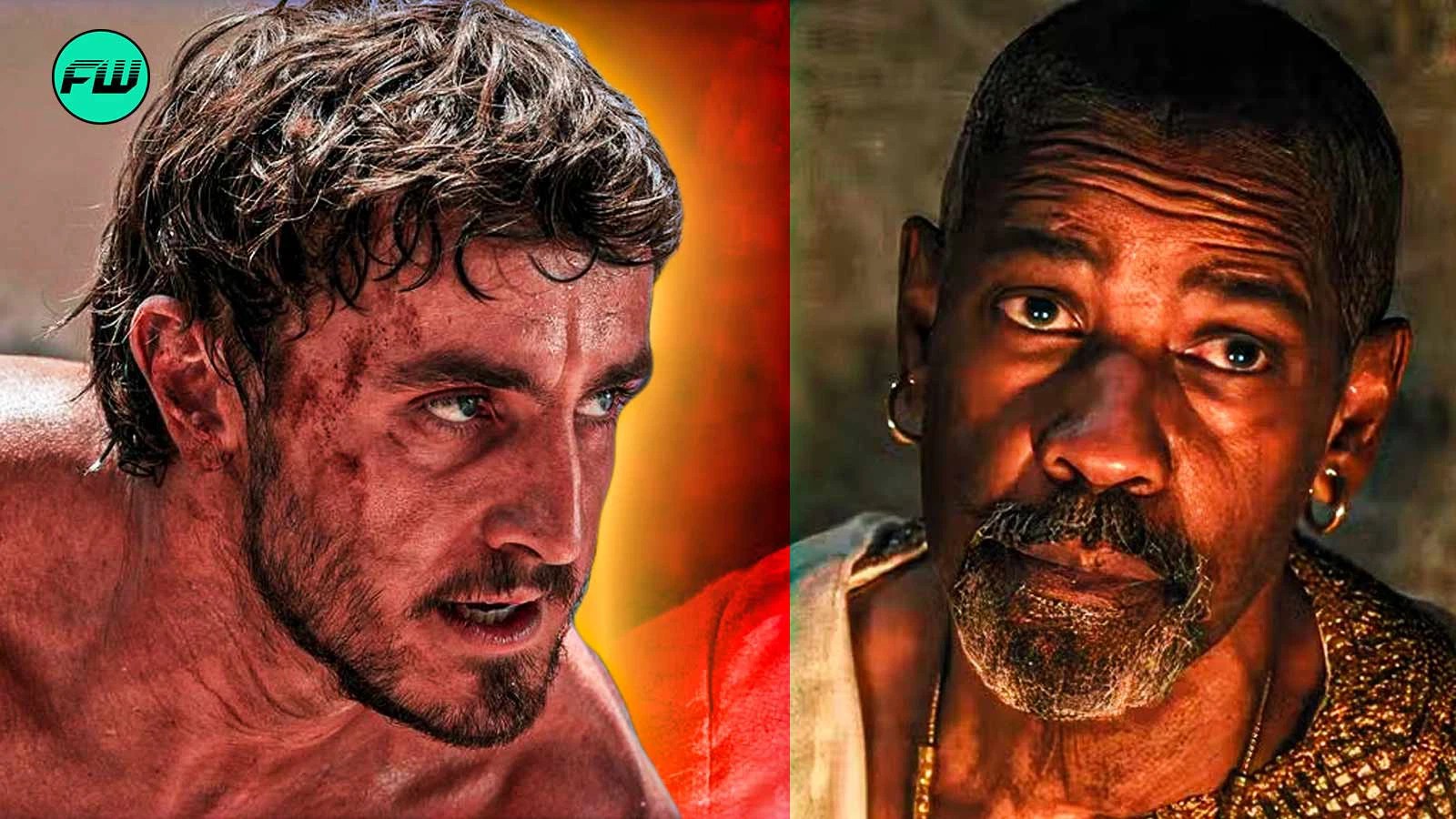
Comparing lead actor Mescal to Crowe may seem unfair as well. But since Lucius is supposed to be kind of a second coming of Maximus, comparisons are worth noting. A great deal of the power of the original film was the presence of Crowe, well known in Hollywood (L.A. Confidential, Oscar nomination for The Insider) but not yet to the public before Gladiator. He exploded on the scene with his acting talent in the film, but to me, his greatest contribution to the film was his great authority, and specifically his (non-toxic) masculinity that stood in sharp contrast to the softer masculinity of the 1990s. While Mescal is only an inch shorter than Crowe, he is slighter and projects much less personal power than Crowe, which puts the onus on others in the cast to help carry the film.
One person who not really carry the film as much as bobs and sways it around is the inestimable Denzel Washington, who simultaneously elevates and throws the film into disarray—in two ways. One is tied to his character and the gradual revealing of his character’s dark motives and actions. The other is tied to Washington’s acting style, which is 1) his own, and 2) is more naturalistic than this grand sword-and-sandal film is able to completely assimilate. Washington is always outside of the film whenever his character is in it, which can be delightful but can also be distracting.
Mescal is a softer creature than either Crowe or Denzel, and his strong statements in conversation and his calls to action to the troops aren’t quite believable. He gives a consistent performance, but he has a sweetness and sensitivity that don’t quite match what he is asked to do or be here.
The two emperors are out of another film entirely. They are supposed to be brothers. One is ghostly and seems perverse and perverted; the other is smaller, just as ghostly, and is signaled as weak and gay (think 1932’s The Sign of the Cross and the way Charles Laughton’s Nero’s sexuality was presented, young boy included). This representation and the way the older brother describes him seem to be enough for an LBGTQ+ protest, but I haven’t heard of any at this point in time.
Thankfully, there is an actor here who seems to fit perfectly into the film, acting reasonably and with feeling, and that is Connie Nielsen as Lucila. Neilson is given a larger role than in the first film, and finds just the right note in her performance here. Her scenes, with Pascal, Mescal, or any and all guards, help ground the film when all around her go too far or just don’t quite fit into the film.
The film ultimately doesn’t quite work, but the various pieces and characters are fun to watch, even if they don’t all quite come together. If disbelief and critical thinking are suspended to a good degree, Gladiator II may well offer most viewers a wild and violent ride that will definitely take them away from the real world for a few hours. Perhaps, now, that might be enough to recommend it.


 Film stuff by Mark