
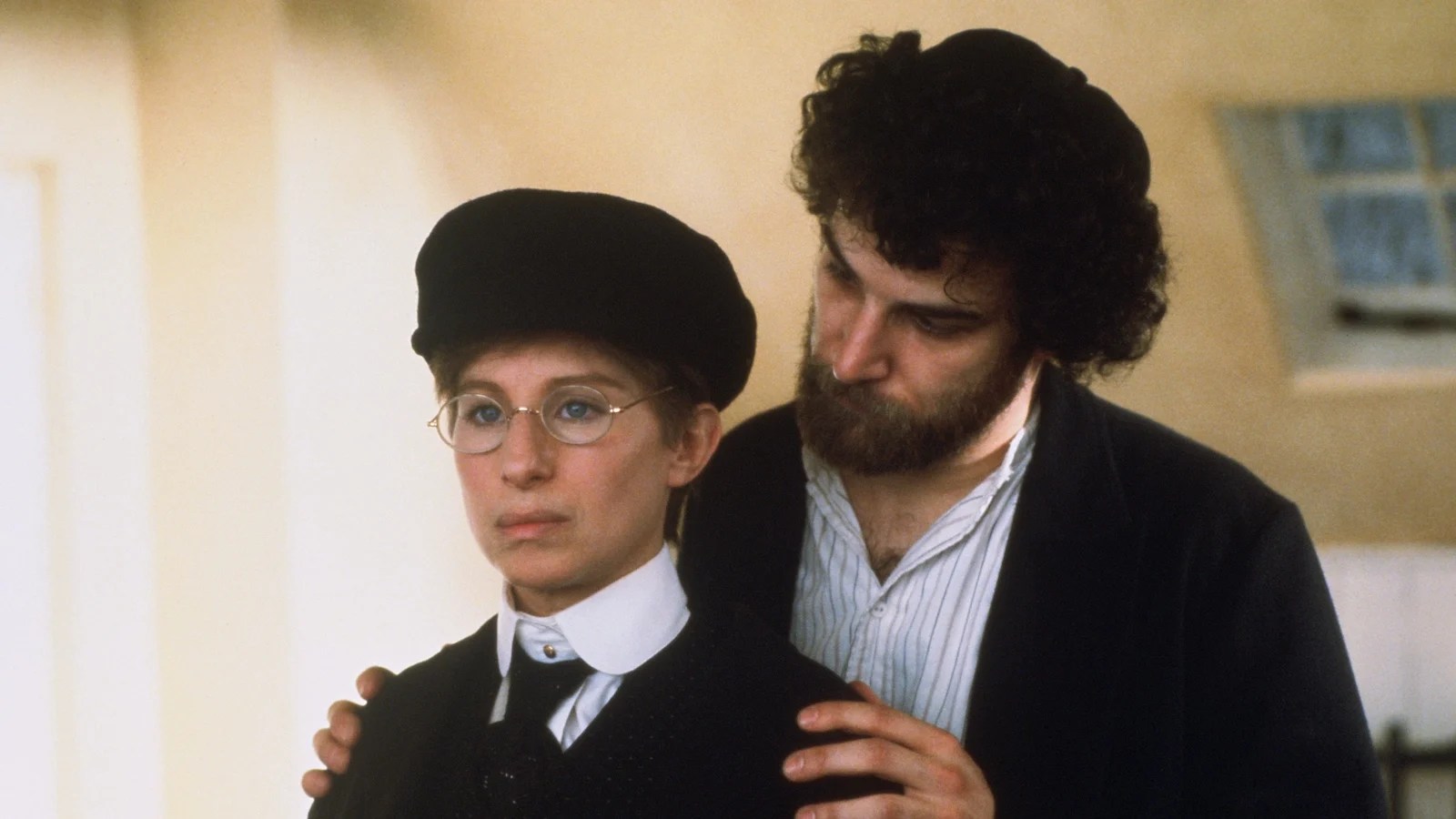
My head is still spinning after my recent rewatch of 1983’s Yentl after originally seeing it in the theater when it was released. Spinning because so much of it was so very good, spinning because much of it was so not good, spinning because there are so many moving parts to consider—and because it’s been hard to view the film as a film apart from all that has been written around it—including from director Barbra Streisand herself. It’s been presented as an example of sexism in the industry, from getting it off the ground to the uneven awards attention to it. It departed significantly from the original short story from Isaac Bashevis Singer, and that provoked some backlash, most strongly from the author. Streisand and the film echoed Orson Welles’ Citizen Kane in that it was her first directorial feature, she produced it, co-wrote it, and starred in it—exactly like Welles and Kane. And exactly like Welles and Kane, there was a great deal of personal animosity around her probably rooted in jealousy, and also, probably, due to personality conflicts with a strong temperament.
Overall, this is a solid-directed film that looks great, thanks to Streisand’s eye, the cinematography by David Watkin (Oscar for this work on Out of Africa), and the production designers. Streisand had a limited budget but made the best of it with her use of small, well-lit rooms and some lovely landscape shots. There is a confidence and artistry at work that is seldom found in a first film. The “No Wonder” scene (https://www.youtube.com/watch?v=yAgMoKBGjT8) is a master class in camera movement, lighting, timing of lines, singing, and acting. It’s complex, touching, and extraordinary.
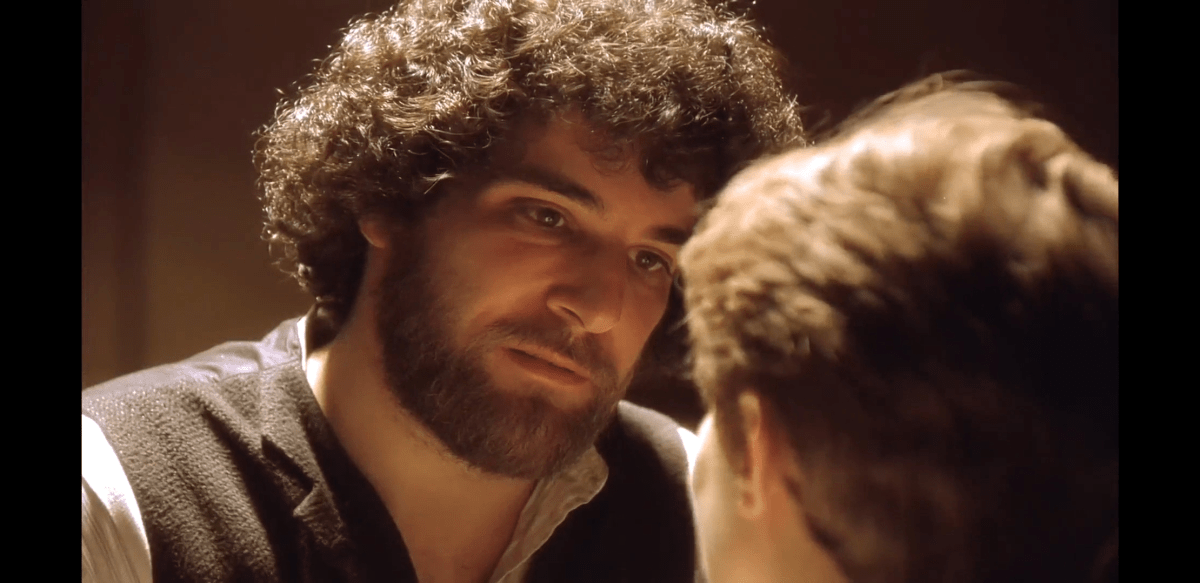
Continuing with what works, we have Tony-winning actor Mandy Patinkin in his first film. Streisand reports a lot of problems with him, both due to personality conflicts, his attitude, and his making the often-difficult transition from stage to film acting. She originally wanted Richard Gere, partly for his looks. But Patinkin was Jewish, looked right for the part, and was excellent in the role. He was strong, funny, angry, hurt, excited, and in love at all the right moments. Streisand apparently had to work with him to introduce stillness into his performance and to forego theatrical mannerisms, and to her great credit, she clearly succeeded. In spite of Streisand’s overwhelming presence in the film, Patinkin gives the better performance
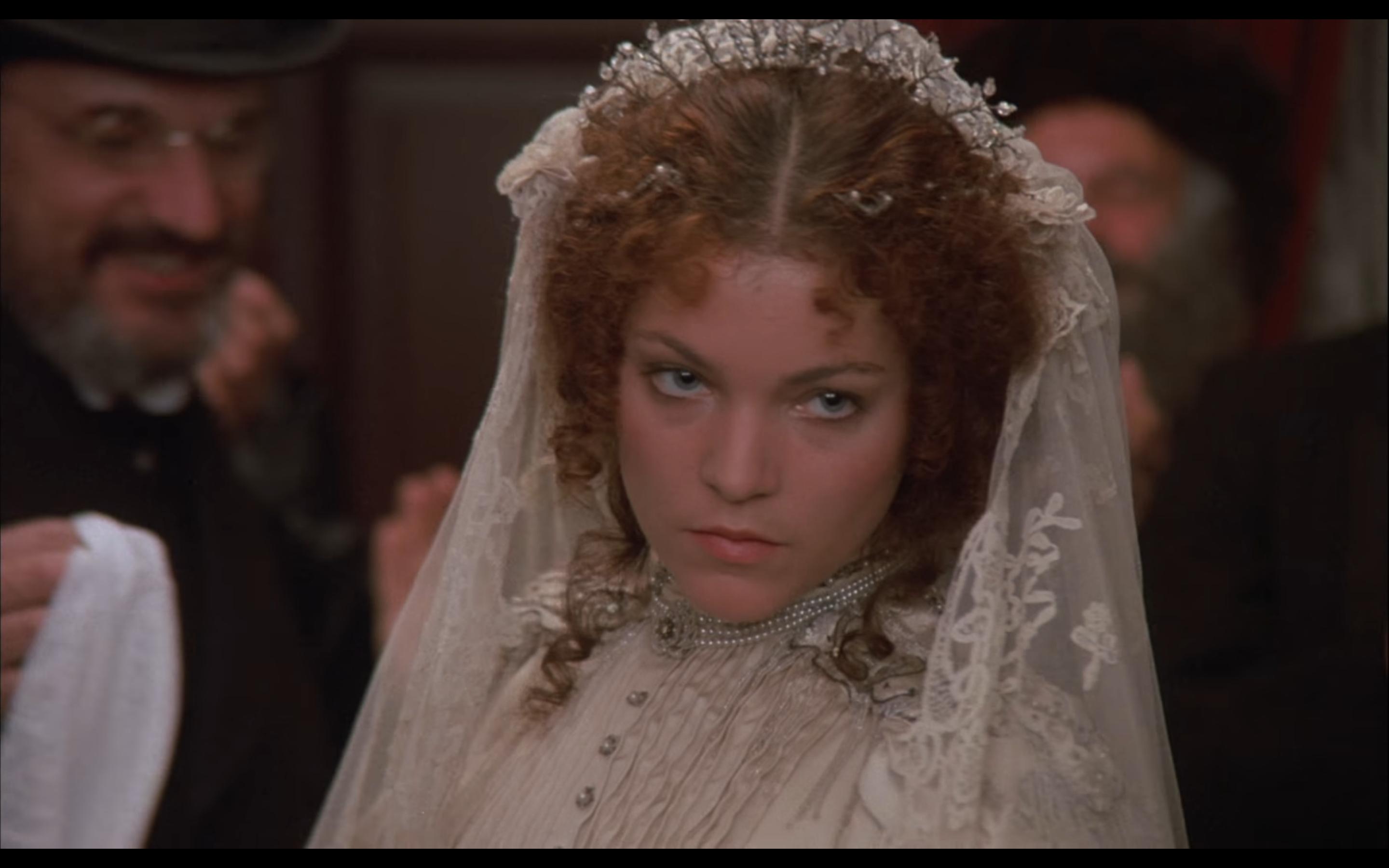
Amy Irving has the responsibility of looking softly beautiful and acting genuinely sweet à la Melanie in Gone with Wind. She succeeds on both fronts.
Then there are the difficulties: the script/story and the central performance. Streisand and co-writer Jack Rosenthal veered away from the more realistic but downbeat story of Singer’s tale and turned it into a feminist manifesto. Yes, the story is of a young woman who wants to read but can’t because her Jewish culture only gave that privilege to men, and therefore she dresses like a man and pretends. The genuine pathos of that is unfortunately driven into the ground by the unsubtle repetition of that major dilemma, making us connect more closely with Patinkin’s character as he gets his fill of Yentl’s ceaseless questioning and challenging. Nuance, and therefore deep pathos, are sacrificed as we are told, endlessly, what’s wrong and why it should change.
Also, and most regrettably, the ending has the central character embracing her identity as a woman and going to America!, where women are free to read. So instead of a moving, focused, perhaps sad story of a woman torn by culture who faces an uncertain future, we are given a girl-power, find-my-true-self, I-am-woman-hear-me-roar filmic manifesto. That may have been fresh in 1983….
Plus, that closing sequence, essentially a complete repeat of the ending of her first film, Funny Girl, just nails that ‘80s female empowerment story trajectory down. Streisand/Yentl (at this point, there is no distinction) is on a boat, singing her guts (if not her heart) out and proving once more that she is one of the great singers of her generation and can hold out a note like nobody’s business. And that’s just indicative of one of the film’s biggest problems, and that is Streisand’s performance. One is tempted to say that she should have either acted or directed, but not both. I would agree with that, but that thought is relegated to the dustbin of “if only”.
There is a full, luscious, and romantic score by Michel Legrand (winning the only Oscar for the film, plus previous Oscars for the score of Summer of ’42 and the song “Windmills of Your Mind” from 1969’s The Thomas Crown Affair. (Lyrics for all three wins were by Alan Bergman and Marilyn Bergman.) There is a certain sameness to the various songs, but they are by the same composer, and arranged in a specific unvarying style, and sung in a uniform style by Streisand.
That’s where some of the head-spinning comes from. Streisand has a glorious voice, but it stays unchangingly beautiful throughout and that beautiful voice seems to determine more than it should. It doesn’t bend to the character or the situation as much as it bends to the ideal of the perfect Streisand vocal performance. Yes, she acts in each song to a point, but the lovely voice and stunning vocal interpretation take precedence; the acting is subservient to the gorgeous sounds we’re hearing. With few exceptions (“No Wonder” being the great exception) we rarely experience anything but perfect and lovely singing, and we’re left less affected by the story or the character as much as by the impression that, darn, that girl can sing!!
Then there’s her performance. Yentl is a fable, which can account for a young-looking 40-year-old female getting away with acting like a man two decades her junior. That smooth face, those beautiful nails on her hands, that voice that in spite of a few seconds of her trying to speech in a lower pitch, still sounds like a young girl—they all are something we and the film’s characters are expected to accept as a version of manhood. When Yentl gets emotional, or even when she doesn’t, she sounds like no male on earth.

But even with accepting the fairy-tale aspect of the story, we have an uneven central performance. Streisand’s vocals and her intensity when acting can cover a multitude of thespian missteps, which are so constant throughout the film that it is easy to just accept them or ignore them. Streisand is a legendarily self-focused performer, and when she’s acting, she’s acting—one can see it. We see the work, the focus, the dedication. But then there are moments when she is obviously not paying attention to what she’s doing, and some grace notes appear. Usually they are when she is unselfconsciously reacting to someone else, and we get a glimpse of what the performance might have been if directed by someone who could have challenged her to let go and accept someone else’s direction.
Then there is the actual character of Yentl, or Anshel, which is Yentl’s “undercover” name. Must as she might have tried, Streisand seemed unable to shake off the American Yiddish mannerisms that worked so well in Funny Girl, and instead comes across as Sadie from Brooklyn far too often. Instead of Singer’s “Yentl, the Yeshiva Boy” (the original story’s title), we far too often have “Rose the Borsch Belt Comedienne.” The Fanny Brice intonations are so threaded into the performance that there is no escaping them, and we can become inured to them. But that doesn’t make them right for the part.
Perhaps because I am a singer and work with singers and actors to get the best performances from them, I am more sensitive to elements of singing and acting that don’t work for a play or film. Streisand’s performances as singer and actor are powerful and engaging, but they are to the detriment of a film that in all other ways is a handsome picture with some good performances. And finally, and simply, it has some of the best singing that, while not always appropriate in context, is some of the most entrancing you’ll ever hear.


 Film stuff by Mark