
Remakes have a reputation of being inferior to the original. That’s not always true; there are many good-to-great films that are remakes. Some of the best include:
The Maltese Falcon ((1941), a remake of the 1931 film of the same name and Satan Met a Lady in (1936).
His Girl Friday (1940), a gender-swapping remake of The Front Page (1932).
True Grit (2010) vastly improved on the 1969 version.
Some Like It Hot is an American comedy classic based on the 1951 French film Fanfare d’Amour.
We can argue about all the strengths or weaknesses of the various versions of The Ten Commandments, Ben-Hur, The Fly, Invasion of the Body Snatchers, Love Affair, The Blob, A Star is Born, Hitchcock’s two films of The Man Who Knew Too Much, The Thomas Crown Affair, the Oceans 11 films, and The Departed/ Infernal Affairs. Nostalgia can make us think that the older film is better sometimes, until we give it another viewing. And some remakes take advantage of greater advances in color, sound, editing, or special effect.
Recently, talented director Spike Lee has made an unfortunately remake of a classic, and the second film doesn’t just pale in comparison, but raises the question: “What the heck was he thinking…?
- Why did he even decide to do a remake of a near-perfect classic in the first place?
- What series of “update” decisions led to such a weak and uneven film?
- Why did the change from Japan to Manhattan result in such a series of messes?
- Where did the power and elegance of the first film go?
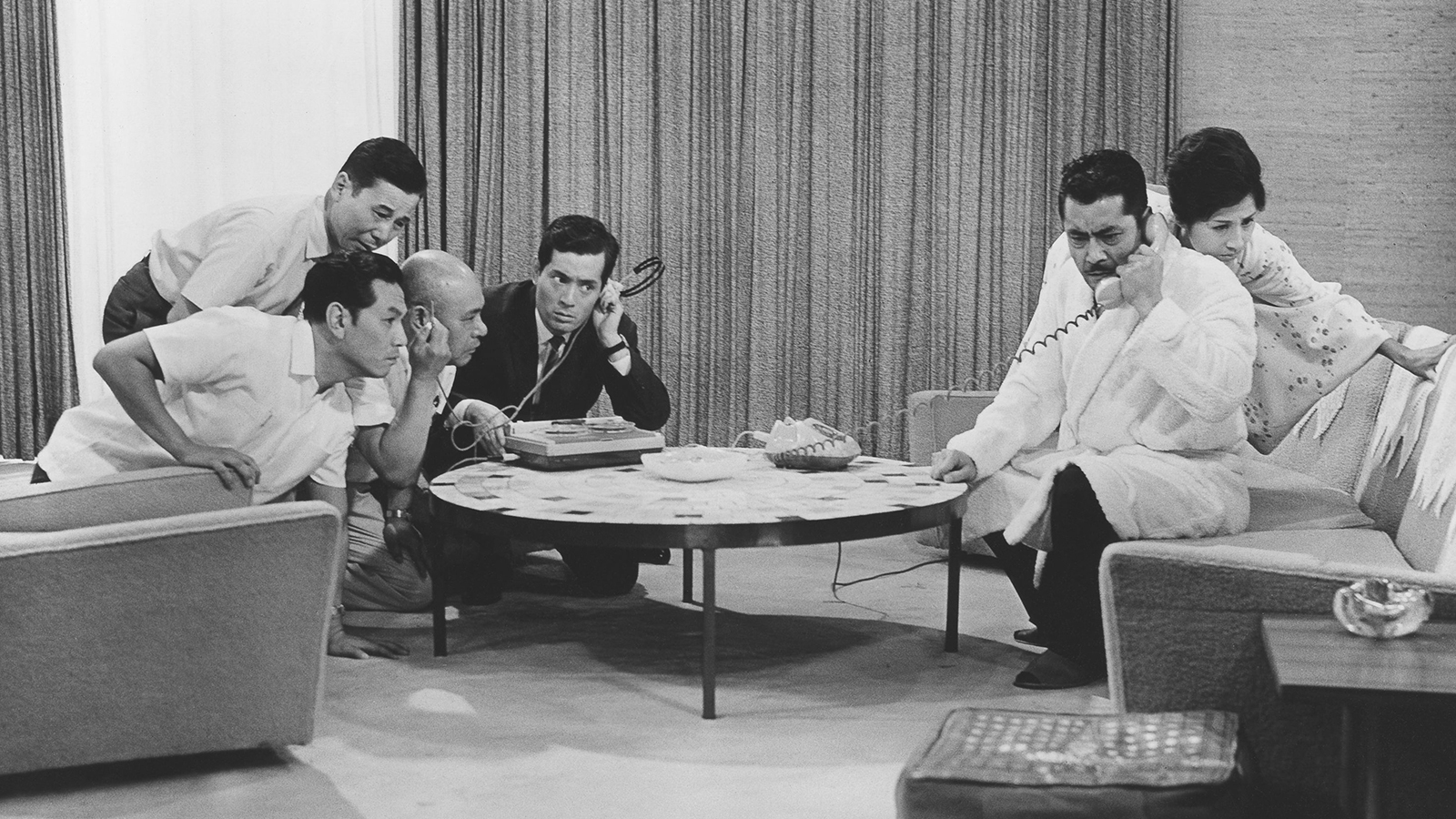
The films are 2025’s Highest 2 Lowest with Denzel Washington and Jeffrey Wright, and 1963’s High and Low, the landmark Japanese thriller directed by Akira Kurosawa and starring the legendary Toshirô Mifune and Yutaka Sada.
High and Low is one of Kurosawa’s masterpieces. The story is powerful, the tension is tight and unspools deliberately ratcheting like a slowly turning screw, the acting is consistently excellent, and the cinematography is a masterclass in how to deal with the wide screen. Mifune plays a wealthy shoe businessman whose son gets kidnapped, and then the film pivots dramatically. That quick twist kicks off the film’s unrelenting tension and sets the stage for the social commentary that runs throughout. (For those familiar with Parasite, many of the elements are similar.)
Mifune, Kurosawa’s favorite lead actor, is a kind of performer unconnected to any timeframe. After seeing him in many films set in the deep past (Rashôman, Seven Samurai, Yojimbo, Throne of Blood), it can almost be disconcerting at first to see him in a modern film playing a modern character. While everyone around him is very much early 1960s, Mifune is that as well but is also a transcendent presence that fills the screen even when he isn’t in the film, which is surprisingly much of the time. This is star power on the order of Tom Cruise crossed with Liam Neeson crossed with Samuel L. Jackson, and then some. Think Marlon Brando in The Godfather.
The film takes several different directions, but never loses its flow or impact. The “high” of course is the upper-class world of rich businessmen who live in expensive apartments on the top floor. Gondô (Mifune) has a subservient and intelligent wife and a submissive chauffeur. He is used to things going his way, and he can barely imagine that what he orders won’t get done. He’s on the verge of a major business deal (perhaps coup is the more accurate word) when the kidnapping occurs and he has to respond to the kidnapper’s demands. Then the twist changes everything, and the film opens a world of tensions between heart and mind, husband and wife, man and underlings, socio-economic realities, and the dark and light of the human heart. And it does these all at once.
That struck me most this time was Kurosawa’s use of mise-en-scene. This is a very wide-screen film at a ratio of 2.35 to 1, and his ability to move folks around in the frame is virtuosic. The entire film is a kind of cinematic visual opera. The spare music in the soundtrack is of its time, but not overdone or out of place by today’s standards. For those enjoying a great suspense story, and can handle the Japanese subtitles, this is a joy to watch. For those more intently interested in filmic form, it’s a joy and a masterclass.
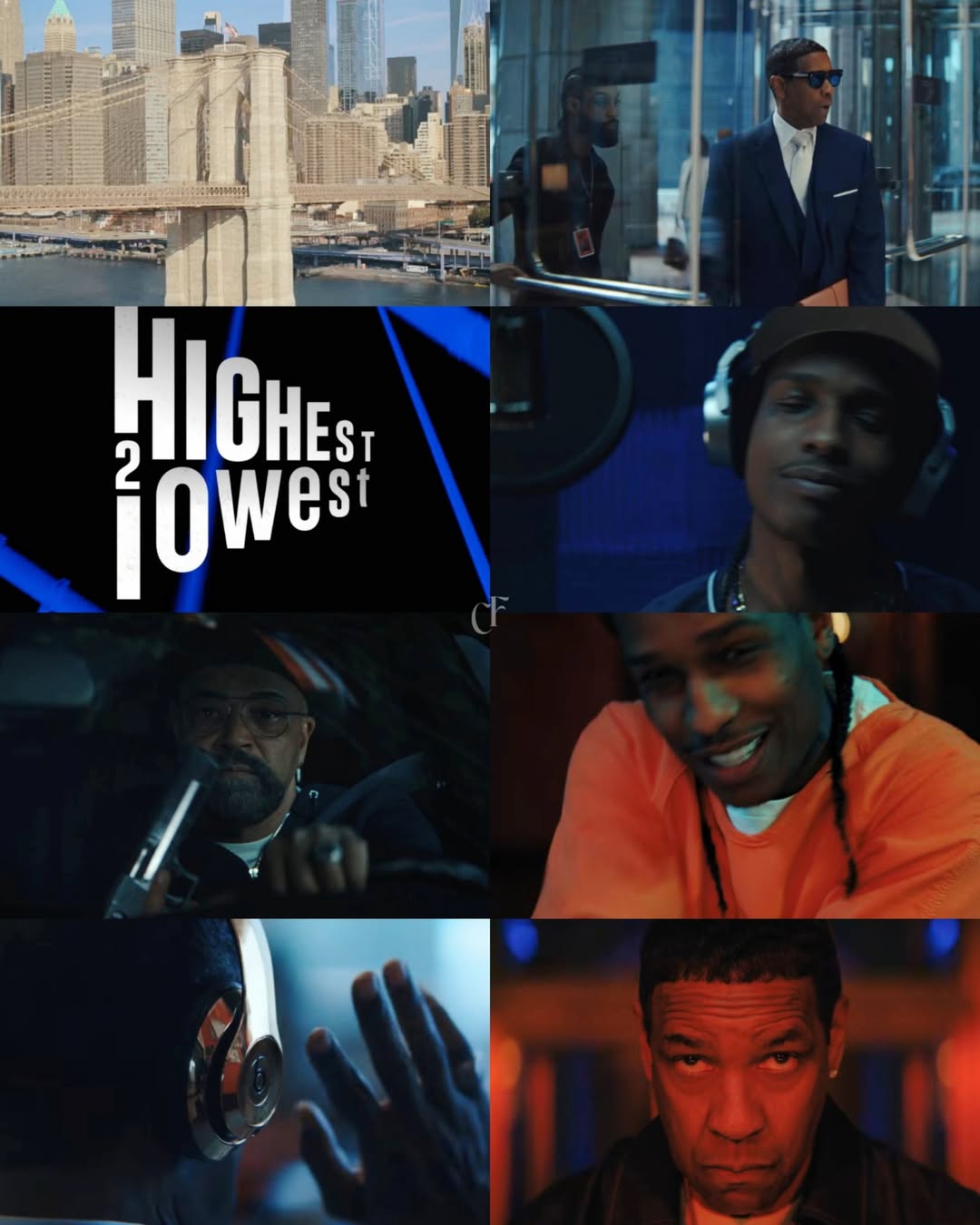
Not so with Highest 2 Lowest. In fact, the “2” is a symbol of much of what’s wrong with the film. The number is a tribute to Prince, and it signal to where Lee went wrong. The bones of the plot of the story are there, but few other elements of the 1963 film are there. Yes, Denzel plays the rich businessman (David King), but here, instead of shoes (Mifune’s character’s business), we have Denzel shoehorned into the role of a music entrepreneur (think Sean Combs /Diddy or Jay-Z, neither of which work well right now as models). Kurosawa spent a short amount of time extolling the virtues of his lead’s dedication to a well-made product, and having established that, we don’t revisit shoes.
Unfortunately, once on this music path, Lee keeps going awry. Of course, Denzel can do pretty much anything, but this characterization isn’t a good fit. Washington can play ghetto in fits and starts, but in the long run, that doesn’t work. Gondô (Mifune) is believable throughout, as an expert in his field, as a loving father and husband (though with a typically Japanese subservient wife, as a ruthless businessman, and has a man with an eventual conscience. His powerful presence at the start of that film keeps us wondering for a while what he is going to do in facing his various dilemmas.
We never really question Washington, who is simply too decent to wear the selfish/bad-guy aspect of his character. (That’s another article for another time.) He, like Gondô, eventually comes around to doing the right thing (yes, I had to go there). But we don’t get to visit the fierce sense of stubbornness, selfishness, and offended pride that we get from Mifune.
Moving away from Kurosawa’s stunning black-and-white photography, we’re introduced into a world of bright colors and loud music, which eventually (and ironically for a film about a music mogul) becomes leads to one of the most irritating and annoying soundscapes in modern history. Seemed like a good start, as of course we all expect a strong soundscape and bright color palette in a film taking place in modern Manhattan. And it sure seemed like a good start…
Instead of homing in on the thriller and suspenseful elements of the original film, which adapt as the plot evolves but which never relents as gears shift. In Highest 2 Lowest, we have so many unnecessary and bizarre distractions that the energy of the original plot consistently gets lost. I get that Lee loves New York (and I get that, having lived there for seven years), but where Kurosawa really gets into the “low” of the locale and the social strata (making for strong social and human commentary), Lee can’t seem to get there. He is too distracted by visiting areas that become draining side trips. The worst by far is the action set-piece (if it can be dignified by such a term) that takes us through far too many streets of Manhattan, too many of which are the locale of a Puerto Rican music festival (again, the music is a fatal distraction). To add confusion to distraction, the festival introduces us to Rosie Perez—yes, the real actress, who of course got her start in 1989’s Do the Right Thing, a distracting fact in itself…and Anthony Ramos of Hamilton fame. This doesn’t celebrate this music and these two talented actors as much as turn them into diverting elements—and diverting not in a good way. They and the music deserve better.
The trajectory of the original film demonstrated the high to low in a way that the remake barely acknowledges. High and Low has an open-wide, breathing mise-en-scene in the beginning and then gradually moves to a more kinetic one filled with moving camerawork, tighter shots and quicker edits as we move to the underworld of the kidnapper/s. It’s a great example of how to present contrast. Highest 2 Lowest, by contrast, is all over the place, with inconsistent pacing and an ironically bumpy rhythm for a film about music. Virtually nothing about the casting is believable, the story loses its way and its intensity too many times to count, and the role of music is erratic at best. And then there is that coda. The 1963 film was supposed to end with more of a Psycho-like explanation of the bad guy’s behavior, but Kurosawa chose to have a devasting conversation between Gondô and the kidnapper end with a literal, devastating bang. The newer film has a similar conversation that is way too long (again, losing its much-needed intensity) and sets up a clash between a music wannabe and a successful mogul that pales in comparison to the resounding high/low clash of the original.
And then there is Jeffrey Wright, perhaps best known for HBO’s “Westworld” and American Fiction (2024), for which he was nominated for Best Actor. (Spoiler alert ahead) Wright plays Denzel’s character’s chauffeur, and it is his son that is wrongly) kidnapped. The original film had the same chauffeur role (played by Yutaka Sada), but the role of class and honor that was in the original are lost in the remake. Sada played a family servant well aware of his lower strata in society, and in some ways, didn’t automatically assume that his boss would come through with the money. His anguish is all the more potent because he is usually very quiet and submissive, making his outbursts unexpected and powerful. He is something of a weak man, but this is a combination of social place, the job, and the quiet deferential nature of his position. Jeffrey Wright, on the other hand, doesn’t quite know what to do with such a role, though he is clearly giving it everything he has to make it work. He’s by nature a strong man, a man of influence, and the balance with the main character is off. The modernizing of that character is half-hearted, making for a performance and a dynamic with Washington that ultimately doesn’t work.
Then there’s that coda. OMGosh. High and Low made it clear that the protagonist was ultimately be OK, and that he would continue his work with a new company and new approach. Normally, I prefer “show me” over “tell me”. The earlier film let us know verbally and succinctly what was going to happen, and then gave place to that impassioned exchange that brought the film to a powerful if disconcerting climax.
Instead, Highest 2 Lowest decides to give us an after-ending following elongated, enervated conversation that spends far too much time showing us that the “best years in the business guy” had a future. We see that his son has learned a good deal of the business and is presenting a new performer to his dad for a possible place on his label. So instead of just enough to make the point, we get THE WHOLE SONG. As a musician, I was delighted to hear a wonderful new voice that has flavors of Mariah Carey and Whitney Houston. But instead of it being used to further the plot, we hear the WHOLE DARN SONG. To compound that problem, the song moves from a simple accompaniment by the pianist in the scene to a puzzling and awkward invastion of a non-diegetic background accompaniment full of other instruments that come out of nowhere. That just confuses things: Where did that come from, why is this turning into a AGT audition, and what happened to the realism of the rest of the film? It’s not just an unwanted and unneeded end to a film that didn’t need another stumble—it’s simply bizarre. Finally, that focus on the music is the problem.
Bottom line: Ignore the newer film and check out High and Low where you can find it. Get comfortable with the subtitles and you’ll be in for a ride that combines an exciting, even thrilling story that also happens to be a work of art.


 Film stuff by Mark