
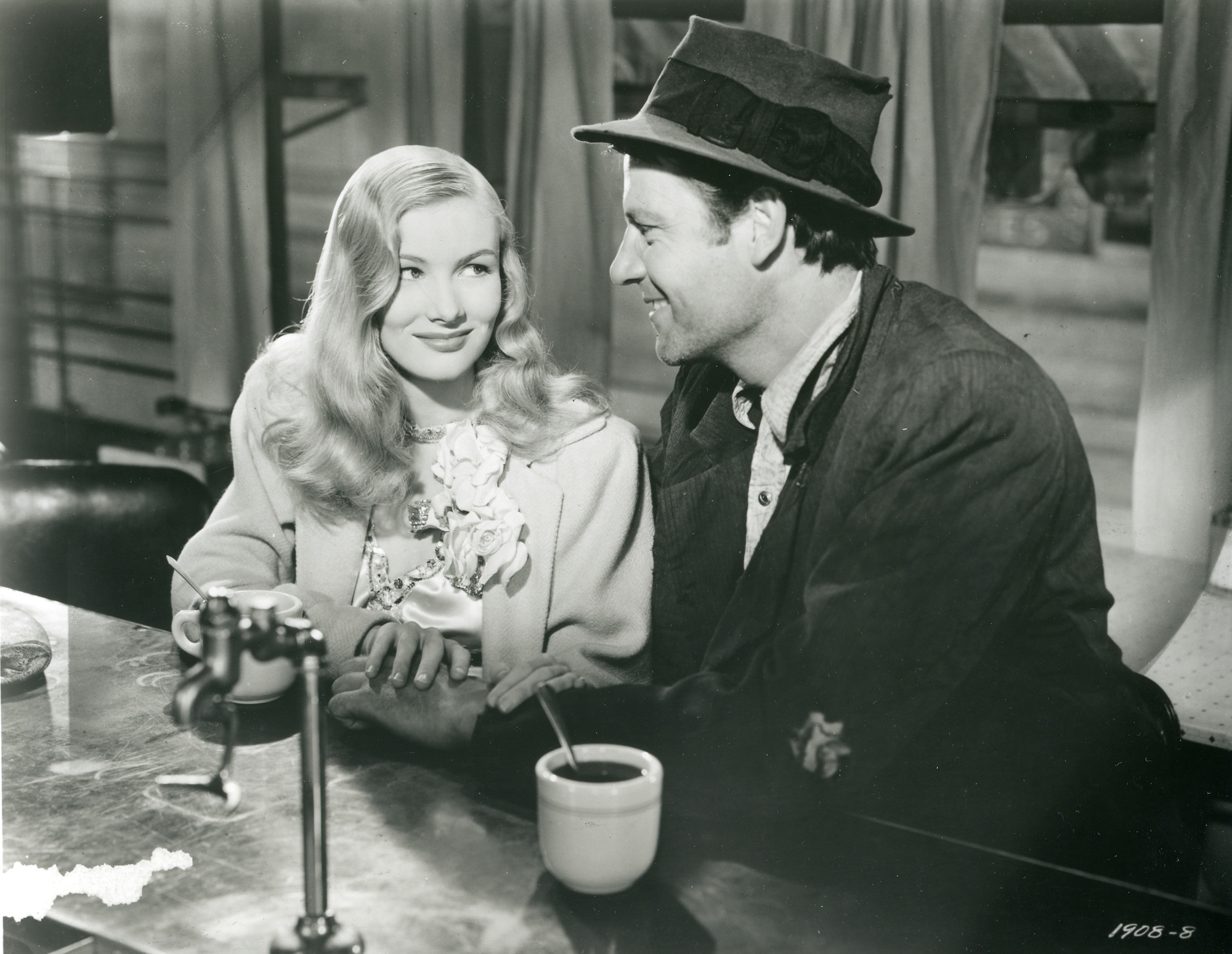
Sullivan’s Travels is considered the masterpiece of Preston Sturges, the playwright and screenwriter who turned director to protect his scripts. His debut directorial effort, The Great McGinty (1940) won him a Best Writing, Original Screenplay Oscar, which shows up in a blink-and-you’ll-miss-it moments in Sullivan’s Travels.
The story of Sullivan’s Travels is simple and profound. John Sullivan, a successful Hollywood director (Joel McCrea), wants to leave his light comedies behind to make a socially “important” film about the condition of man, labor, etc. To prepare himself, he goes on the road as a hobo, but encounters a large variety of problems with that decision. Along the way he meets and connects with Veronica Lake, who pretends to be a man to go along with him. Note: The film never really pursues that line and we just accept that this is not a problem. At this point the film is a cousin to It Happened One Night (with director Frank Capra mentioned earlier by name).
What’s surprising is the serious turn the film takes (spoiler alert) when it looks like his efforts have hit what he thinks of as bottom. Here it leaves any resemblance to It Happened One Night. Instead, the film becomes dark and foreboding as it goes on, and Sullivan faces real prejudice, violence, and personal harm as he gets into a situation he couldn’t have imagined. But this is ultimately a fable, and of course everything eventually turns out for the good. In one was, the story is only the central line on which Sturges hangs his biting, cynical, and funny dialogue. It’s very modern in both its cynicism and quick wittedness. The editing also works well to keep the humor biting and the film moving along with energy.
Part of Sturges’s cynicism is his use of classical music, which is often dumbed down in terms of its arrangement, perhaps as a way of skewering the upper crust. Beethoven’s third movement of his Moonlight Sonata, for instance, becomes an orchestral fight scene. Mendelssohn’s Spring Song is used fully tongue in cheek at a rare quiet moment, and Rossini’s William Tell Overture and Wagner’s Ride of the Valkyries are used as action background music, but with a satiric twist to them all—nothing akin to Apocalypse Now or 2001: A Space Odyssey here.
Perhaps the element of the film that ages the least—and was a major criticism of Sturges’s films in general, is his overuse of slapstick. It seemed odd then and seems odd now that a man of such profound ideas and biting commentary would fall back so regularly on slapstick. Slapstick of course undercuts what is happening on the screen, and skewering seriousness was Sturges’s thing, but the film occasionally gets stilly instead of satiric and these scenes can be distracting at times.
Yet Sturges manages to include some deep and meaningful social criticism, as well as some touching humanistic shifts in the plot. One rare element of this is the respect for evangelical outreaches. The first is somewhat satirically presented, but the group’s good work is clearly respected. The second time, we have an all-black ministry that is given the greatest amount of respect as well as demonstrating an understanding of the racial prejudice of the time. These are beautiful moments and lead to the final revelation for Sullivan.
What he comes to learn is that comedy is valuable, and desperately needed, especially in times of trouble. This of course was a defense for all Sturges’s work, but also becomes perhaps the greatest cinematic call for the high place and significance of comedy in our individual and corporate lives.
The film takes twists and turns but is ultimately a clarion call to social understanding while promoting comedy for the healing and unifying force it can be. And all with a modern fast pace and some of the sharpest dialogue of any era.


