This film analysis/review will be in two parts to give me an opportunity to respond fully.
First, the film as a film:
Cabrini is the story of the first American Catholic saint, Mother Francesca Xavier Cabrini, the Italian immigrant who came to America to help the poor and homeless, with a special focus on children. It’s a story of a remarkable woman who fought against every kind of prejudice present—anti-Catholic sentiment, anti-immigrant sentiment, anti-Italian sentiment, and of course, sexism—after all, this is New York City in the late 1800s. The film is from director Alejandro Monteverde, the director of the surprise hit Sound of Freedom and Bella, and is a solid piece of filmmaking, if not a bit stylized for the subject manner.
The central performance by Christiana Dell’Anna is impressive. Her Cabrini is equal parts emotionally strong, feisty, and a sweet spot somewhere between determined and disrespectful. With all the obstacles set before her, not the least of which is her weak constitution, her character manages to work with a pope, bishops, and government leaders to achieve her lofty goals.
The look and sound of the film seem to want to reach to the heights of Cabrini’s story, with all its power and magnificence. But the music is far too loud and grandiose in the beginning, and if the purpose of the film was to lead the viewer to prayer, it succeeded. I prayed it would soon let up, which it did. But then it came back a bit too often, and a bit too strongly.
The cinematography was also curious. I tend of think of Italian camerawork as moving, prowling, able to back up and press in as the subject and filmmaker demand (I’m thinking of Vittoria Storaro and Giuseppe Rotunno). But at times I felt as if I were watching a Dreyer or Bergman film. The use of frontality and the placing of a scene’s main character dead in the middle kept this fast-moving tale a bit too rooted and sedentary, especially for someone so very much on the move. It reminded me of an Agony and the Ecstasy or A Man for all Seasons approach to the central personage—far too respectful and epic an approach for such a down-to-earth and “troublesome” woman.
The production design and costumes were PG-grungy, but more suggested the grit, grime, and depravity than even indirectly showing it. It looked real enough, but just didn’t feel real enough.
Stars John Lithgow and David Morse (you know who he is and will recognize him right away) make their appearance for the North American market. But Giancarlo Giannini (Best Actor Oscar nomination for 1977’s Seven Beauties) as Pope Leo XIII? Seems an odd choice for those that remember his work and persona way back when. But work is work, and he does a very good job.
All in all, Cabrini is the story of overcoming adversity and layers of obstacles to do a great work of service. For better or for worse (see rest of the analysis below), Cabrini presents the stirring story of a survivor and relentless advocate for the young and poor who achieves her dream through fortitude, intelligence, savvy, and courage. On this level, it’s deeply inspiring.
Second, the film as a Christian or “faith-based” film:
Cabrini was executive produced by J. Eustace Wolfington, a Philadelphia businessman and Catholic philanthropist, and distributed by Angel Studios, which began as VidAngel and is now known more as the distributor of The Chosen and Sound of Freedom, among other “faith-based” fare. As written above, it’s a story of courage, strength, vision, and overcoming adversity. But I can’t completely call it a faith-based film.
In my definition, a true faith-based film has its real hero God, or Jesus specifically, or at least, expressed Christian faith. Yes, Mother Cabrini is deeply and historically Catholic, but we don’t get insight into her faith. She quotes Scripture once, with a large pause in between the two halves of the verse (Philippians 4: 13): “[We] can do all things…(sizable pause here)…through Christ who strengthens us.” It’s a great Bible quote, but the film leans on the side of the “doing all things” rather than the One who gives them the strength to fulfill their calling. On the more positive side, something of faith can be inferred when she encourages various people to take the first step and the resources will follow: “Begin the mission and the means will come.” Where I received that as an expression of faith, it could unfortunately also be taken as a general philosophy having nothing to do with God, à la “the universe is telling me…”, etc.
We don’t see her pray, though my guess is that her life was filled with prayer. Instead, we are constantly encouraged to look to her guts, her determination, and her political savvy as the reasons for her success.
In terms of the gospel message of salvation through faith in Christ, we have perhaps the biggest missed opportunity in a recent film when a repentant prostitute says that there isn’t enough water in the world to make her clean. What I hoped/expected to hear was that the blood of Christ/the cross of Christ/the sacrifice of Christ was enough to wash away her sins. Instead, we hear Cabrini tell her that she is strong and a survivor. A major whiff right there, and a major miss of an opportunity to share the gospel. As the scriptures make clear, good works should follow our faith. Mother Cabrini might have had a rock-solid faith in Christ’s love for her and sacrifice for her sins. But we wouldn’t know that from this film. We see the expression of good works, but the film credits her fortitude, attitude, and aptitude.
The Cabrini of the Cabrini film is a hero, a visionary—“The world is not big enough for what I intend to do”, a proto-feminist, a powerhouse, and a founder of a great world-wide mission. If great good works and social involvements led to salvation, this could be considered a Christian film. But in spite of the distribution by Angel Studios, the true gospel is not really presented here, even by implication. Instead of what we’ve come to call a Christian or “faith-based” film in the current definition, Cabrini is a religious film about an extraordinary woman, but one that exalts a person instead of Christ.
HOLLYWOOD, CALIFORNIA – MARCH 10: Christopher Nolan, winner of the Best Directing award and the Best Picture award for “Oppenheimer”, poses in the press room during the 96th Annual Academy Awards at Ovation Hollywood on March 10, 2024 in Hollywood, California. (Photo by Arturo Holmes/Getty Images
I would have thought that a week after the Oscars, there would be nothing left to remember of the ceremony. No real streaker (though we had an imitation one from John Cena), no wrong Best Picture announcement, and especially no “slap heard ‘round the world” with the MC and the guy about to win Best Actor.
All in all, it was a relatively low-key affair with only a couple of real surprises—one major and one minor. The minor one was the win for Best Sound by The Zone of Interest, which also won Best International Feature Film. That award was predicted by most to go to Oppenheimer, whose use of sound was an experience only Christopher Nolan’s team could have presented. Perhaps it would have won in the “Most Sound” category, if there were one. But sound in The Zone of Interest is a whole other chilling aspect of the film (an aspect of the film which I will leave alone to those looking to see—and experience—that film).
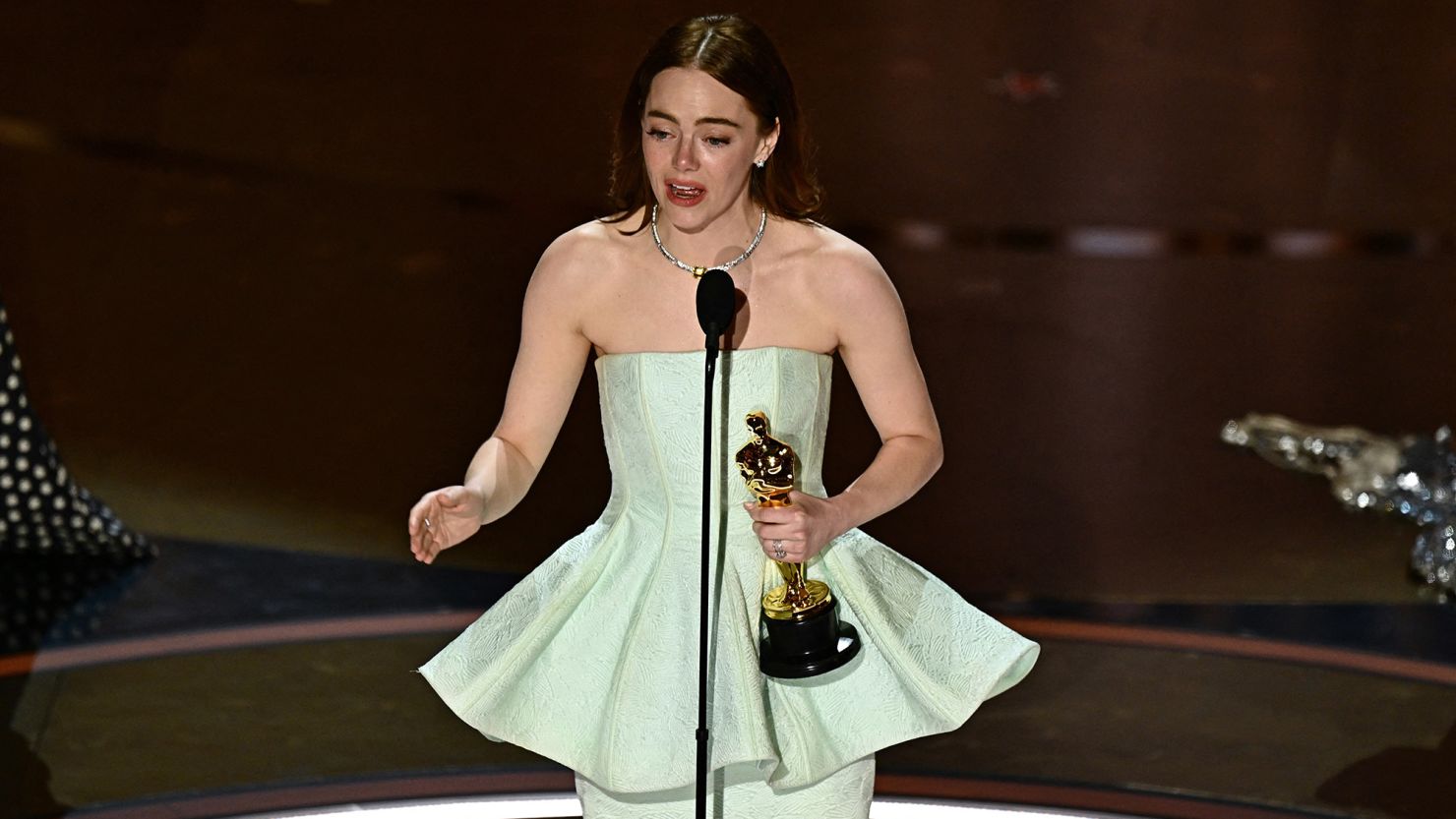
The big surprise of the evening was Emma Stone’s win for Best Actress for Poor Things, which nearly everyone, including obviously Stone herself—assumed was going to go to Lily Gladstone for Killers of the Flower Moon (which, with 10 nominations, went home empty-handed.) Stone’s shock and joy at the announcement of her win were fun to watch, and provided a big shot of energy and authenticity to an otherwise slightly lackluster evening. In fact, the love for Poor Things was something I thought I saw coming, but only in a distance, and not enough to affect the awards. I was wrong. In addition to Stone’s win, the film won Best Make-up and Hairstyling, which was thought to go to Maestro. It also won two awards that many thought would go to Barbie: Best Costume Design and Best Production Design.
The big winner, of course, was the deserving Oppenheimer, which won Best Picture, Best Director (Christopher Nolan), Best Actor (Cillian Murphy, the first Irish actor to win in this category), Best Supporting Actor (Robert Downey, Jr.), Best Cinematography, Best Original Score, and Best Film Editing. I always thought that Nolan would eventually win Best Director and possibly Best Film if he upped the human aspect of his films, allowed a little emotion to creep in, and pulled back on the cerebral. He made moves in that direction with Dunkirk, but really hit his sweet spot with Oppenheimer.
Host Jimmy Kimmel is not my favorite television personality, but I was impressed by much of his opening, which was gracious and hit the proper note of celebration. Then he went for the low-lying political fruit jokes, and slightly soiled the evening. The presenters were mostly fine, if not great. But the spontaneous banter should be left to the comic greats, and while the teleprompter lines were boring and milquetoast-y, at least they had a semblance of sense and order, and should have been stuck to more often.
The lowlight of the evening were the controversial statements made by The Zone of Interest director Jonathan Glazer bemoaning the current Israeli-Hamas in terms that have become justifiably controversial. Apparently, hundreds of folks in the film industry have formally objected to his (ultimately) Hamas-supporting statement. In a related side story, some attendees wore red pins, which were a call for a cease-fire. The most famous duo who wore the red pins were the naïve but brilliantly talented Billie Eilish and her brother Finneas O’Connell, who deservedly won Barbie’s only Oscar for their song “What Was I Made For?”, which they delivered beautifully in a live performance. The other most famous red-pinner was unsurprisingly, Hollywood’s current great contrarian Mark Ruffalo. (I’m sorry—did I just inject a political opinion in an article discussing the celebration of an art form? I can’t imagine anyone wanting to make a virtue-signaling personal political statement when they are supposed to be saluting artistic cinematic achievements…I mean, who would do that?)
A consistent disappointment these days is the otherwise touching In Memoriam segment. Instead of just giving us the names in a clear close-up series of images with a musical background, we had another visually distracting musical presentation, this one aggravated by an even more distracting dance moves by a small crowd. Less is more, people.
The awarding of Best Picture was the best argument yet for letting the award be given by someone under 80. Yes, Al Pacino is a legend, but his presentation was bumbling and embarrassing. Either he was coached wrongly, wasn’t coached at all, or the coaching didn’t stick. Either way—discomfiting.
The highlight of the evening was Ryan Gosling’s performance of “I’m Just Ken.” For someone not a professional singer or dancer, he really pulled it off in the most exhilarating moment of the evening. I have respected him as an actor since Murder by Numbers (2002), and my respect for him peaked with his performance in Barbie and on the Oscar stage. For a deeply talented (and generally serious dramatic) actor to put his ego and persona aside to give everything to a number like this makes it a number for the ages. It was as memorable as Will Smith’s slap of Chris Rock, but for opposite, happy reasons.
Final thoughts:
I’m glad Nolan has found recognition as well as success. He is one of the great ones, for several reasons.
It was nice to see Robert Downey, Jr. praise his wife for her loyalty to him and her major role in the restoration of his life and career.
This year’s Oscar show is likely to be a snooze fest. There might be a surprise here and there, but most folks feel that the awards are already set in stoneSo in the interest of time, and with the reality that I don’t much of that time, here are my thoughts in a Cliff Notes fashion—meaning I’m not listing all the nominees, but just putting my predictions and associated thoughts out there.
Best Picture
Oppenheimer
Best Director
Christopher Nolan, Oppenheimer
Best Actress
Lily Gladstone, Killers of the Flower Moon
(Possible upset person: Emma Stone, Poor Things)
(Note: Natalie Portman should be on this list for May December.)
Best Actor
Cillian Murphy, Oppenheimer
(Possible upset person: Paul Giamatti, The Holdovers—please, God no. I love Giamatti, but not this year and not for this performance.)
Best Supporting Actress
Da’Vine Joy Randolph, The Holdovers
Best Supporting Actor
Robert Downey, Jr., Oppenheimer
(Possible upset person: Ryan Gosling, Barbie)
Best Animated Film
Spider-Man: Across the Spider-verse
(Possible upset film: The Boy and the Heron)
Best Cinematography
Hoyte van Hoytema, Oppenheimer
Best Costume Design
Jacqueline Durran, Barbie
Best Film Editing
Oppenheimer
Best Production Design
Poor Things
(Possible upset film: Barbie)
Best Score
Oppenheimer
(Possible but unlikely upset film: Killers of the Flower Moon)
Best Song
“What Was I Made For?”, Barbie
Written by Billie Eilish and Finneas O’Connell
Note: This will be the second Oscar win for the pair, after 2022’s “No Time to Die”. Billie is all of 22 years old. Expect that this Oscar will not be her last.
(The “God help us” possible upset song: “I’m Just Ken,” which probably provided the silliest and most fun moment of the film, but which doesn’t come close to “What Was I Made For?” as a piece of music. Let’s hope the Academy doesn’t do a “Talk to the Animals” here.)
Best Sound
Oppenheimer
Best Documentary Feature Film
20 Days in Mariupol
Best Adapted Screenplay
American Fiction
(Note: The Academy wants to recognize this film, and this category gives them a legitimate opportunity.)
Best Original Screenplay
Anatomy of a Fall
(See note immediately above, especially since the Best International Film winner will NOT be Anatomy of a Fall).
Best Visual Effects
Godzilla Minus One
Note: I don’t understand this one, as I don’t think it should even have been nominated. But it was a surprise hit, so there’s that….
Best Makeup and Hairstyling
Maestro
Note: For several reasons, the Academy doesn’t like/doesn’t get this film, but this category provides a legit reason to award something to it.)
Best International Film
The Zone of Interest
Best Animated Short
“WAR IS OVER” Inspired by the Music of John and Yoko
(Note: See title for why this will win.)
Best Documentary Short
The ABC’s of Book Banning
(Note: See title for why this will win. It will also be the one film to scratch the itch of current political correctness, so desperately desired by the Academy for their yearly virtue signaling.)
Best Live Action Short
The Wonderful Story of Henry Sugar
Final note: This has been a surprisingly rich year for films. Many will be classics, and many that didn’t get nominations, or did and will lose, will be looked at closely and reevaluated in the future: MayDecember’s three central performances; what Carrie Mulligan does in Maestro (nominated) and Margot Robbie in Barbie (not nominated): Greta Gerwig’s accomplishments with Barbie, Leonardo DiCaprio’s work in Killers of the Flower Moon; Asteroid City. The one thing I can predict with hope, though, is that the winners in all categories will at least be worthy of honor.
Well, a couple of reasons. One is that I usually like to wait until the hubbub/brouhaha is over before writing about a film. This more than any film of 2023 was surrounded with so much noise that it would have brought a lot of signal interference with my writing about it near the time of its release. Also, I wanted to get this in before the Oscars, as Barbie will be very much yesterday’s news just a few days after this coming weekend.
Barbie is funny, stupid, beautiful, messy, and confused. Let’s start with the good: Its production values are wonderful. Director Greta Gerwig and the production team have created a fantasy world that is as believable as Barbie herself is; it’s a world of imagination—tough to do successfully—and consistently on the other side of anything realistic. The pastel colors are lovely to the eye and of a piece with Barbie’s world.
Margot Robbie, one of the producers and the film’s lead, is really excellent as Barbie. She didn’t receive an Oscar nomination, which was a disappointment to me (and many others). This may well be an actual snub (see https://film-prof.com/2024/01/26/oscar-nominations-2024-first-thoughts/ for my thoughts on that overused and abused word), and the reasons may be obvious, or not. Barbie is not a drama, which tends to draw higher raves; comedy is notoriously hard to do, as is staying consistent with a specific comic tone, which makes her performance a little less obvious and of a whole with the film itself; and yes, there might be a little jealousy and sexism here. It might be because Robbie is one of the beautiful actresses currently making films and the film highlights her physical appeal, and it might be because she is playing a doll. So there might be some understandable jealousy mixed in with not playing an actual human.
The actor who did receive an Oscar nomination is the very talented Ryan Gosling as Ken. This could have been disastrous for another actor, but Gosling gives himself over completely to this “living doll” who is equal parts insecure and is not the sharpest knife in the drawer. Gosling is neither a dancer nor a singer (yes, I saw La La Land), but he has the moves and the notes to distract us from this fact. In fact, a real dancer or singer would have been distracting in this world and for this character. Kudos to one of best young (and intelligent) actors in taking this role and leaning into it so much.
The other strong points are the performances by America Ferrara (also nominated in the supporting category) and Michael Cera. Ferrara made a speech for the ages about the challenges of being a woman, but her performance is much more than that. That speech is her “moment,” but she brings a lovely strong realism to her character that is essential to the film. (It reminds me of the talk that Luise Rainer’s phone call in The Great Ziegfeld was the sole reason for her nomination and win back in the 1930s, when her performance was so much more than that moment.) She is the connection between Barbieland and the real world that helps hold the film together (an element much needed, and well exploited).
The other actor who should be mentioned is Michael Cera, who brings in an understated yet hilarious performance as Allan, the friend of Ken’s who was introduced after Ken was but pulled from the shelves a few years later. Cera is humbly and ably playing up his blandness compared to Gosling and the other Kens, all of whom are good looking and in great shape. Cera never once “winks at the audience” to let him know that he is in on the joke, but sacrifices himself as an actor for the part.
What’s NOT good in Barbie? A lot, but I’ll go to the beginning for what I believe to be the worst part. There is an admittedly clever takeoff on 2001: A Space Odyssey, with Strauss’s “Thus Spake Zarathustra” blasting behind a recreation of the apes scene. Barbie herself becomes the stand-in for the monolith, all of which could be referentially cute except for the narrator’s message. Apparently, little girls who play with dolls only did so after a while because it was forced on them and they were criminally limited to baby dolls. So we see a group of miserable children stuck with playing with baby dolls, obviously practicing for the inevitable “servitude” of motherhood. Instead of just offering another alternative to the baby dolls, Barbie’s arrival leads them not to add an adult doll to the mix, but to destroy the baby dolls with diabolical force, sending the film’s first message about motherhood. For us film historians, it’s all very clever. But it’s also a horrific scene in its images and implications. (There are a lot of other film references throughout the film, most of which are amusing: The Matrix, Love Actually, Monty Python and the Holy Grail, The Sixth Sense, The Shining, Top Gun, Zack Snyder’s Justice League, etc.)
Yes, the picture is “woke,” whatever that means anymore. But its feminism seems old-fashioned and its adherence to the Academy’s new rules for inclusion and representation, whether intentional or not, is funny in its own right. We have a bit of gay representation (actually, more of a suggestion), a trans Barbie who simply looks like a long-haired male, an overweight Barbie, and a Wheelchair Barbie, and of course, black and Asian Barbies and Kens to beat the band. On one hand, expanding the Barbie universe is legitimate, as it reflects the gradual development of the brand and the new Barbieworld the filmmakers envision. On the other hand, the characters often seem shoehorned in rather than arising naturally from Barbieland, which, let’s face it, is essentially and historically white and middle class. While we get “one from each underrepresented group,” the one unwanted Barbie is Midge, who is the pregnant Barbie. So again the appearance of a baby is highlighted as being unwelcome and ultimately rejected. And the only time motherhood is presented as a possibly “OK” option—as best as I can remember—is with Ordinary Barbie, and the line is a throwaway at best.
There is a great deal of clever humor in the film. When Barbie steps out of her high heels and her feet remain on tiptoe, that’s a delightful joke to anyone who has seen Barbie’s feet. The fact that there is neither water in the shower, not tea in the cup, again resonates, and is used well in the second half of the film. “Hold my ice cream” is a great substitute for “hold my beer.” Of course, role/gender reversal is a key part of the story, and that’s where the film is funniest and weakest. Having male cheerleaders for an all-women’s athletic team is a great sight gag that can hit home philosophically, but does so with a light touch. The narrator’s (Helen Mirren) remark about the casting of Margot Robbie at a certain point of Barbie’s journey of self-discovery is on the nose and charming. Guys playing their insipid songs ad nauseum for girls—great! Men still needing help with the remote—priceless. And when the head of a corporation talks about the patriarchy, and says that they still believe in it and work with it, but just hide it better—that may be the best dark line in the film.
Yet, the film isn’t exactly sure what the patriarchy really is. Is it simply the historical taking of roles that should be shared? Is it sexual oppression, pure and simple? Is it a rather disturbing love of horses, which are explained as “men extenders”? Is the darkness of it revealed finally in the statement, “I wanna push you around”? It seems the idea is more “men vs. women” here in than other films exploring the idea in more subtlety, and it also seems the end result of patriarchy in this film is a parade of stupid men (a redundant phrase in this film?) in power by default. There seems an attempt to “be fair” in helping Ken come to his own sense of identity, but his journey of self-discovery is awkward and lacking in logic. All the Kens (and Allan, of course) are presented as being stuck in a larger oppressive construct at a few points, but mostly they are just insecure jerks.
Perhaps the weakest aspect of the entire film are the presence and actions of the corporate Mattel group, headed by a misused/miscast Will Ferrell. The presence of Ferrell should have provided a great side trip for the viewer, but he seems cast only so that we don’t completely hate or dismiss such a repulsive character. Corporate America is taken down a few humorous pegs in the early courtroom scene, where a strong socio-political statement about the role of corporations in the legal world is sharply criticized but is quickly candy-coated with a strong truth about the legitimacy of being both emotional and logical. The corporate criticism is quickly eclipsed by the truthfulness and humor of the fact that logic and emotion can legitimately co-exist. It’s a great way to hide a strong statement inside of a distracting humorous context that happens to contain another strong statement about wrongful criticism against some women. It makes its points while being deft enough to exist in the film about a doll. But the corporate side story, even with Ferrell at the lead, just doesn’t work, and I was happy when he and his cohorts disappeared.
Finally, the film contains some “pearls of foolishness” that continue to endanger young minds and ultimately society itself. For example, to paraphrase, “If Barbie can be anything, you (a young female) can be anything.” Sorry, we can’t do or be anything, and while having vision and being encouraging are always in order, we can’t be “anything” we want. Also slipped in is the idea of reality being created by feeling, which is a mental scourge of the age. (I personally keep feeling like a billionaire who looks like Brad Pitt, but that hasn’t gotten me anywhere….) “Feeling” is how the film presents Barbie as being able to become “real.” Sorry, feeling alone can’t create reality, as much as some individuals and groups are pushing the idea, and I was disappointed to see the film present simply feeling as something that has the power to create reality. And lastly, the great and most famous quote that will probably outlive the film is this: “By giving voice to the cognitive dissonance required to be a woman under the patriarchy, you’ve robbed it of its power.” Great line, if a little overly optimistic. But in a film that relies on this as a theme, even if in the make-believe worlds of dolls, the line loses much of its power when Barbie acts surprised that the words came out of her mouth. It’s like when the Scarecrow in The Wizard of Oz says that “The sum of the square roots of any two sides of an isosceles triangle is equal to the square root of the remaining side.” What’s funny about that 1939 statement is that it’s true, but surprising and funny considering its source, who remains untaught and clueless. Same with Barbie and her comment here. It’s wise for a comedy to say the loud part quietly instead of the quiet part out loud, but any possible reverberations of that idea throughout the film are lost in Barbie’s (and hence our) surprised reaction at what is coming out of her mouth, even if bypassing her head.
Barbie is ultimately cotton candy—very pretty, delightful to look at, and tasty at first bite. But it’s full of useless calories, can provide a sugar rush followed by a swift carb crash, and eventually ends up providing unhealthy ingestion.
Note: Yes, I know Barbie is “just” a movie, and about a doll that’s not real and works with the imagination. But there is finally no such thing as “just” a movie.
Not a particularly successful film financially, the dramedy The Holdovers nevertheless managed to snag five Oscar nominations. The Best Picture nomination isn’t even close to being deserved, especially in a year like this. But at least two of the other nominations are deserved, and are the reason to see the film. They are the performances of lead Paul Giamatti—very much loved in Hollywood—and Da’Vine Joy Randolph, who runs away with the film.
If Dead Poets Society and TheSterile Cuckoo had a baby, it would something like The Holdovers. We have a teacher trying hard to instill at least something of worth in his students and we have a confluence of events that lead to folks being stuck at school over the holidays. ‘Nuff said about the storyline. If the plot seems a bit retro, the entire film embraces that, leaning heavily into a 1970s feel, 1970’s music, and even a heavy 1970s filmmaking style that can seem jarring at times to those not realizing what director Alexander Payne is trying to do (e.g., that quick reverse zoom that could take one out of the film entirely).
But this familiarity and sense of throwback help make this a comfortable film to watch. It’s as threatening and subversive as a basket of puppies and often just as cute. Casting the ever-lovable Paul G. in the lead is reassuring to the viewer, especially to those who have his famous performance in Sideways as a backdrop (we just need to forget about his role in 12 Years a Slave). There are a lot of tug-at-your-heartstrings moments—perhaps one or two too many—but a tight yet laidback film like The Holdovers can be seen as counterprogramming to a loud superhero movie or anything in the category of Barbenheimer.
Giamatti, whom I originally hoped would be so fresh and wonderful that he might win the Oscar, isn’t, but is nonetheless solid and hits every note well. He is almost always a joy to watch, and no matter how stubborn and clueless and even cruel his character here can be at times, since it’s Paul G., we still love him.
Da’Vine Joy Randolph’s character could have easily been cloyingly stereotypical, but what she does with it is quietly amazing. As a pillar in the film’s structure, it’s her job to be the down-home realist who brings loving support when needed, and a swift metaphorical kick in the rear end when required (mostly by Paul G.’s character). But she is an excellent example of how to flesh out a role that on paper seems rather formulaic. Yes, as an actress she has her “big moment,” but even that is underplayed. What is a joy to watch is how realistic and specific her dialogue is in every conversation. This is not a typical character that any decent actress could have played; this is a fully formed human with depth, insight, and yes, the requisite humor. She seems a lock on the Oscar. Her performance reminded me of the response to Broadway legend Laurette Taylor’s stunning performance in the original stage version of A Glass Menagerie, that was hailed as so true and un-stagy that a common description was that she didn’t come across as an actress as much as someone wandering in off the streets and being real for two hours. Randolph’s performance is a triumph of not just what is, but of what she managed to avoid.
Dominic Sessa as the troubled kid left behind and Carrie Preston as a blink-or-you’ll-miss it romantic possibility for the teacher are both marvelous, and their work shouldn’t go unnoticed with two other large performances around them.
Oddly for a film from director Alexander Payne film, who usually writes his scripts, this screenplay by David Hemingson seems a bit paint-by numbers, showing the seams more than it should: the rich man taking away everyone BUT “the kid who will be left behind” is a bit bumpy, as is the discovery of a certain medication by the teacher, for example. The structure creaks here and there, but is like an old comfy house with an occasional squeak of a floor and a draft from some of the windows. Not cutting edge in any way, but either comfortably familiar and non-threatening, or cliché and derivative. You choose.
Randolph will likely bring home the film’s only Oscar. She well deserves it, but the film is ultimately an enjoyable, “they don’t make movies like that anymore” film most folks will end up enjoying at home.
There’s nothing terribly unexpected about this year’s crop of Oscar nominations. There are a few surprises, of course, some of which are called snubs (more on that later), and some simply indicate the more international flavor the Academy has taken on these past few years.
Best Picture
Definitely nothing unexpected here. The usual suspects of Oppenheimer (which will win) and Barbie are here, plus Killers of the Flower Moon and The Holdovers. Maestro deserves to be in the mix, but will likely turn out to be even less honored than Bradley Cooper’s A Star is Born was a few years ago. To keep things short, I’ll just say that the other nominations in this category are a tip of the hat to foreign films.
Best Director
This is where the word “snub” comes in. I do think the word is occasionally legitimate, as Hollywood often chooses to not like someone for some reason. But that is neither the case with Barbie director Greta Gerwig nor Margot Robbie (who played Barbie, but received a nomination as one of the producers). Both women are well respected in the industry and have had Oscar nominations before, and I don’t sense any blowback because of who they are or the great success that had with that film. Those thinking of sexism need to be reminded of the Argo “snub” years ago when male Ben Affleck failed to get a nomination for directing what won the Best Picture Oscar, and the fact that one of the directors taking “Gerwig’s place” is Justine Triet for Anatomy of a Fall.
The “givens” were Nolan for Oppenheimer (who will win), Scorsese for Killers of the Flower Moon, and Lanthimos for Poor Things. For the other two, see the last sentence in the Best Picture paragraph above.
Best Actress
I’m glad the “perennially nominated but never winning” Annette Benning got a nod here, as her performance was dramatically and technically outstanding in Nyad. Lily Gladstone will probably win for Killers of the Flower Moon, for mostly good but also some virtue signaling reasons—an irresistible combination for the Academy. I was hoping this would be Carey Mulligan’s year for Maestro, but she will have to wait. Emma Stone might have won had the voting been done earlier, but she already has an Oscar, and the Anointed One is definitely Gladstone this year. German actress Sandra Hüller starred in both Anatomy of a Fall and The Zone of Interest, making it her year in some ways. Perhaps she will be a future winner. The only big one missing here is the brilliant Natalie Portman, who did such good work in May December that she made the impossible look effortless, and hence a bit more invisible than it should have been.
Best Actor
This one is pretty much a lock for Cillian Murphy, who is benefiting from the tsunami of love and respect for Oppenheimer. I thought his recessive presence and the fact that the film focuses on what happened to him as opposed to what he did would turn off some members of the Academy. But the only competition I see is with the much-loved Paul Giamatti for The Holdovers. The rest are just signs of respect for the performances and the actors themselves. The combination surprise/snub is Leonardo DiCaprio for Killers of the Flower Moon. He was considered a lock until just recently, but his omission makes room for some deserving newbies.
Best Supporting Actress
This is a motley if well deserving crew. Emily Blunt is receiving well-earned respect for her acting here, but she is also benefiting from Oppenheimer love. Jodie Foster’s nomination is another sign of respect for a performance and a performer, but as she has two Oscars already, and because Nyad’s nominations are considered the win, she will come up short here. Da’Vine Joy Randolph has been cleaning up the other film awards for her work in The Holdovers, and that doesn’t seem to be slowing down; she’s set to win. America Ferrera is an actress I respect greatly, but I fear her nomination was a combination of Barbie love, love for the performer, and ultimately, love for her one big monologue.
Best Supporting Actor
I loved seeing Sterling K. Brown get some respect for his acting (here, in American Fiction), though he hasn’t a chance to win. Same with Robert DeNiro for Killers of the Flower Moon. It’s a sign of the greatness of his performance that in such a strong year, the two-time Oscar legend still gets a nomination. So it’s between Robert Downey, Jr. (the probably winner), and Barbie’s Ryan Gosling. If it weren’t for Oppenheimer love and the fact that Downey has helped bring billions into the film world, I would say that love of Gosling and his performance might win the day. It still might if things shift in his direction, but I’m hoping and still believing that Downey gets it. (I keep hearing stories of people who don’t know that the actor playing that part is Downey, Jr. until the end credits; he does disappear into the role with nary a Tony Stark snark.) Missing? Charles Melton from May December.
Best Cinematography
Lots of excellent work here, and the nominations seem deserved across the board. I’m glad Matthew Libatique was cited for his work on Maestro, which was stunning, and that Rodrigo Prieto was recognized for Killers of the Flower Moon. But it’s Oppenheimer’s year, and there is no more worthy nominee here than Hoyte van Hoytema for his work on this film.
Film Editing
I can’t imagine that Oppenheimer’s Jennifer Lame won’t win for her work on a film that so intelligently and deftly works with its editing. The other nominations are just nice to have for the recipients.
Best International Feature
The joke among many film folks is that if it’s about the Holocaust, it will win, especially with documentaries. So the non-documentary drama The Zone of Interest has that historical energy coming at it, but will win because of its particular focus and overall quality. Besides, it’s nominated for five Oscars in total, including Best Picture.
Best Makeup and Hairstyling
Of course Oppenheimer is getting swept into the mix here, but I think this might be the one win for Maestro. Extraordinary work, especially with the close-ups.
Best Original Score
Seriously, another nom for John Williams, just because he’s John Williams? But the big tension here is between Killers of the Flower Moon’s Robbie Robertson and Oppenheimer’s Ludwig Göransson. Göransson has his film’s momentum behind him, and has that strong advantage. But Robertson just passed away a few months ago after a long career partnering with Scorsese, making the film his swan song. Plus, he is the first indigenous person nominated in this category, and the Academy loves bestowing awards like this.
Maestro, the film directed by, starring, and co-written by middle-aged wunderkind Bradley Cooper, is one of the most anticipated films of the year. Coming as Cooper’s sophomore effort after his wildly successful A Star is Born with Lady Gaga, it arrives with great fanfare (pun not really intended), but may unfortunately fade away soon. This is for several reasons, the obvious first one being that one can only see this beautifully shot film on Netflix. That limits availability plus the opportunity to see this on the big screen.
The other reasons are the subject of the film itself—composer/conductor/performer Leonard Bernstein, and the film’s decision on what exact story to tell. The film wisely chooses not to tell a whole chronological biography of the genius, and instead focuses on one slice of his life—his relationship and marriage to the highly intelligent and accomplished actress Felicia Montealegre. This approach will have the same effect on many viewers that the subject of the film had with his friends and colleagues. The film makes clear that one of Bernstein’s major struggles, both internally and externally, was the question of what he wanted to be and do. A conductor only? A composer only—and if so, what genre: chamber music, orchestral music, individual and choral pieces, opera, ballet, musical drama, musical comedy? Or a performer (he was an excellent pianist)? Or how about just a music teacher, and if so, teaching what exactly—piano lessons, conducting, something else? And then there’s the issue of sexual identity.
By focusing the film so structurally on his relationships and marriage, much of Bernstein’s life must be put on the periphery. That is going to frustrate, and has already frustrated, many critics and viewers who want their own Bernstein film—complete with more visible successes (West Side Story, etc.), more gay sex scenes (there aren’t any), more emphasis on his affairs with men, more emphasis on his affairs with men and women, more conducting sequences, more focus on his groundbreaking television work, more lecturing, more scenes at Tanglewood, more time spent with all the famous people either buzzing around or genuinely connected to him, and on and on.
But this is not Cooper’s film. What those disappointed in this film are often dealing with is the frustration of Bernstein himself…his own internal frustrations and the non-stop attempts to pigeonhole him, even if the pigeoning was for his own supposed good. Bernstein wanted to be and do everything musically, and that was anathema to some: ”You could be the first great American conductor.” Since his almost fairytale arrival to the top of the orchestra conductor world at the age of 25, it was assumed that this pathway was going to be his life.
But then there was the world of theatrical performance. Though the film doesn’t go into this, Bernstein played for the Revuers, in the late 1930s, a group featuring Adolph Green, Betty Comden, and Judy Holiday (then Judy Tuvim). If Green and Comden sound familiar, it is because they wrote On the Town, Wonderful Town, and Bells are Ringing (among others) for the stage, and Good News, The Barkleys of Broadway,Singin’ in the Rain, The Band Wagon, It’s Always Fair Weather, and Auntie Mame, among others for the movies. That’s a lot of standard mid-century musical theater and film work. But those didn’t represent “serious music” to those around him, echoing the stage world’s disparaging of the arrival of “movies,” and the movies’ disparaging of television in TV’s earliest decades.
Bernstein clearly couldn’t lock himself down to any one form of musical expression. He did the film score for Best Picture winner On the Waterfront (1954) and was nominated for an Oscar, and then never did the score for any dramatic film after that. Even his work in the theater was unlike what anyone else was doing. His Candide strives toward opera, and is even listed as an opera by some. What it is is one of the most glorious musical theater creations ever, even though the book has issues.
The creation of West Side Story is the story of the tension between great musical theater with a soaring musical score and the demands of a form that wanted a stricter adherence to a more traditional musical theater sound. (West Side Story on Broadway ended up casting Carol Lawrence, Larry Kert, and Chita Rivera as Maria, Tony, and Anita respectively, all possessed with splendid but non-operatic voices—even in spite of Lawrence’s amazing range. Bernstein apparently “corrected” this error by re-recording the music in 1984 with opera greats Kiri Te Kanawa and José Carreras. IMHO, lovely, but a mistake. The music was meant to be sung by traditional musical theater singers with glorious voices. The 1957 original cast recording is a classic for a reason. But apparently Bernstein was always conflicted on what was a worthy endeavor for his time and talent, and couldn’t simply be content that he was great in so many categories, even if some of those categories were denigrated by those outside the field.)
Interested as we all seem to be about folk’s sex lives, it’s not unusual that many expecting a focus on his sex life or sexual identity struggles are disappointed. Even the reviewers of the film and those describing Bernstein’s personal life don’t know whether to call him gay or bisexual. Mentor (and lover?) Aaron Copland used the word “homosexual” in describing Bernstein, but would he have even used the word “bisexual” back then? Again, Bernstein defied categorization.
I have read more than once that Bernstein was giving in to societal pressure when he married, so that he could move up in the conducting world—even as he held on to his Jewish identity and never changed his last name in spite of pressure to do so. The film holds a greatly different perspective. The film presents a loving, stormy friendship and marriage between two highly intelligent and talented people. All of this challenges today’s viewers who want to put everything into a previously labeled box. For those who feel that Bernstein was hamstrung by society to be his “authentic self” (whatever that means), and that this was a lavender marriage, the film and the facts seem to contradict that. And for those who feel that if it weren’t for that pesky same-sex attraction thing, Bernstein would have preferred a quiet marriage and family life, well, the film doesn’t suggest that either.
We live in an age where we don’t want to be stretched in mind and heart, where we feel we have the right to plug our understanding of an event or person—even one outside of our current understandings—into a previously existing compartment of our making, and woe be unto anyone asking me to stretch and either enlarge our own conceptions or create a new compartment. That’s the challenge Maestro makes on us, whether we asked for it or not. This may be the film of the year “that everyone asked for, and that no one was ultimately happy with.” So ultimately, and ironically, a great deal of the trouble some people are going to have with this film is that it reflects the conundrum that was Bernstein himself—not sure of who he was, or what he ultimately wanted, and the calls inside and outside of himself working to place a specific narrower identity on him.
There is also another element of Maestro that will likely work against its popularity. It inhabits the world of theater, classical music, ballet, and opera, among other things, and works very hard to create a believable world for Leonard and Felicia to inhabit. Their rapid-fire dialog when they first meet can seem too cool for school, but it genuinely reflects the kind of extroverted and energized conversations of those in the arts, especially when they encounter an intellectual and verbal equal. The joy of finding someone that one can go back and forth with like that is a joy for those that have encountered it. But the thinking of these two, their joyful verbal jousting, and the artistically creative world they live in can be a turn-off to many Americans who just can’t identify with that world; it’s like All About Eve on steroids at times. I recalled showing my film classes the film Capote (during the week we studied acting) to see the incredible performance of Philip Seymour Hoffman. I had to give a heads-up to a class largely made up of engineering and computer students to relax while the film sets up its world of talky intellectual New York Upper West Side artists, which it so aggressively does in the beginning, and let the film settle down to something more accessible, which it also does. Maestro’s world can seem many things but relatable to a lot of people. Again, think Bernstein.
Now to the film itself. It’s gorgeous to look at, with stunning black-and-white and glorious color shot on 35mm film by Matthew Libatique (Black Swan and A Star is Born). Much has been made of its differing color palettes and aspect ratios, but it’s best to just experience it, not to think about it too much. Yes, the black-and-white reflects the past and a golden age, etc., but this aspect of the film should be enjoyed more than analyzed.
The script, by Cooper and Josh Springer (Spotlight, The Post, First Man) is as intelligent as its protagonists, but suffers slightly from an attempt to include, even just in passing, more of Bernstein’s interests and successes than one film can hold. It namedrops to an almost embarrassing degree, but all these many famous people should be mentioned. (Shouldn’t they, or is that part of the problem here?)
As you might expect, the music and the sound do justice to its subject’s work, and give viewers/listeners at least a taste of the beauty and power of his music. As someone familiar with a lot of Bernstein’s work, I experienced that disappointment that comes with not hearing enough of his music, though the Candide rehearsal scene is spine-chilling in the best way, and the incredible long take of Bernstein conducing Mahler’s Resurrection Symphony is breathtaking sonically, cinematically, and in terms of performance.
Speaking of long takes, one feature of the cinematography, aside from the color and aspect ratio, is the surprising use of very long takes. This isn’t common in most of today’s films, and can suggest that Cooper and Libatique are replicating Old Hollywood here. But many of the more modern scenes are shot this way as well. Note: There are as many shots of doors and people seen through doorways as in a John Ford film and The Godfather, seeming to suggest the limiting and/or pigeonholing elements of the lives of both Bernsteins.
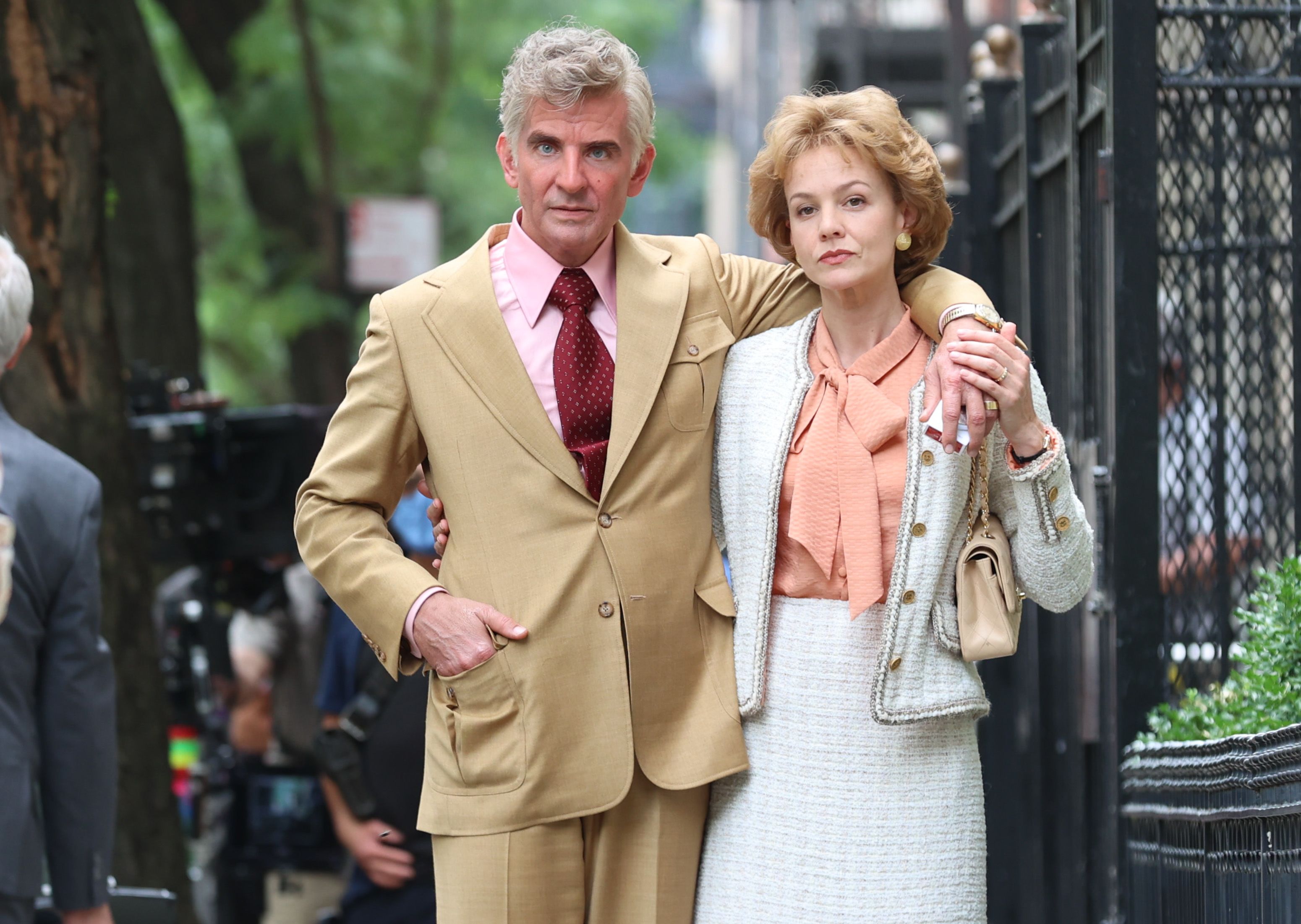
Last but certainly not least are the performances. Cooper is extraordinary as Bernstein, as an over-the-top personality, a creator, a performer, a conversationalist, and of course as a rather flamboyant conductor. That’s not always the most likable of traits for a film character, but Cooper’s energy and solid acting choices (whether you might agree with his choices or not) are mesmerizing for those willing to be drawn in.
More of a surprise is comedienne Sarah Silverman, who disappears into the role of Leonard’s sister Shirley. She demonstrates nothing of the eager-to-please comic actor, but gives a sharply defined, very credible performance.
And that leads us to the real main character in the film, by the actor giving the best performance. For those paying attention, Carey Mulligan is given top billing over Cooper in the end credits, who certainly could have done otherwise. But the time the film is done, we realize (perhaps adding to the disappointment of some?) that Felicia is the real center of the story, and that Mulligan does the best work here. I admit my prejudice, as she is one of my favorites. But this is a stellar performance, starting right from her first words on screen, and carrying through the many ups and downs of her life, with and without Leonard. Mulligan’s eyes might be the most expressive of any actress of our time, and she shows more depth and emotional conflicts without saying a word than most actresses can manage in a scene filled with crying and yelling. If it weren’t for Lily Gladstone and her work in Killers of the Flower Moon (and the tendency of the Academy to self-congratulate by being as “inclusive” as it wants us to perceive them), Mulligan would be a shoo-in for Best Actress. (Of course I’m not saying that Gladstone wouldn’t deserve the award, but just sayin’ that there are a lot of elements that can go into an Oscar vote.)
Cooper swings for the fences as a director, daring to be bold in terms of his visuals, and the back-and-forth between realist and formalist elements (e.g., Bernstein temporarily “joining” the cast of his ballet with Jerome Robbins, Fancy Free, which later was lengthened and redone as Broadway’s On the Town, which was then gutted and redone to become a film musical of the same name, which I still love). But perhaps the biggest swing of all is keeping its focus on the marriage in the middle of a couple of extraordinary lives during some extraordinary years, sidelining or seeming to give short shrift to the many other elements of the rich and full lives presented here, and to the frustration of those viewers that come with expectations that the film has chosen not to meet. But as I usually told my students in the first class of a semester, let the film take you on its own journey, and don’t judge it until you’ve experienced the whole thing. Let Maestro take you on its own bumpy journey, and you’ll engage with an audacious film by one of our most talented actors and directors.
Note: This entry is dedicated to my “cousin-in-law” Ryan (R.T.).
“It’s the most wonderful time of the year…” for film folks, anyway. The films putting their hands up for awards attention reach their greatest number in the last six weeks of the calendar year, and this season is no exception. What is different this year is that, of the three films above, the one I would have wanted to see on my television I paid to see in the theater, and the other two, that I would have been happy to pay to see, I saw for free at home on Netflix. A whole new world….
This entry is dedicated to my “cousin-in-law” Ryan (R.T.)
May December
May December is Todd Haynes’ newest film, and his third featuring Oscar winner Julianne Moore, whom Haynes worked with in Safe (1995) and Far from Heaven (2002). In brief, it is a wonderfully acted, precise piece of filmmaking loosely based on the case of teacher Mary Kay Letourneau , who raped a 12-year-old student, gave birth to his two children with him, and married him between prison sentences—and later legally separated from him. This might be seen as grist for a particularly lurid mill, but Haynes and the writers have other things in mind.
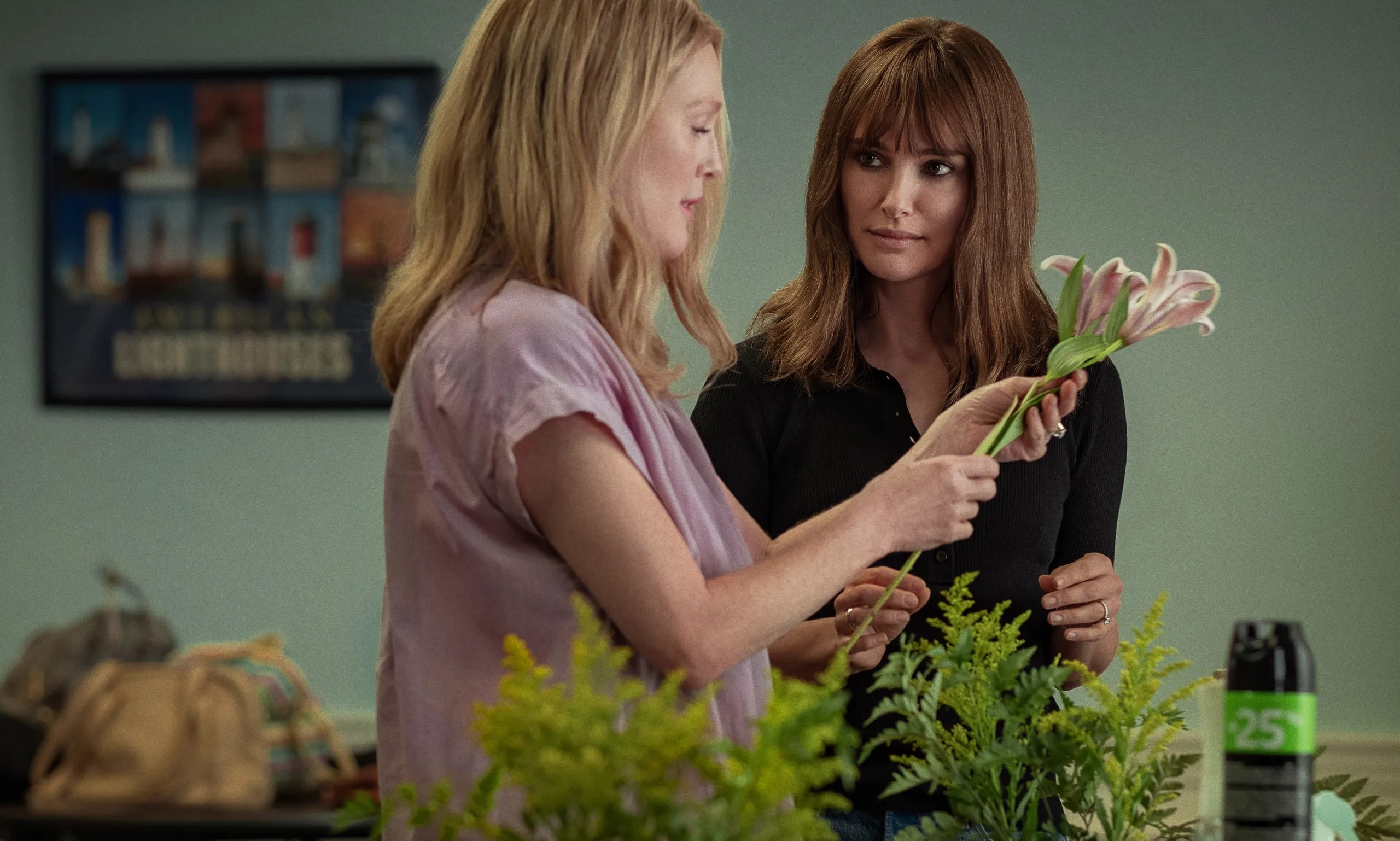
The fictionalized version of the tale features a TV actress, played by Natalie Portman, who, though a somewhat untrustworthy narrator, provides some distance and objectivity from which to view this unconventional relationship. Elizabeth (Portman) arrives to spend some time with the couple and their family ostensibly to get a greater understanding and appreciation of these people and their situation before taking on a role in the film version of the story. Structurally, the story is hers, but the film’s fascination is with Moore’s character and her much younger husband, played in a star-making role by Charles Melton.
The peeling back of the onion of story and characters is deftly done, both with Elizabeth on her path of discovery, and in the lines and performances of Moore and Melton. What could have been exploitative and smarmy instead becomes revelatory and insightful.
Much could be said about the three leads’ performances, which are worth watching the entire film for. Moore, who often is dressed and coiffed to look like Letourneau, rarely lets her proverbial hair down, but conversations with those around her eventually reveal a deeply disturbed woman. Joe (Melton) eventually grows up in more ways than one, but in a heartbreaking and touching way comes to realize the reality of the situation when he was not even a teenager.
As good as all three are, my favorite performance is a high-wire act from Natalie Portman. Portman, a great actress and an extremely intelligent woman, does the near-impossible in believably playing someone less intelligent and talented than she is. Her initial Hollywood superficiality gradually gives way to a more layered personality who is nonetheless not a hero. And her last scene as the actress playing Moore’s character in the film she was doing the research for is brilliant in its lack of artistic depth. Portman never once telegraphs to the audience (us) that she is actually better than her character in terms of morality or talent, and the performance is all the richer for it.
A deep dive into a story like this is not everyone’s cup of tea. But it is keenly observed, sympathetic to truth, and soars when it could easily have come crashing down.
Godzilla Minus One
This is the film that made me say, “I give up!” There are just some films that I am not going to appreciate in the same way as others, and my lack of connection with certain films is more about me than the films themselves. After getting three recommendations about the film—from a very intelligent friend familiar with Japanese culture, a brilliant college professor friend, and a former Asian student who went out of his way to recommend it to me as his former professor, I headed into the theater ready to be blown away.
I wasn’t, and while realizing that this particular genre is not my thing, I still wondered why it didn’t work for me as much as it did for others.
I asked my former student, Stanley Chan, who made the recommendation in the first place, what he appreciated about the film. Here is what he sent to me (permission to print here granted by Stanley):
“I felt like it was not your typical (western) monster movie. It was a Japanese post-WW2 story that could’ve been an enjoyable story with or without Godzilla. The main character, Koichi, struggles with abandoning his duty and the survivor’s guilt that follows. Despite the “obligation” to his country (dying in the name of it and for honor), he continues to live, (re)discover his purpose through Noriko and the orphaned child, and even thrives. Godzilla is what brings the story and characters together as the monster that needs to be defeated.
In a way, Godzilla stands out as a way to confront a past the characters would rather shun and move on from. This is actually in line with Japanese depictions of Godzilla, which was a metaphor for post-WW2 Japan. Themes of political/governmental incompetence and negligence are also represented; in Minus One, this played out by the press literally by misleading the public about the monster and then abandoning the Japanese people to fend for themselves.
Aside from that, it was a very fun film! The focus was more on the characters than Godzilla, where you care about their struggles and quest for resolution. It’s also worth noting that the film was made with a tight budget, demonstrating that the excessive Hollywood spending for blockbusters need not be so excessive to be successful. With the limited settings and tight sets, Minus One could’ve easily been a rather fun stage play.”
Thank you, Stanley!
What I agree with is that the film is all the stronger for its portrayal of how the public can be misled, and specifically, how the Japanese government can do that in dire situations. Also, the film has a great balance of epic monster movie and personal journey, and it weaves them together well, if not particularly subtly.
Something that did drive me a little crazy, a weakness in films from many countries, is this tendency to freeze characters for a dramatic moment instead of allowing them to run for their lives, as anyone would do in real life. (My personal least favorite is when a person is called up front of a group or class, and they knows it’s coming, and they just sit there for a few supposed dramatic seconds.) This film does that several times, and each time I was taken out of the film (and wanted to stand up and yell “Run, for heaven’s sake! Your lives are in obvious imminent danger!”)
The film had more elements than the standard Godzilla movie, and that they were woven in relatively well. Though the film seemed a bit thin at times, I have to bow to the wisdom of my friends who enjoyed it, and respect it for what it is.
The Killer
Put director David Fincher together with actor Michael Fassbender, and it was only a matter of time before I saw this. It brought together memories of Locke (with Tom Hardy), Collateral, and a bit of Body Heat. Fincher goes very narrow and focused here with a tale of an assassin who (spoiler alert) has to “clean up” the mess he made by missing a target.
The style is clean and sleek, with lots of nighttime shots. Cinematographer Erik Messerschmidt (Oscar for Fincher’s Mank) is the second star of the film after Fassbender, providing slick and glossy images that literally and figuratively obscure the violence committed by the main character. The film moves along at a pace that works for the action and the lead character’s “arc,” if he has one.
Aside from Fincher’s steady hand and talent with images, the film rests on the casting of Fassbender, one of the better actors of our time. Fassbender easily plays with his character’s intense intelligence, his drive, and his limber physicality. But this is not your mother’s action hero. A Bruce Willis could have slipped into this role years ago, and it would likely have been a more fun crowd-pleaser. One can imagine the same film with Tom Cruise, Keanu Reeves, Liam Neeson, Stallone, or Vin Diesel. But that would be a more star-driven role that would have changed the nature of the film, making it far more extroverted than it is.
Fincher seems to be more interested in the inner mental workings of a killer who majors in self-talk to keep himself on his own “straight and narrow.” Fassbender hides his star power, and plays things close to the chest, with little outward bravado. That makes this a headier action film that is less violent than it might seem. There are plenty of murders, to be sure, but this is not a gorefest by any means. The film opens a bit as it goes along, but it is always tied down by Fassbender’s concentrated characterization and performance.
Coming from a major director like Fincher (The Social Network, Gone Girl, Se7en, Mank, The Girl with the Dragon Tattoo), The Killer has the more direct focus of an indie film with a strong central performance. What’s different is that it is very competently and confidently directed. Whether or not this kind of film and/or villain is your idea of a good cinematic time, at least know you’re in the hands of a master.
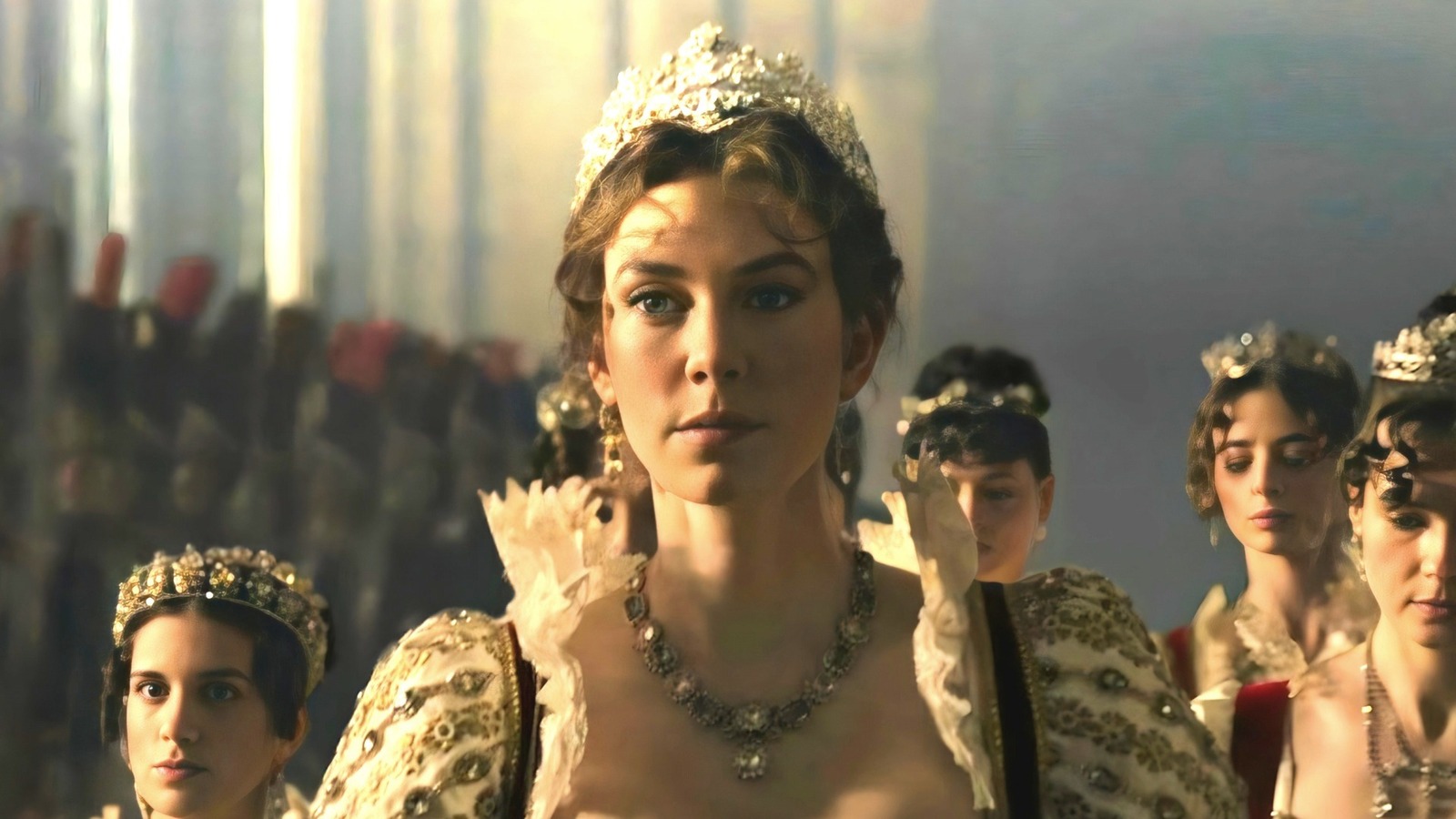
Ridley Scott’s new film Napoleon can be compared in many ways to his Gladiator (2000). Some of the comparisons are helpful, but most show the newer film to also be the lesser film. Like Gladiator, Napoleon has artfully crafted and exciting battles, in which Scott excels. Unfortunately, this is where the positives end, but the comparisons can make for some good discussions.
The script was challenged by the opposing pulls of the grand scale of the history and battles on one hand, and on the film’s narrow focus on Napoleon’s relationship with Josephine on the other. According to IMDB, “Sir Ridley Scott and screenwriter David Scarpa rejected Stanley Kubrick’s [unproduced] Napoleon script as being underwhelming, but kept 80% of the structure, scenes, and development.” Of course we will never know what a Kubrick take on the French general’s life would look like, but the script here is one of the film’s biggest weaknesses. It doesn’t seem to know what story it wants to tell, and for whom. The current broad consensus for biopics is for them to choose a slice of a person’s life rather than trying to cover it all, and find meaning there beyond the events themselves. This film is not a cradle-to-grave biography and does stay within a tight timespan, but stumbles around issues of warfare, revolution, insecurity, love, obsession, ambition, and hubris without ever pulling these issues into a coherent whole.
The other helpful comparison with Gladiator and Napoleon is with its two leads, and it may well be a matter of casting more than direction. Of course, Russell Crowe won the Best Actor Oscar for Gladiator, and that was due in great part to the cinematic impression Crowe made, in general and in relation to the character of Maximus. And of course, there was a Best Supporting Actor nomination for Joaquin Phoenix for this role of Commodus. Both Crowe and Phoenix are excellent actors, but they can’t do everything (see https://film-prof.com/2013/01/04/les-miserables/). Crowe was terribly miscast in Les Misérables, and here Phoenix is miscast as Napoleon.
What Crowe brought to his role of a slave in Gladiator was great personal authority. Yes, we are meant to realize that Maximus has a royal heart, and is a great man stuck in a slave’s situation. But Crowe also tends to make his parts bigger and fuller than the character he plays, and that adds a level of power and grandeur to those parts. What made Phoenix so good as Commodus is that Phoenix tends to make his characters smaller than what they seem. His Commodus, while ostensibly the heir to the throne as the natural son of the Roman Emperor, is a small man, full of insecurities—petty and whiney. Unfortunately, that also describes his Napoleon.
This Napoleon is a far cry from the great leader seen in so many other films. Seeing his nervousness before his first major battle is one (good) thing. But Napoleon must have had some innate confidence to accomplish what he did, which you won’t find here. We’re left with the question of how he could have led so many and conquered so much in such a short period because the man presented here couldn’t have pulled that off. Not that the script is any help to the character here: “You think you’re so great because you have boats” has my vote as the most ridiculous and memorable line in the film, and a line likely to be quoted for a long while. And the “You are nothing without me” lines that Napoleon and Josephine say to one another are both cliché and far too quickly turned around to be anything but confusing or laughable.
We don’t see the great military mind or the great leader, and we don’t see a relationship with Josephine that makes sense. Vanessa Kirby (“The Crown,” Pieces of a Woman) is an excellent actress, but her character is so enigmatic here that we never get a sense of what makes her special (or even what makes her tick), and certainly we can’t see what she sees in Napoleon beyond the power we know he is supposed to possess. One gets the sense of an actress of talent trying very hard to add life to an underwritten character that the film offers such little help to explain.
Part of the problem may be the positioning of the camera. We get great medium and long shots of battles, and some strong close-ups of Napoleon at the more dramatic moments, but the shots of him and Josephine together are often at a mid-distance that is more observational than interpretive. We see the two of them together. but don’t know them any better. And the so-called “lovemaking” scenes are uncomfortable and only serve to make the general seem smaller still. (Why would Josephine want to be with this man?)
The cinematography and CGI are also similar to Gladiator, but especially in comparison to Oppenheimer’s overwhelmingly practical effects, the special effects here seem tired, and render a kind of dull haziness to the film.
The film is at this point a box office failure, not even recouping its original budget. It’s too long in its current version, but the rumored four-hour version may turn out to be better. The two-and-a-half-hour version now in theaters is full of holes, and has a bumpy rhythm to it. Perhaps like the various versions of Griffith’s Birth of a Nation, where the longest version one can find is probably the best, the next iteration of Scott’s Napoleon may be an improvement.
This movie has been called the Napoleon film that no one asked for. True enough. For now and likely for quite some time, Abel Gance’s Napoleon (1927) at 5.5 hours is still the definitive cinematic version.
Yes, I know it’s technically a mini-series and not a film per se. But as we joke in our house, it’s not a series, but it’s a movie in four parts (inside joke). But it’s a very popular Netflix show, and it’s not hard to see why. It’s also not hard to see why Rotten Tomatoes shows it having an 87% audience score, and has a 27% critics score.
The show had all the potential in the world. Based on a popular book, it features a blind young woman in France, a German soldier who was never converted to Nazism, and a strong WWII background. Between the war setting and it’s being focused on France, we (my wife and I) headed into it with high hopes.
It didn’t take long for those hopes to be, if not dashed, at least torn and stomped on. The look of the film is soft and lovely, which is a bit at odds with the subject matter. Yes, it’s a memory (as well as a period) piece, but it looks like a Hallmark movie with low lighting and a lot of browns. Then there is the mise-en-scene and the music. In the first instance of someone about to die from aerial bombing, the young man about to meet his Maker is set so far apart in the back of the frame that I was impatient for the obvious to happen so we could move on. Not only was there no sense of either surprise or discovery, I was unhappy with myself for wanting the stretched-out shot to be over and dispense with him already. The obvious compositions signal to us what’s about to happen all through the series.
There is actually a moment (repeated near the end) that is a jump scare. No, this is not a horror film by any stretch, but it was refreshing to not seeing something coming a mile away. It added some much needed, if temporary, energy to the series. It’s a scene that used music well—“Clair de Lune” is featured repeatedly in the series. Unfortunately, most of the time, the music is reminiscent of 1940s noirs or dramas that sets up the viewer very early in the scene and lets you know if there was any danger around the corner. I was wondering how much more I would have enjoyed it had there been no non-diegetic music at all.
I admit to seeing all four parts. One, I enjoyed the story, the setting, and the timeframe; two, I tend to be a completist (to my wife’s general frustration); and three, I got invested in the characters. Yes, the final outcome was as surprising as what happens when the hyper city girl runs into the laid-back country boy in a Christmas movie. But the two leads are decent enough actors, and are very sympathetic. They are the reason to stick with the story. Marion Bailey (who played the Queen Mother in The Crown) is also a strong presence in a part that could have just been either all soft and squishy or hard and Lesley Manville-y. She among the older folks is the only one completely submerged into her part, speaking every line with conviction and purpose.
And that brings us to the two greatest acting disappointments of the film. I generally love Hugh Laurie (“House”). Laurie, who has been heralded as the gold standard for accents—especially the difficult American accent—speaks in something like a soft British accent (he’s a Brit after all) coated in American. It’s a bit confusing, if not alienating. Plus, he has the most awkward lines to speak with a straight face. The series can’t make up its mind whether it wants to be a tough war film with a soft center, or a fable set during WWII. Laurie seems to do what he can with the character he’s given, but there is an unreality about both his characterization and his accent that his character both stands out in the wrong way and recedes in another wrong way.
And that brings us to the most disconcerting part of the film, and that is the casting and performance of Mark Ruffalo. Perhaps Ruffalo was the “American name” needed to greenlight this show, and I understand if I were him, I would want a softer, nicer role for a change. I guess it’s supposed to be a French accent he’s sporting, but it sounds more Mittleuropean at times, though he’s in and out of whatever accent he’s going for. His character is the kind, gentle, and helpful dad, but between the lines he’s forced to say and a character that’s halfway to the tired generic sweet old grampa, he clearly places himself on the fable side of things, which robs the film of a great source of interest and energy.
One aspect I found fascinating, and that hinted at something more that the film was doing, even if it wasn’t trying to, had to do with the Nazi characters. Yes, they are generally as black-and-white as you can imagine, and thankfully, Lars Eidinger humanizes the most evil of the evil Germans, which is quite the feat considering both his character and what he is asked to do. But every Nazi, from the youngest and freshest to the oldest and hardest—with the exception of our male lead, of course—puts on an arrogant, power-hungry, wicked mien as soon as he opens his mouth or has an action to perform. As one who still shakes his head at what happened to the Germans that led to the rise of Nazism, I found this aspect of the film to be intriguing, and made me wish the film had done more with that.
If you don’t mind being signaled both visually and aurally before something occurs, and if the plot and setting override the question of whether realism or fable is what the filmmakers are going for, and if you can handle seeing the electric/eclectic Ruffalo awkwardly try to play soft and sweet, then go for it. Just think of it as 1917 combined with “World on Fire” combined with The Diary of Anne Frank combined with a soupçon of Titanic. It’s on Netflix, and, as we say in our house when referring to something a step up from meh, it’s “fine.”













 Film stuff by Mark