
This film from 1946 should not hold up. I was just checking off a box when I decided to see it. The film is based on the life of an entertainer who was essentially forgotten by the time it was filmed. It’s wildly, wildly inaccurate—more of a fantasy than a biopic. The film has him marrying once, not four times, and the singer’s famous third wife so hated him that she refused to have her name attached to the film, thus sending things in some crazy directions. The musical numbers are overdone, and the color borders on the garish at times. It also contains performances that are completely unacceptable and could easily be considered too offensive to even view.
And yet…it was far more enjoyable than I could have thought. As a film historian, I knew Al Jolson more for being the star of the first sound film The Jazz Singer (1927) than anything else, though I knew he was a very famous entertainer before that. Jolson himself did the singing for the film, though it might be argued he was past his prime. Being mostly familiar with his short vocal bits in The Jazz Singer, I was surprised at the vocal quality of the no-longer-young performer.
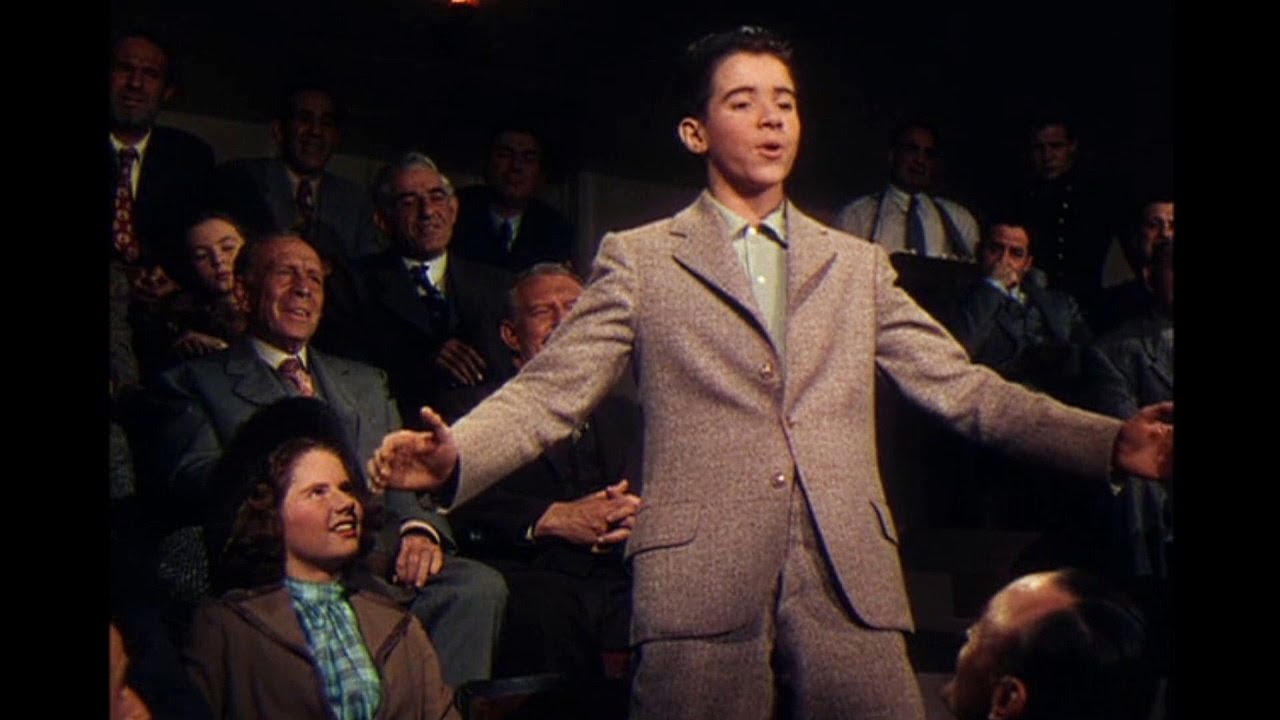
There are two great strengths and one great weakness of the version of the Jolson story that we’re given. There is a teenage Jolson played by Scotty Beckett, who gives a lovely and sensitive performance (in the old studio system style of acting) as the youngster struggling with the same challenge as Jakie Rabinowitz in The Jazz Singer. While this fabricated first act must have echoed strongly with those familiar with the plotline of the 1927 film, that never happened, though Rudy Wissler’s voice was a pleasure to listen to. Side note: Beckett, a promising young actor, ended up making every poor life decision known to man, and fatally and tragically overdosed at the age of 38.
With continued fudging of facts, we follow Jolson step by laborious step as he makes his way up the entertainment ladder. Of course, the peak should be in 1927, but since this is a Columbia film and The Jazz Singer was a Warner Bros. film, we only get to hear the songs from that film and we don’t get to see him on the screen. But nearly all the big hits are covered: “My Mammy,” “Swanee,” “April Showers,” “California Here I Come” and more. Jolson himself appeared in long shot for “Swanee” so that he could more accurately depict the physical movements for which he was so famous. (After all the close-ups of Larry Parks, who played Jolson, it is a bit jarring to have the camera back so far for an entire number.)
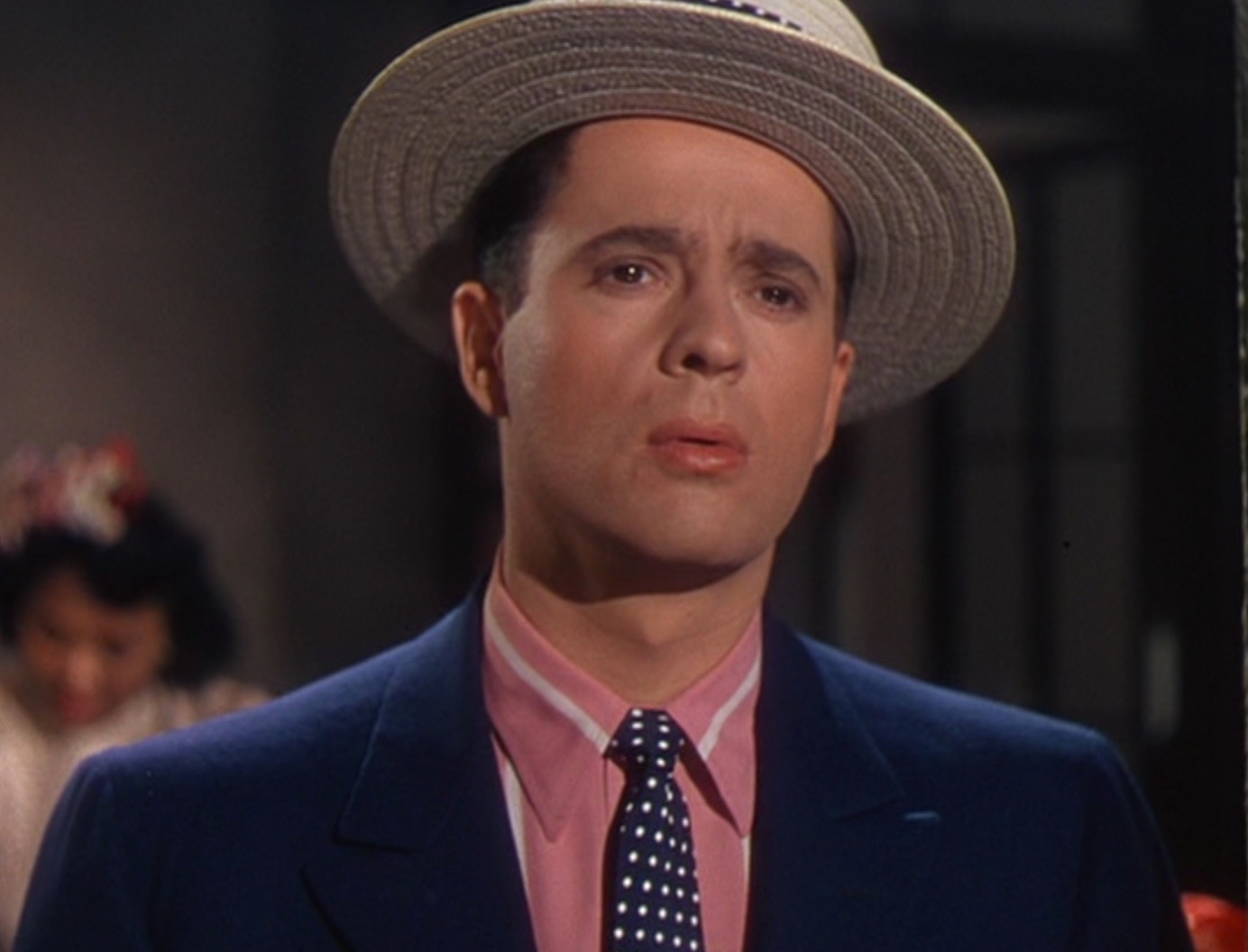
While even in its mangled version, Jolson’s story is fascinating, especially as he connects two great forms of art and entertainment in the early years of the 20th century. But the highlight of the film has to be the performance of Larry Parks as the adult Jolson. Parks was a moderately successful actor, but not a star. When James Cagney and Danny Thomas turned down the role, it went to Parks. He won an Oscar nomination for the performance, and it is the one big reason to see the film. For one, his lip-synching is spot on, partly because, like Judy Garland, he actually sang along with the prerecorded performance and didn’t just move his lips. His movements do more than mimic Jolson’s—they embody them. He makes a viewer forget that they’re watching an imitation. Jolson’s style was unique and included every body part and a plethora of facial expressions. Parks is uncanny here.
Then there is his acting in the straight, nonmusical scenes. If you’re not paying attention, Parks as Jolson is simply over the top with energy and enthusiasm. If you keep looking more deeply, you see that this is a great entertainer but also a self-centered and controlling man completely unaware of these weaknesses. It’s an extraordinary performance. Unfortunately, while Parks was able to make the successful sequel, he became a victim of the Hollywood blacklist, and we lost an actor of talent and even greater potential.
The strongest supporting performance—nominated for an Oscar—is by William Demarest, best known as Uncle Charley in television’s “My Three Sons”. His character is named Steve Martin—always a modern laugh—and while Demarest expresses his famous grouchy side, he also demonstrates a warmth and caring that helps hold the whole film together.
Yes, the film will always house a great performance we can all enjoy, but it is also a kind of Rorschach test. Jolson came out of a vaudeville history that featured blackface, and not just occasionally. That’s simply a part of this song-and-dance man’s history. It’s not presented as racist, but just as vaudeville tradition. In fact, without irony, the film presents black jazz musicians as having a strong and positive affect on Jolson once Jolson discovered this “new” kind of music.
Personal note: I understand the history of minstrelsy and am appalled at its origins and longevity. By Jolson’s time, its sickening origins had faded somewhat into theatrical tradition. There’s a lot of blackface here in The Jolson Story. If that makes it unwatchable for some, that is more than understandable. Yet there is room to watch it as an historical biopic and a look into a moment in American theatrical history. Of course, the fact that it wasn’t considered controversial within the film is a topic worth discussing at length another time.
The film was successful nationally and internationally and was Columbia’s biggest hit that year. Three years later, Jolson Sings Again (also starring Parks) was even more successful, becoming the biggest hit of 1949 and garnering even better reviews. Perhaps inspired by the success of 1942’s Yankee Doodle Dandy, the mid-forties were packed with wildly inaccurate musical biopics: In 1945, there was A Song to Remember, The Dolly Sisters, and Rhapsody in Blue. In ’46, along with The Jolson Story, there was Night and Day and Till the Clouds Roll By.
Final note: Lest we judge, let’s not forget about Amadeus and Bohemian Rhapsody.


