
Song Sung Blue is the true story of a pair of singers who, after covering a lot of different performers, land on a semi-successful career as presenters of a “Neil Diamond experience.” It’s a funky, bumpy mid-range-budget film, the kind they pretty much don’t make anymore. It features one great performance, a couple of very good ones, and a slew of “I know that guy” actors that add color and humor. It stars Hugh Jackman and a luminous Kate Hudson

Full disclosure: I don’t love Neil Diamond (with a few exceptions), I don’t love Hugh Jackman (Mike) as much as others do, and I don’t warm to his voice as much as others do. For those who love Diamond and Jackman, however, this film is a treat, as it features his singing all over the place. One thing that he “seemed” to do that I admire is that he didn’t sound as polished in the beginning of the film, and his voice seemed to strengthen and grow fuller as the film went on. For someone known for his voice, that was a bit of a risk, and it paid off. He also was never afraid of acting something like a jerk, with drops of cluelessness and a narcissism that wasn’t earned.
That performance fit well into the story and the production values. Taking place in Milwaukee in the late 1980s and 1990s, the film transpires in a half-tacky home and a series of second-rate (and sometimes pitiful) venues that are halfway between sad and tawdry. But the folks in those places are neither sad nor tawdry, which keeps the film more open-hearted than other films and filmmakers might have handled things. The director and co-writer (with Greg Kohs) is Craig Brewer, director of the respected Hustle & Flow and the less-respected Black Snake Moan. The direction is clean and direct, never calling attention to itself and respecting the story and the players.
The problem is the script, that had two major challenges. One is that (spoiler alert) the two main players were married for 12 years, a passage of time that would have given some breathing room to all the intense events of their lives, but apparently served up an insurmountable problem in terms of aging the children, an issue already on the edge of credibility.
The second problem is that there is a lot—a lot— that happens to them, and the condensed time frame gives the viewer little time to breathe between major events (no spoilers here—you’ll have to see for yourself). Perhaps we could have been given a few moments of peace, quiet, and joy that they must surely have experienced. The highs they experience are enjoyable and we share in that joy, but there is little downtime to give a sense of the proper timeline and to give us a few moments that aren’t about dealing with some heavy problems.
The children all do a solid job, but the standout is Elia Anderson as Rachel, Mike’s daughter, who should have a successful career ahead of her. The well-known secondary actors are Michael Imperioli (very good), Fisher Stevens (fun and fine), and Jim Belushi, whose character and characterization both seems odd.
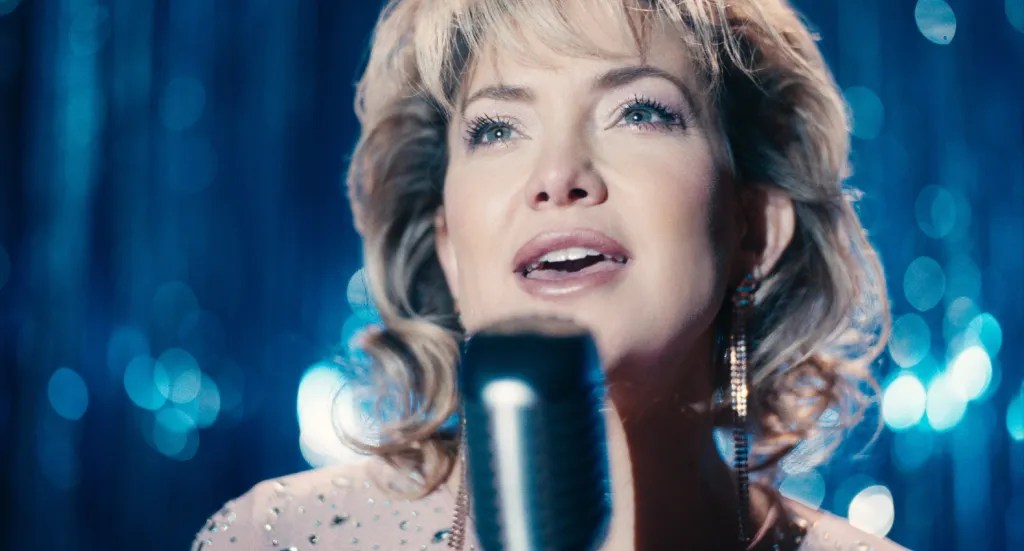
The standout, however, is the Oscar-nominated Kate Hudswon. Hudson roared to fame and earned her first Supporting Actress Oscar for 2000’s Almost Famous, and was seemingly lost to rom-coms and forgettable secondary roles. Here, however, she owns the film from beginning to end, her singing is marvelous, and you can’t take your eyes off her. Her Midwest accent varies a bit here and there, but it’s barely noticeable. Hudson had shown her singing and dancing chops as the best thing in the awful Nine (2009), where nearly every lead performer was an Oscar winner except for Hudson, who was “only” a nominee. Her character here is less pizzazz and more heart and warmth. Many other actresses could have played this part, but few could have brought the kindness, vocal chops, gentle stability, and subtlety to the role as well as Hudson. Her performance alone is enough to see it.
The film’s power and main limitation is that it is based on a true story. A fictional tale wouldn’t have had the power of real-life people and events, but the twists and turns and the multitude of major events make it seems stuffed for a middle-sized film. The condensed story line is part of the problem, and the ending seems contrived and narratively unnecessary, until one realizes that a happy/happier ending was needed to finish off the film. Bumps and all, it’s a fascinating if messy story with a male star that most people love and a female star gloriously re-inventing her career.


