
There’s so much to recommend about Spielberg’s latest, and perhaps even more to dissuade. Perhaps the box office reveals something. With a $115,000,000 budget, the film has only made $220,000,000 as of this writing, a surprisingly low take for a new Spielberg film, and one that will likely put this in the money-losing category when all is said and done.
That’s understandable, because while the acting is very good throughout, the script is sorely lacking, and verges of being insulting. This is essentially a high-budget educational video, and the viewers are being talked down to throughout much of the film.
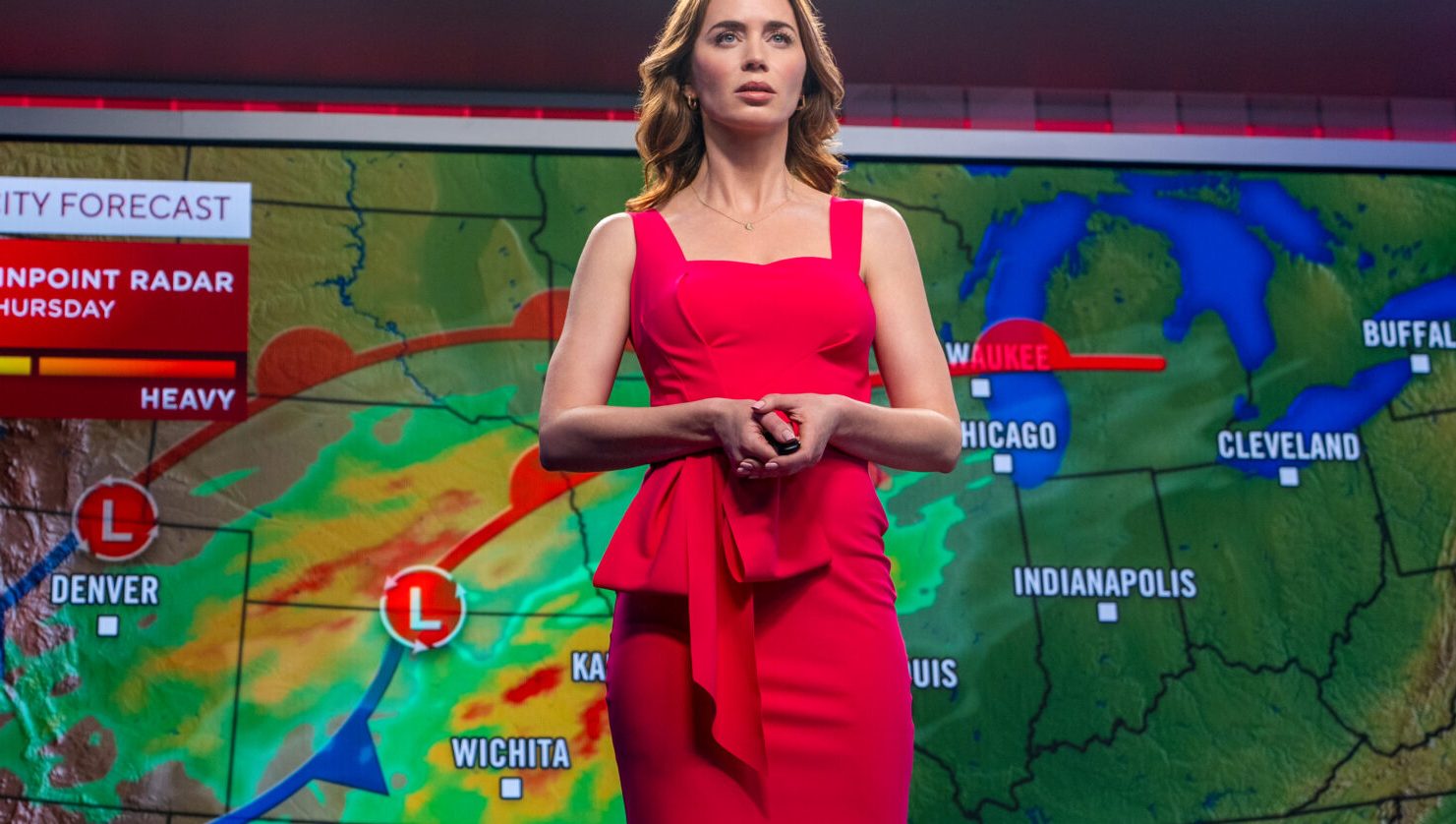
What the film has is excellent performances, even when the arc of each character is confusing and when they are forced to do what they can with rather ridiculous expository lines that don’t just tell us what happened, but WHAT IS REALLY GOING ON HERE. Emily Blunt may have been directed occasionally to go a little over the top, but she is excellent and would almost assuredly been in contention for an Oscar nomination (she still may be) if this were a better film. I enjoyed what she did with her voice and characterization, moving between a girlish high-voiced TV personality and a lower-voiced, intelligent, impressively multi-lingual dramatic lead. Josh O’Connor always manages believability, even with a character that doesn’t always make sense; he holds the film together. Bono’s daughter Eve Hewson is also very good, though she disappears for too much of the film; once her character is established, we want to see more of her.

The two heavyweights operating at opposite ends of the narrative spectrum are Colman Domingo and Colin Firth. Domingo is a consistently good actor, and brings a strong, necessary palpable presence to the film. Again, his dialogue is often embarrassing in its exposition; apparently, we must be told everything and can deduce nothing by ourselves. Firth is … interesting. He’s a good actor, but first, doesn’t have the necessary inner dark side to go with his dark actions, and second, he is tasked (spoiler alert) with making a 180-degree change near the end that any actor would struggle with.
Then there is the awkward dealing with God and faith and the Bible and all that. We have an ex-novitiate and an older and supposedly wiser nun. Hewson is the former, and the latter is well played by Elizabeth Marvel. So apparently, the only faith presented is of the Catholic tradition, which is the supposed stand-in for all faith in God and Jesus. No other religions need apply, and Christianity outside of Rome doesn’t seem to exist. Sister Maura (Marvel) misrepresents the Scripture’s meaning in Genesis about man and creation, distorting it to first address and then ultimately dismiss the entire issue of God, reducing Him to a general creator with no real call upon or specific interest in human beings. For those who have actually read Genesis, this is insulting and offensive; it essentially and condescendingly dismisses God from the narrative, disallowing any deeper and more thoughtful discussion on the matter.
Once that “irritating” issue of the Creator of the universe is set aside, we have a strange and not always coherent plotline, including a thoroughly unbelievable action sequence involving a train. No spoilers here, but there is nothing the sequence adds except a level of incredulity that works completely against the film in two ways: The sequence is pure fantasy and crazy action, which works against the aims of a film trying to convince us of an important “reality.” Secondly, it comes out of nowhere, goes nowhere beyond pumping up our adrenaline, and ultimately adds nothing to the narrative.
While not always surefooted in its exposition, the film’s story moves inexorably toward two climaxes. One is the issue of how humanity would react to knowing (spoiler alert) that there are aliens, and not only that, but that they have been among us for years. The second is the actual “proof” of such aliens, which Spielberg apparently believes with Gospel force. This is where the film completely goes off the rails. Instead of an intriguing but often confusing story that we can watch from an entertaining distance (a usual Spielberg trait), we end up with a final in-your-face direct declaration that again allows for no deductive thought on our part. (It’s also dragged out at the end far too long, with Screenwriting 101 vibes throughout.) We’re told what is “true,” and then told in so many words that we better accept it. We’re never allowed as viewers to own the story ourselves and are not encouraged toward a viewpoint. We are instead given a command at the end of the film that builds on the already over-explained screenplay and tells us directly what WE NEED TO DO. It takes cinematic condescension to a whole new level.
The strength of the film is in its acting, and the separate parts of the film are its best aspects. The sum of those parts doesn’t add up, but each “part” is well-filmed and generally very well acted. Viewers are encouraged to enjoy each scene for what it is, and hold the film’s aims at a distance.


