The Fall Guy is the best middling but well-timed film of the year so far. Released shortly after the Oscars a couple of months ago, it benefited greatly from the all the press that Ryan Gosling received for his Oscar-nominated role as Ken in Barbie, plus all the press that also Oscar-nominated Emily Blunt received as part of the Oppenheimer wave. I don’t think it would have been half as successful if it had been released at any other time.
Not much to say here. It’s an enjoyable film to watch, and it will make an enjoyable evening when it comes to streaming services. It’s fun because of its two greatest strengths—the incredible action/stunt sequences, and the two leads. Directed by David Leitch (Bullet Train, Fast and Furious Presents: Hobbs and Shaw), the film is a well-deserved Valentine to stunt men. The plot may be paper-thin, but the action sequences almost make you forget that. (Spoiler alert: The reason for Gosling’s character’s withdrawal is pretty much unbelievable.)
Then there are the two leads. The good news is that each of them knows what they are doing here. Gosling leans into his Ken-mode with a suppresser on his intelligence and a slight ramping up of the wounded puppy dog. Blunt, on the other hand, comes off as beautiful as ever, but also fiercely intelligent and focused. It makes a great combo, though any realist might balk at these characters’ hopes for a long future together.
What detracts from the leads’ performances is the slight aroma of slumming. Gosling and Blunt are both clearly above this material, and are working hard to hide that. It reminded me of great opera singers who “get down” with a Broadway classic—not always the best choice. These are two excellent actors, and they tend to elevate the film. But one gets the impression sometimes that two lesser talents might have fit in better with the rest of the film.
But I quibble. There are not many films that simply want to entertain. The Fall Guy will fall out of your brain the day after you see it, but for most folks, it will generally be worth the two-hour investment.
The Zone of Interest and Anatomy of a Fall were two of the most celebrated foreign language films of 2023. Among many other international awards, the former won Academy Awards for Best International Feature Film and Best Sound, while the latter won Best Original Screenplay.
Both are serious, excellent dramas that are freshly cinematic in their approach and look. Both are examples of what great non-Hollywood films can be
The Zone of Interest is based on the true story of Rudolf Hüss, the SS officer and commandant of the Auschwitz concentration camp. But this isn’t your usual Holocaust story; it’s neither Schindler’s List nor Life is Beautiful, and not anything in between. It’s the story of a family trying to make life work with a busy household, an oft-times confusing war in the background, and pressure on the husband to become more efficient in his duties. The only difference here is that the family lives just outside of the walls of a concentration camp with the ever-present sounds of killing permanently in the background, and the husband’s duties include discovering more effective ways of killing Jews and disposing with their remnants. The “banality of evil” has perhaps never been as strongly presented as in this film.
The dramatic tension is not in the plot per se, which what plot there is can be distilled to the question of what is going to happen if we have to move (like Meet Me in St. Louis, but way darker). The dramatic tension is between what we are watching (a so-called “normal family” living the literal shadow of a death camp), what we believe about evil, and what we know of history. There is the slight undercurrent question of how much the family, and especially the wife, know of what is happening just yards from their yard. But (spoiler alert) then there is a devasting moment when we realize that she knows exactly what is going on, and it’s chilling.
For a film to win Best Sound over the incredible soundscape in Oppenheimer, and especially a foreign film, one has to believe that the use of sound is something altogether other, which it is. One could watch the film several times and would just be scratching the surface of what the sound is doing. It’s brilliant, and haunting. The film won nominations for Best Picture, Best Director, and Best Motion Picture, in addition to the two wins already noted; it could easily have garnered a Best Cinematography nomination as well. Its use of infrared photography just adds to the presence of ghosts that lie everywhere in the film. Just see it.
Anatomy of a Fall is the other great reminder from last year that foreign films, even those with subtitles—this film is in English, French, and German—are well worth the watch. In many ways, this is a courtroom drama in the same cinematic universe as 1959’s Anatomy of a Murder, after which it is named. Also nominated for five Oscars—Best Picture, Best Director, Best Editing, and Best Actress, including its win in the Best Original Screenplay category, the film follows the case of a death from a fall—accident, suicide, or murder. Some feel that the film settles the issue, or at least suggests an explanation. In my mind, it’s more like the film Doubt, which kept the incidentals of an action—the did she/didn’t she?—in the background and swirl of questions and emotional responses in the foreground. Sandra Hüller, playing the wife, was instructed by the director to play her character is if she were innocent.
For those of us in the West who want to know for sure what happened in our TV shows and films, there is still so much that’s marvelous in the film that it’s worth spending its admittedly long 2.5 hours with it. Like its earlier namesake, the film has extraordinary performances. I am one who thinks that James Steward should have won his second Oscar for Anatomy of a Murder, and here, there are two—OK, three—performances worthy of an award.
Sandra Hüller, for those who weren’t familiar with her, is the cinematic thespian find of last year. These two performances alone should guarantee her a place in film history. It’s difficult to pay as close attention as the performance deserves in The Zone of Interest, in that the story is far broader than the story of the wife, and her stellar acting is simply of a piece with the other elements of a subtly powerful film. But in Anatomy of a Fall, Hüller is front and center, and the story is hers. And she owns every moment she’s in the frame, whether in the background cooking or yelling in frustration at her soon-to-be-dead husband. It’s easy to see why of her two great performances last year that this would be on the one Oscar-nominated. It’s full, rich, powerful, and enigmatic all at the same time.
The other great human performance is that of Milo Machado-Graner, who plays the couple’s 11-year-old son Daniel. Machado-Graner actually opens the film, but at a distance. That distance is slowly but steadily decreased until he is giving the dominant performance, and he is outstanding. Put this in your list of best child performances. Nothing I write here, though, is meant to take away from the solid work by Samuel Theis as the husband, and especially, Swann Arlaud as the lawyer.
Lastly, there has been a great deal of deserved talk over the “performance” of Messi as Snoop, the family dog. Messi has actually won several awards for his work here, my favorite being (not kidding) the Palm Dog Award at Cannes. He has his own seat at this year’s Oscar show, and if a dog can be said to give a real performance, this is the best you’ll ever see. At first, Snoop is simply the family pet in the background. But as with Daniel, he eventually becomes a major character, and every other dog performance will look phony after this.
These two films should be seen by anyone interest in modern European cinema, what sound can do, historical films, mysteries, courtroom dramas, and films with great acting, especially Hüller, and yes, even Messi. There are larger issues galore in both these films, issues of evil, self-delusion, human cruelty, the ups and downs of marital life, the question of how can come to know the truth of anything. But these issues lie gloriously under the surface in both these films, and enrich their films without suffocating them. Rare, indeed. But oh so artful.
My first celebrity crush was blonde ingenue Hayley Mills. If you are older or have seen old Disney movies, you may remember her from 1960’s Pollyanna and/or 1961’s The Parent Trap—the original one. Those were probably the first two films I ever saw her in, being of an age for kid’s movies, and Disney being a safe choice for children. But as I grew in film knowledge and thought back to my unrequited love for this young actress, I discovered that she had made a big splash the year earlier in a film called Tiger Bay, directed by J. Lee Thompson (Oscar nominee for directing The Guns of Navarone) and featuring her famous father John in a supporting role. (Note: John Mills was already a stage and screen legend at this time. Aside from a hefty list of stage successes, Mills had already starred in David Lean’s Great Expectations as Pip, and in Noel Coward’s In Which We Serve, and later went on to win a Best Supporting Actor Award for his work in Lean’s Ryan’s Daughter.)
I looked at various streaming services with no success, and even tried the library system in my region, all to no avail in terms of being able to view this mysterious film. I finally tried YouTube, not my first choice for quality films, but I was finally able to view a good version of it there.
It’s a fascinating film, both for its promises and its unusual look and feel. Its promises were its two leads: first-time actor 12-year-old Hayley and the supposed “German James Dean,” Horst Buchholz, making his debut in English-speaking films. These two are the promises, which have sadly been unfulfilled. Buchholz was in 1960’s The Magnificent Seven and later, in 1997’s Life is Beautiful. But he never achieved the level of success of his German-speaking career, and has perhaps become more famous for the roles he turned down: Sherif Ali in David Lean’s Lawrence of Arabia, which made Omar Sharif an international star; the lead in A Fistful of Dollars, which made Clint Eastwood an international star; and the role of Tony in West Side Story, which would clearly have catapulted him to international stardom (and which might have resulted in a better film).
After this spectacular debut, Hayley Mills could have had one of the careers of the century. She was so natural, so unaffected in this film (especially as contrasted with many of the child actors of the time) that it seemed she could do anything. She quickly stacked up the honors: a Silver Berlin Bear Special prize for her performance in Tiger Bay, as well as a BAFTA Award for Most Promising Newcomer to Film. Then she won the last Juvenile Oscar given for her work in Pollyanna, as well as a Golden Globe for Pollyanna for Most Promising Newcomer-Female. She was also nominated for BAFTA Best Actress Awards for Pollyanna and 1962’s Whistle Down the Wind. Lastly, she scored a hit with the song “Let’s Get Together,” which made it to number 8 on the Billboard Top 100, and which found a place in my brain that it refuses to leave. British exhibitors voted her the most popular film actress in England in 1962, when she was all of 14.
The Disney connection was a two-edged sword. It brought her world-side success, and then cramped her artistic growth. Mills also seems to have fallen into the trap of many child stars who jump into adult life too quickly, and then pay for it. In 1966, 20-year-old Mills met began a relationship with 53-year-old director Roy Boulting, whom she married in 1971—her first, his fourth out of five. Not surprisingly, this personal and professional connection set her on a less-than-successful personal and professional path, and while she had the occasional modest success, and is still acting, she never fulfilled that early promise. (They divorced in 1977).
Her partner in Tiger Bay, Buchholz, was also on the verge of becoming a major international star when he made the film. But his subsequent choices in what he would and would not take seem to have worked against a stellar career. He skillfully chews on every piece of furniture in the film, à la James Dean, and has the requisite pain in his eyes. But his acting career was soon relegated back to his native Germany, and he augmented his film work there with a successful career in dubbing.
Tiger Bay itself is something of a hybrid. It has wonderful black-and-white cinematography that beautifully matches its noir influences. But it also has early stylistic signs in its camerawork and editing that lean into both New Wave influences from France as well as the “kitchen-sink” dramas of early 1960’s British films. Those styles don’t always combine well for a modern viewer, but for film nerds/buffs/aficionados, it’s fascinating to watch. What doesn’t work at all is the music, which borrows the worst of 1940’s and ’50’s Hollywood films, reflecting and announcing insistently on matching what we see to what we are unfortunate enough to hear. It is well worth the watch, in spite of its odd features, and is a thrilling story with strong human dimensions.
Unlike River Phoenix, Heath Ledger, Brittany Murphy, Anton Yelchin, Chadwick Boseman, and James Dean himself, Ms. Mills is still with us. Just thinking of her brings up complicated feelings. She was my “first love,” she made an amazing first film, and she was able to make several more films over her lifetime. But…what could have been…? We’ll never know.
Fun last note: Hayley’s actual “debut,” like Liza Minnelli, was as a baby in a film starring one of her parents. In Hayley’s case, it was 1947’s So Well Remembered, which also featured her sister Juliet, also an accomplished actress. So when Tiger Bay was released, it was advertised as her “return” to film.
Gladstone, De Niro and DiCaprio in Killers of the Flower Moon
What? Why are you writing about that “old” movie now? Well, yes, Killers of the Flower Moon was released way back in October 2023, and yes, it’s been nominated for a variety of awards but has won very few apart from Lily Gladstone as best actress.
But this is as good a time as any to mention why and how I write. I don’t write reviews; I write analyses. There’s nothing wrong with writing reviews, and obviously my personal thoughts are going to be included as I write. But film reviewers are up against a deadline, usually only see a movie once before having to review it, usually spend half the review recounting the plot, and finally, end up with some kind of recommendation (see it, don’t bother, see it but know what you’re getting into, etc.)
Also, this particular film is three-and-a-half hours long, and for this writer to find that window of time when he’s not already doing something more time-critical than watching and writing—and is sure that he won’t fall asleep—well, that opportunity often takes a while to present itself. So what could be more important than watching a film? Well, babysitting the cutest twin girls in the universe, counseling, keeping up with friendships, and writing a play—for starters.
Killers is old news at this point, and already has a curious history. When it was released, there was excitement about a new Martin Scorsese film starring Scorsese stalwarts Leonardo DiCaprio and Robert DeNiro. It was looking like this was the front-runner for Best Picture for a while, but then it began to fade in light of the Barbenheimer silliness, and in the reality of the impressiveness of Oppenheimer. By the time the awards season was in high swing, very few awards came its way outside of Lily Gladstone’s apparent dominance in the Best Actress category. But even that ran into a speed bump by the surprise lack of a BAFTA nomination, and then the finishing touch was Emma Stone winning Best Actress for Poor Things, which only a few folks saw coming.
So here are some thoughts, more for the record than anything else:
With the 2016 Scorsese film Silence running just under three hours, and the 2019 The Irishman and 2023’s Killers of the Flower Moon both clocking in at 3.5 hours, Scorsese is clearly going for more than just box office success. In fact, all these films were money-losers, even while the exact numbers for The Irishman can never be known in the light of Netflix accounting. Scorsese seems more interested now in passion projects that reflect end-of-life concerns, be they spiritual, the painful process of mortality, or just the desire to address a nearly lost chapter in American history that’s been burning in his heart and mind. It can be a challenge to see his recent (and future) films outside of the bright light that is the director himself. But they are films that can stand on their own, albeit with some work required to pry them away from their director’s aura.
Killers is the baby that Giant and There Will Be Blood might have had, and perhaps those comparisons don’t always work in its favor. Killers is long and epic and about something important, but doesn’t always have the historical scope of the former and the forward momentum of the latter. It moves along, like The Irishman, at a pace that is not boring but neither is it engaging. Given the scope of Killers, the editing, as deft as it is, is hamstrung by having to cover too much of a story with too many characters and side plots. To make matters more challenging for the viewer, the film seems to have leaned away from dramatic intensity in favor of nimbly moving us from one action and event to the next. There is beautiful music, some breathtaking cinematography, and some very good to excellent acting. And while the film portrays a horrifying chapter in American history, we’re never invited in to experience the horror. It’s a crime that took place over time, which can be hard to dramatically sustain when we spend so much time with individual stories. Plus having two film superstars and a superstar performance at the center of your story, it’s easy to get distracted from the big historical picture.
I still am not sure what to make of DiCaprio’s performance. He is one of our great young(ish) actors, and he can non-condescendingly play down his intelligence at the service of his characters. But his character’s relationship with his future wife is the dramatic center of the film, and his starting point and turning point are ill-defined. Casting Leo was a smart move for his acting skills and likeability, and we are obviously supposed to connect with him as he takes us on the film’s journey. But it’s hard to know who he really is and why we should like him when he and the film send us so many mixed signals.
Both DiCaprio and DeNiro wear frowns looking like upside-down U’s, and that look can border on the satiric at times. Both, and especially DeNiro, give performances that transcend the frown, but the facial expression can be much at times.
Lily Gladstone, whom I was pretty sure would win the Oscar, holds the film together with something that is between a leading and supporting performance. Her acting is deeply felt and expertly expressed, with an emphasis on the quiet inner life of the character. (A Hollywood cliché is that sometimes the film that wins awards for the best music, best editing, or best acting is actually the film with the MOST music, the MOST editing, and the MOST acting. In this light, one can see why Emma Stone won over Gladstone.) There is a softness but not a weakness to Gladstone’s performance, and that helps to give some understanding to what DiCaprio’s character is doing in this story. Perhaps if she had been the center of the plot instead of either the big historical story or what the two leading men were doing, it might have been a more powerful film.
Some events end up birthing films that don’t do the subject matter justice, e.g., Red Tails, or more recently, The Boys in the Boat. A Scorsese film with great actors, powerful music, and great cinematography ought to provide the perfect setting for a story that shouldn’t be forgotten. I’m afraid that with the length of the film combined with its ultimate lack of dramatic punch, the film doesn’t quite offer a telling commensurate with the power of its real-life story.
Science fiction is not my thing—so hard to connect with for me. Plus, movies that have so many characters doing so many things can get confusing for me. That said, Dune: Part Two is the best mainstream film of the year so far. It’s bravura filmmaking by a master, and is the sleeker, smarter descendant of the Lord of the Rings trilogy.
Where to begin? The cinematography by Greig Fraser (The Batman, Zero Dark Thirty) is spectacular, reminding the viewer of both David Lean at his finest, and the best work of Peter Jackson—stunning landscape shots combined with medium shots and close-ups that are revelatory rather than simply arresting. The music is by the incredible Hans Zimmer (Oscars for Dune: Part One and 1995’s The Lion King, and nominations for Dunkirk, Interstellar, Inception, Gladiator, and Rain Man, among others). Zimmer’s work with Christopher Nolan is echoed here in the best way, as it works with all other production elements to create a Nolan-esque experience. There were moments when the music stood out, which isn’t a negative, but mostly the music is so intertwined with the cinematography, editing, and production design as to be a thread in a tapestry.
The production design is by Patrice Vermette (Oscar for his work on the previous Dune, shared with Zsuzsanna Sipos), and again, like the music, is of such a high quality as to threaten to stand apart from the whole, but doesn’t. The world-making here is so real, so engaging, that the viewer easily accepts what he sees without question.
left to right: Pugh, Chalamet, Zendaya
The acting is of such a level that, once more, it could stand apart from the film, as the acting does in The Blind Side, or The Eyes of Tammy Faye, or The Whale, but doesn’t. That could either mean that the acting is of such a mediocre quality in Dune: Part Two that it can’t stand apart, or that the acting, as good as it is, is integrated into the film as a whole, which is the case. What makes that statement such an anomaly and a cinematic triumph is that four of film’s best young actors have significant roles in the film, and three out of four of them have highly defined characters. (Future Oscar winners, IMHO) Timothée Chalamet, Zendaya, Austin Butler (Elvis) and Florence Pugh (Oppenheimer, Black Widow) are all featured, with only Pugh with a minor role here that doesn’t fully demonstrate her talent. (Perhaps, like Zendaya’s Chani, she will be more strongly featured in the next film.)
Chalamet has the hardest task, and his (spoiler alert) eventual turn isn’t entirely believable, but the shift is nearly invisible beneath the surface of a great young actor digging into a great role. Zendaya proves here that she can hold a film together, as she essentially does here. Of course her role is much greater than in the first film, but it’s not just screen time that gives her the weight in this film, but her quietly fierce performance. Her character often doesn’t say much, but you know exactly what she is thinking and feeling at all times.
Austin Butler’s presence is a bit of a shock for those that know him from Elvis and the mini-series “Masters of the Air”. He’s built up that thin physique of his as much as is humanly possible, and he becomes a frightening character that widens the world being built here, and gives us as rich a villain as Freddy or Jason. For an actor looking to a long career, he couldn’t have made a better career move. Pugh’s role here is minimal, but suggests a great presence in the next iteration. Rebecca Ferguson does more standing around here than in Part One, but locks down a character that could be relegated to insignificance in the hands of a lesser actress.
Oscar winners and nominees show up all over the place. Thanos Josh Brolin brings a strength and realism to his character that keeps the film from getting lost in fantasy. Charlotte Rampling (45 Years) has a career going back to 1965, and has grown into a great actress of not only talent, but authority on the screen. Her Reverend Mother Mohiam could have been simply creepy, but far exceeds that with this performance. I’m still not sure what I think about what Javier Bardem (No Country for Old Men) is doing with Stilgar’s character, but it never completely disassociates itself from the film. Christopher Walken can be a fine actor, which he is here, but his presence is a bit jolting when we shows up.
Dave Bautista as Beast Rabban is…fine.
Director Denis Villeneuve has demonstrated a great talent over the years (Oscar nominations for co-producing Dune: Part One as well as co-writing it, and directing Arrival), one that is surprisingly short of nominations and wins. That season in his life should be over. This film is a triumph of weaving cinematic elements together into a coherent whole, and that is to Villeneuve’s credit. To pull out the performances that he does, to create the amazing world that exists here, to weave together sound and image and editing into such a comprehensive whole—this is the work of a master at his peak.
Quibbles are few: For someone like me, there are too many characters to keep track of, and I tend to give up on the story early in films like this, and just sit back and enjoy everything else. But there is so much to sit back and enjoy here. Again, the genre is not my cup of tea, but this is still the best film of the year so far.
This film analysis/review will be in two parts to give me an opportunity to respond fully.
First, the film as a film:
Cabrini is the story of the first American Catholic saint, Mother Francesca Xavier Cabrini, the Italian immigrant who came to America to help the poor and homeless, with a special focus on children. It’s a story of a remarkable woman who fought against every kind of prejudice present—anti-Catholic sentiment, anti-immigrant sentiment, anti-Italian sentiment, and of course, sexism—after all, this is New York City in the late 1800s. The film is from director Alejandro Monteverde, the director of the surprise hit Sound of Freedom and Bella, and is a solid piece of filmmaking, if not a bit stylized for the subject manner.
The central performance by Christiana Dell’Anna is impressive. Her Cabrini is equal parts emotionally strong, feisty, and a sweet spot somewhere between determined and disrespectful. With all the obstacles set before her, not the least of which is her weak constitution, her character manages to work with a pope, bishops, and government leaders to achieve her lofty goals.
The look and sound of the film seem to want to reach to the heights of Cabrini’s story, with all its power and magnificence. But the music is far too loud and grandiose in the beginning, and if the purpose of the film was to lead the viewer to prayer, it succeeded. I prayed it would soon let up, which it did. But then it came back a bit too often, and a bit too strongly.
The cinematography was also curious. I tend of think of Italian camerawork as moving, prowling, able to back up and press in as the subject and filmmaker demand (I’m thinking of Vittoria Storaro and Giuseppe Rotunno). But at times I felt as if I were watching a Dreyer or Bergman film. The use of frontality and the placing of a scene’s main character dead in the middle kept this fast-moving tale a bit too rooted and sedentary, especially for someone so very much on the move. It reminded me of an Agony and the Ecstasy or A Man for all Seasons approach to the central personage—far too respectful and epic an approach for such a down-to-earth and “troublesome” woman.
The production design and costumes were PG-grungy, but more suggested the grit, grime, and depravity than even indirectly showing it. It looked real enough, but just didn’t feel real enough.
Stars John Lithgow and David Morse (you know who he is and will recognize him right away) make their appearance for the North American market. But Giancarlo Giannini (Best Actor Oscar nomination for 1977’s Seven Beauties) as Pope Leo XIII? Seems an odd choice for those that remember his work and persona way back when. But work is work, and he does a very good job.
All in all, Cabrini is the story of overcoming adversity and layers of obstacles to do a great work of service. For better or for worse (see rest of the analysis below), Cabrini presents the stirring story of a survivor and relentless advocate for the young and poor who achieves her dream through fortitude, intelligence, savvy, and courage. On this level, it’s deeply inspiring.
Second, the film as a Christian or “faith-based” film:
Cabrini was executive produced by J. Eustace Wolfington, a Philadelphia businessman and Catholic philanthropist, and distributed by Angel Studios, which began as VidAngel and is now known more as the distributor of The Chosen and Sound of Freedom, among other “faith-based” fare. As written above, it’s a story of courage, strength, vision, and overcoming adversity. But I can’t completely call it a faith-based film.
In my definition, a true faith-based film has its real hero God, or Jesus specifically, or at least, expressed Christian faith. Yes, Mother Cabrini is deeply and historically Catholic, but we don’t get insight into her faith. She quotes Scripture once, with a large pause in between the two halves of the verse (Philippians 4: 13): “[We] can do all things…(sizable pause here)…through Christ who strengthens us.” It’s a great Bible quote, but the film leans on the side of the “doing all things” rather than the One who gives them the strength to fulfill their calling. On the more positive side, something of faith can be inferred when she encourages various people to take the first step and the resources will follow: “Begin the mission and the means will come.” Where I received that as an expression of faith, it could unfortunately also be taken as a general philosophy having nothing to do with God, à la “the universe is telling me…”, etc.
We don’t see her pray, though my guess is that her life was filled with prayer. Instead, we are constantly encouraged to look to her guts, her determination, and her political savvy as the reasons for her success.
In terms of the gospel message of salvation through faith in Christ, we have perhaps the biggest missed opportunity in a recent film when a repentant prostitute says that there isn’t enough water in the world to make her clean. What I hoped/expected to hear was that the blood of Christ/the cross of Christ/the sacrifice of Christ was enough to wash away her sins. Instead, we hear Cabrini tell her that she is strong and a survivor. A major whiff right there, and a major miss of an opportunity to share the gospel. As the scriptures make clear, good works should follow our faith. Mother Cabrini might have had a rock-solid faith in Christ’s love for her and sacrifice for her sins. But we wouldn’t know that from this film. We see the expression of good works, but the film credits her fortitude, attitude, and aptitude.
The Cabrini of the Cabrini film is a hero, a visionary—“The world is not big enough for what I intend to do”, a proto-feminist, a powerhouse, and a founder of a great world-wide mission. If great good works and social involvements led to salvation, this could be considered a Christian film. But in spite of the distribution by Angel Studios, the true gospel is not really presented here, even by implication. Instead of what we’ve come to call a Christian or “faith-based” film in the current definition, Cabrini is a religious film about an extraordinary woman, but one that exalts a person instead of Christ.
HOLLYWOOD, CALIFORNIA – MARCH 10: Christopher Nolan, winner of the Best Directing award and the Best Picture award for “Oppenheimer”, poses in the press room during the 96th Annual Academy Awards at Ovation Hollywood on March 10, 2024 in Hollywood, California. (Photo by Arturo Holmes/Getty Images
I would have thought that a week after the Oscars, there would be nothing left to remember of the ceremony. No real streaker (though we had an imitation one from John Cena), no wrong Best Picture announcement, and especially no “slap heard ‘round the world” with the MC and the guy about to win Best Actor.
All in all, it was a relatively low-key affair with only a couple of real surprises—one major and one minor. The minor one was the win for Best Sound by The Zone of Interest, which also won Best International Feature Film. That award was predicted by most to go to Oppenheimer, whose use of sound was an experience only Christopher Nolan’s team could have presented. Perhaps it would have won in the “Most Sound” category, if there were one. But sound in The Zone of Interest is a whole other chilling aspect of the film (an aspect of the film which I will leave alone to those looking to see—and experience—that film).
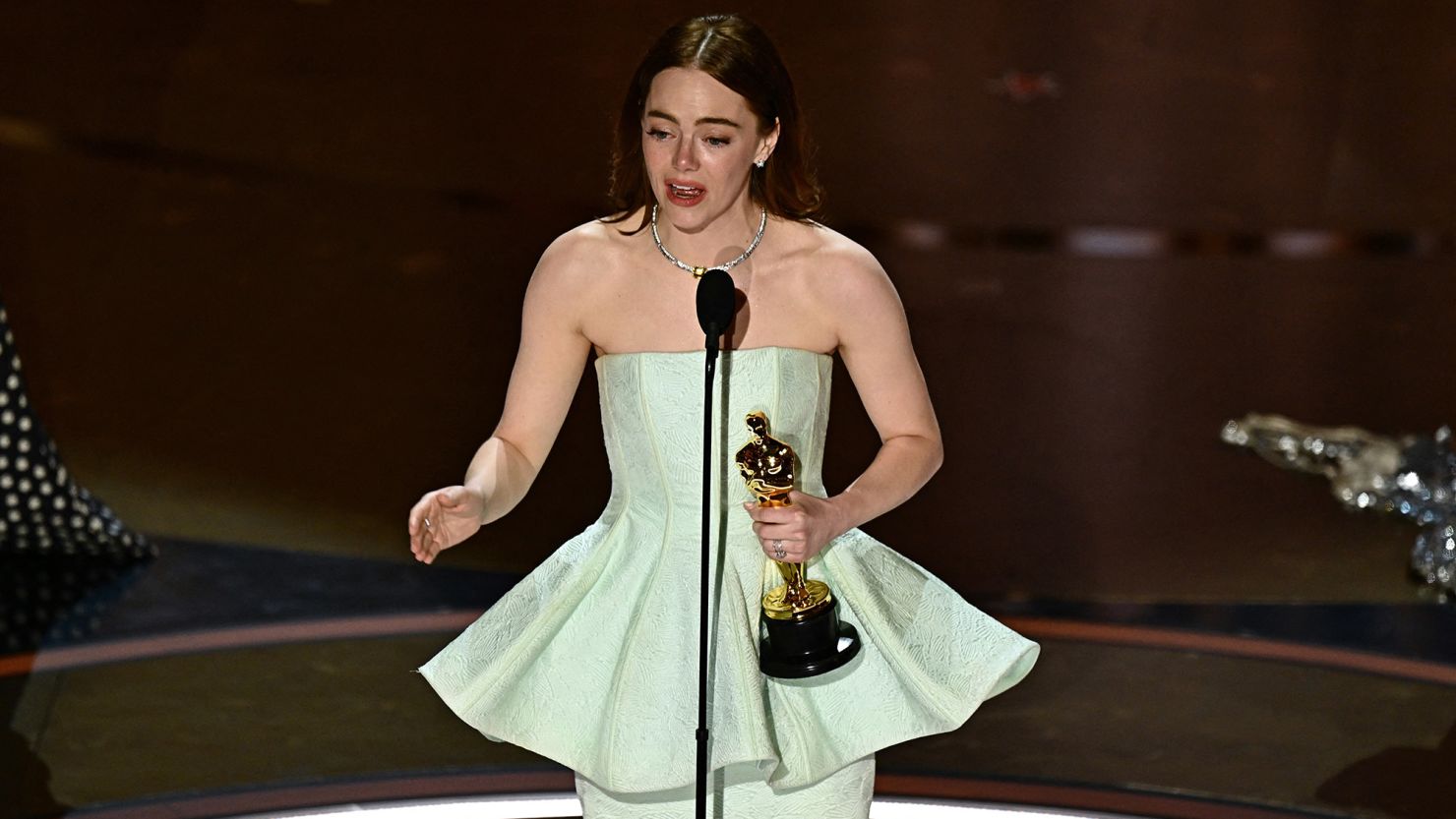
The big surprise of the evening was Emma Stone’s win for Best Actress for Poor Things, which nearly everyone, including obviously Stone herself—assumed was going to go to Lily Gladstone for Killers of the Flower Moon (which, with 10 nominations, went home empty-handed.) Stone’s shock and joy at the announcement of her win were fun to watch, and provided a big shot of energy and authenticity to an otherwise slightly lackluster evening. In fact, the love for Poor Things was something I thought I saw coming, but only in a distance, and not enough to affect the awards. I was wrong. In addition to Stone’s win, the film won Best Make-up and Hairstyling, which was thought to go to Maestro. It also won two awards that many thought would go to Barbie: Best Costume Design and Best Production Design.
The big winner, of course, was the deserving Oppenheimer, which won Best Picture, Best Director (Christopher Nolan), Best Actor (Cillian Murphy, the first Irish actor to win in this category), Best Supporting Actor (Robert Downey, Jr.), Best Cinematography, Best Original Score, and Best Film Editing. I always thought that Nolan would eventually win Best Director and possibly Best Film if he upped the human aspect of his films, allowed a little emotion to creep in, and pulled back on the cerebral. He made moves in that direction with Dunkirk, but really hit his sweet spot with Oppenheimer.
Host Jimmy Kimmel is not my favorite television personality, but I was impressed by much of his opening, which was gracious and hit the proper note of celebration. Then he went for the low-lying political fruit jokes, and slightly soiled the evening. The presenters were mostly fine, if not great. But the spontaneous banter should be left to the comic greats, and while the teleprompter lines were boring and milquetoast-y, at least they had a semblance of sense and order, and should have been stuck to more often.
The lowlight of the evening were the controversial statements made by The Zone of Interest director Jonathan Glazer bemoaning the current Israeli-Hamas in terms that have become justifiably controversial. Apparently, hundreds of folks in the film industry have formally objected to his (ultimately) Hamas-supporting statement. In a related side story, some attendees wore red pins, which were a call for a cease-fire. The most famous duo who wore the red pins were the naïve but brilliantly talented Billie Eilish and her brother Finneas O’Connell, who deservedly won Barbie’s only Oscar for their song “What Was I Made For?”, which they delivered beautifully in a live performance. The other most famous red-pinner was unsurprisingly, Hollywood’s current great contrarian Mark Ruffalo. (I’m sorry—did I just inject a political opinion in an article discussing the celebration of an art form? I can’t imagine anyone wanting to make a virtue-signaling personal political statement when they are supposed to be saluting artistic cinematic achievements…I mean, who would do that?)
A consistent disappointment these days is the otherwise touching In Memoriam segment. Instead of just giving us the names in a clear close-up series of images with a musical background, we had another visually distracting musical presentation, this one aggravated by an even more distracting dance moves by a small crowd. Less is more, people.
The awarding of Best Picture was the best argument yet for letting the award be given by someone under 80. Yes, Al Pacino is a legend, but his presentation was bumbling and embarrassing. Either he was coached wrongly, wasn’t coached at all, or the coaching didn’t stick. Either way—discomfiting.
The highlight of the evening was Ryan Gosling’s performance of “I’m Just Ken.” For someone not a professional singer or dancer, he really pulled it off in the most exhilarating moment of the evening. I have respected him as an actor since Murder by Numbers (2002), and my respect for him peaked with his performance in Barbie and on the Oscar stage. For a deeply talented (and generally serious dramatic) actor to put his ego and persona aside to give everything to a number like this makes it a number for the ages. It was as memorable as Will Smith’s slap of Chris Rock, but for opposite, happy reasons.
Final thoughts:
I’m glad Nolan has found recognition as well as success. He is one of the great ones, for several reasons.
It was nice to see Robert Downey, Jr. praise his wife for her loyalty to him and her major role in the restoration of his life and career.
This year’s Oscar show is likely to be a snooze fest. There might be a surprise here and there, but most folks feel that the awards are already set in stoneSo in the interest of time, and with the reality that I don’t much of that time, here are my thoughts in a Cliff Notes fashion—meaning I’m not listing all the nominees, but just putting my predictions and associated thoughts out there.
Best Picture
Oppenheimer
Best Director
Christopher Nolan, Oppenheimer
Best Actress
Lily Gladstone, Killers of the Flower Moon
(Possible upset person: Emma Stone, Poor Things)
(Note: Natalie Portman should be on this list for May December.)
Best Actor
Cillian Murphy, Oppenheimer
(Possible upset person: Paul Giamatti, The Holdovers—please, God no. I love Giamatti, but not this year and not for this performance.)
Best Supporting Actress
Da’Vine Joy Randolph, The Holdovers
Best Supporting Actor
Robert Downey, Jr., Oppenheimer
(Possible upset person: Ryan Gosling, Barbie)
Best Animated Film
Spider-Man: Across the Spider-verse
(Possible upset film: The Boy and the Heron)
Best Cinematography
Hoyte van Hoytema, Oppenheimer
Best Costume Design
Jacqueline Durran, Barbie
Best Film Editing
Oppenheimer
Best Production Design
Poor Things
(Possible upset film: Barbie)
Best Score
Oppenheimer
(Possible but unlikely upset film: Killers of the Flower Moon)
Best Song
“What Was I Made For?”, Barbie
Written by Billie Eilish and Finneas O’Connell
Note: This will be the second Oscar win for the pair, after 2022’s “No Time to Die”. Billie is all of 22 years old. Expect that this Oscar will not be her last.
(The “God help us” possible upset song: “I’m Just Ken,” which probably provided the silliest and most fun moment of the film, but which doesn’t come close to “What Was I Made For?” as a piece of music. Let’s hope the Academy doesn’t do a “Talk to the Animals” here.)
Best Sound
Oppenheimer
Best Documentary Feature Film
20 Days in Mariupol
Best Adapted Screenplay
American Fiction
(Note: The Academy wants to recognize this film, and this category gives them a legitimate opportunity.)
Best Original Screenplay
Anatomy of a Fall
(See note immediately above, especially since the Best International Film winner will NOT be Anatomy of a Fall).
Best Visual Effects
Godzilla Minus One
Note: I don’t understand this one, as I don’t think it should even have been nominated. But it was a surprise hit, so there’s that….
Best Makeup and Hairstyling
Maestro
Note: For several reasons, the Academy doesn’t like/doesn’t get this film, but this category provides a legit reason to award something to it.)
Best International Film
The Zone of Interest
Best Animated Short
“WAR IS OVER” Inspired by the Music of John and Yoko
(Note: See title for why this will win.)
Best Documentary Short
The ABC’s of Book Banning
(Note: See title for why this will win. It will also be the one film to scratch the itch of current political correctness, so desperately desired by the Academy for their yearly virtue signaling.)
Best Live Action Short
The Wonderful Story of Henry Sugar
Final note: This has been a surprisingly rich year for films. Many will be classics, and many that didn’t get nominations, or did and will lose, will be looked at closely and reevaluated in the future: MayDecember’s three central performances; what Carrie Mulligan does in Maestro (nominated) and Margot Robbie in Barbie (not nominated): Greta Gerwig’s accomplishments with Barbie, Leonardo DiCaprio’s work in Killers of the Flower Moon; Asteroid City. The one thing I can predict with hope, though, is that the winners in all categories will at least be worthy of honor.
Well, a couple of reasons. One is that I usually like to wait until the hubbub/brouhaha is over before writing about a film. This more than any film of 2023 was surrounded with so much noise that it would have brought a lot of signal interference with my writing about it near the time of its release. Also, I wanted to get this in before the Oscars, as Barbie will be very much yesterday’s news just a few days after this coming weekend.
Barbie is funny, stupid, beautiful, messy, and confused. Let’s start with the good: Its production values are wonderful. Director Greta Gerwig and the production team have created a fantasy world that is as believable as Barbie herself is; it’s a world of imagination—tough to do successfully—and consistently on the other side of anything realistic. The pastel colors are lovely to the eye and of a piece with Barbie’s world.
Margot Robbie, one of the producers and the film’s lead, is really excellent as Barbie. She didn’t receive an Oscar nomination, which was a disappointment to me (and many others). This may well be an actual snub (see https://film-prof.com/2024/01/26/oscar-nominations-2024-first-thoughts/ for my thoughts on that overused and abused word), and the reasons may be obvious, or not. Barbie is not a drama, which tends to draw higher raves; comedy is notoriously hard to do, as is staying consistent with a specific comic tone, which makes her performance a little less obvious and of a whole with the film itself; and yes, there might be a little jealousy and sexism here. It might be because Robbie is one of the beautiful actresses currently making films and the film highlights her physical appeal, and it might be because she is playing a doll. So there might be some understandable jealousy mixed in with not playing an actual human.
The actor who did receive an Oscar nomination is the very talented Ryan Gosling as Ken. This could have been disastrous for another actor, but Gosling gives himself over completely to this “living doll” who is equal parts insecure and is not the sharpest knife in the drawer. Gosling is neither a dancer nor a singer (yes, I saw La La Land), but he has the moves and the notes to distract us from this fact. In fact, a real dancer or singer would have been distracting in this world and for this character. Kudos to one of best young (and intelligent) actors in taking this role and leaning into it so much.
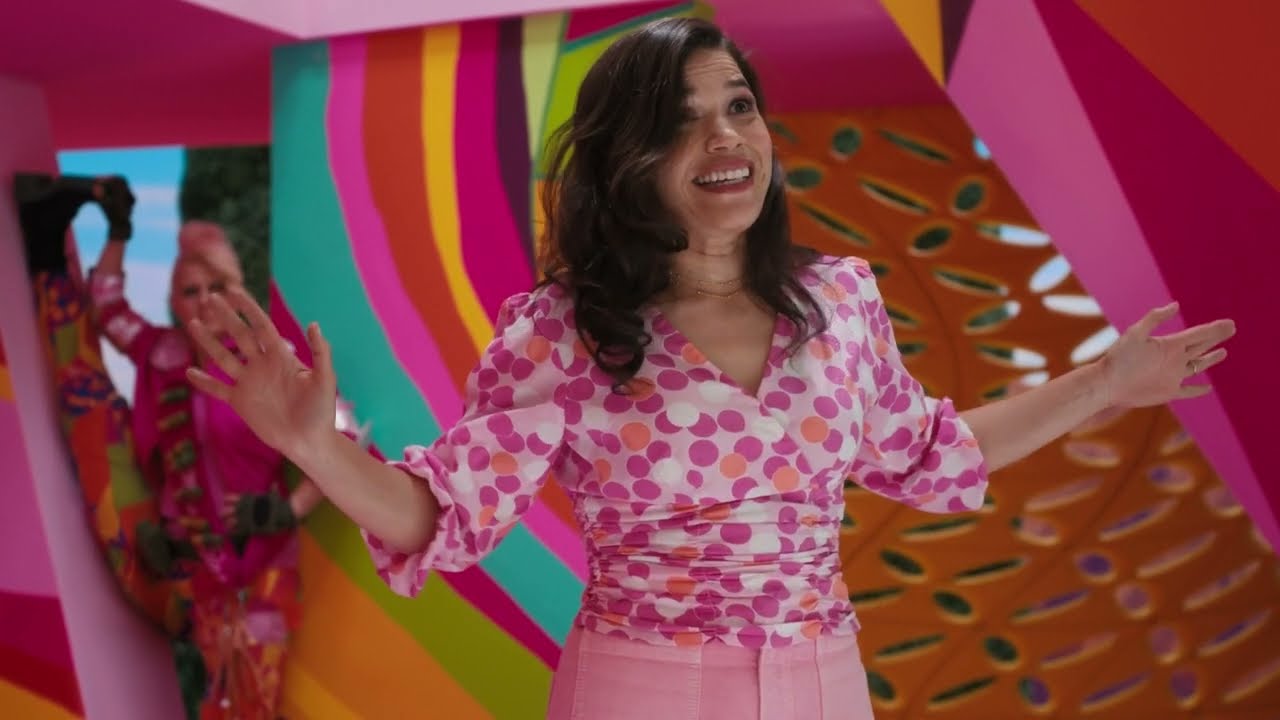
The other strong points are the performances by America Ferrara (also nominated in the supporting category) and Michael Cera. Ferrara made a speech for the ages about the challenges of being a woman, but her performance is much more than that. That speech is her “moment,” but she brings a lovely strong realism to her character that is essential to the film. (It reminds me of the talk that Luise Rainer’s phone call in The Great Ziegfeld was the sole reason for her nomination and win back in the 1930s, when her performance was so much more than that moment.) She is the connection between Barbieland and the real world that helps hold the film together (an element much needed, and well exploited).
The other actor who should be mentioned is Michael Cera, who brings in an understated yet hilarious performance as Allan, the friend of Ken’s who was introduced after Ken was but pulled from the shelves a few years later. Cera is humbly and ably playing up his blandness compared to Gosling and the other Kens, all of whom are good looking and in great shape. Cera never once “winks at the audience” to let him know that he is in on the joke, but sacrifices himself as an actor for the part.
What’s NOT good in Barbie? A lot, but I’ll go to the beginning for what I believe to be the worst part. There is an admittedly clever takeoff on 2001: A Space Odyssey, with Strauss’s “Thus Spake Zarathustra” blasting behind a recreation of the apes scene. Barbie herself becomes the stand-in for the monolith, all of which could be referentially cute except for the narrator’s message. Apparently, little girls who play with dolls only did so after a while because it was forced on them and they were criminally limited to baby dolls. So we see a group of miserable children stuck with playing with baby dolls, obviously practicing for the inevitable “servitude” of motherhood. Instead of just offering another alternative to the baby dolls, Barbie’s arrival leads them not to add an adult doll to the mix, but to destroy the baby dolls with diabolical force, sending the film’s first message about motherhood. For us film historians, it’s all very clever. But it’s also a horrific scene in its images and implications. (There are a lot of other film references throughout the film, most of which are amusing: The Matrix, Love Actually, Monty Python and the Holy Grail, The Sixth Sense, The Shining, Top Gun, Zack Snyder’s Justice League, etc.)
Yes, the picture is “woke,” whatever that means anymore. But its feminism seems old-fashioned and its adherence to the Academy’s new rules for inclusion and representation, whether intentional or not, is funny in its own right. We have a bit of gay representation (actually, more of a suggestion), a trans Barbie who simply looks like a long-haired male, an overweight Barbie, and a Wheelchair Barbie, and of course, black and Asian Barbies and Kens to beat the band. On one hand, expanding the Barbie universe is legitimate, as it reflects the gradual development of the brand and the new Barbieworld the filmmakers envision. On the other hand, the characters often seem shoehorned in rather than arising naturally from Barbieland, which, let’s face it, is essentially and historically white and middle class. While we get “one from each underrepresented group,” the one unwanted Barbie is Midge, who is the pregnant Barbie. So again the appearance of a baby is highlighted as being unwelcome and ultimately rejected. And the only time motherhood is presented as a possibly “OK” option—as best as I can remember—is with Ordinary Barbie, and the line is a throwaway at best.
There is a great deal of clever humor in the film. When Barbie steps out of her high heels and her feet remain on tiptoe, that’s a delightful joke to anyone who has seen Barbie’s feet. The fact that there is neither water in the shower, not tea in the cup, again resonates, and is used well in the second half of the film. “Hold my ice cream” is a great substitute for “hold my beer.” Of course, role/gender reversal is a key part of the story, and that’s where the film is funniest and weakest. Having male cheerleaders for an all-women’s athletic team is a great sight gag that can hit home philosophically, but does so with a light touch. The narrator’s (Helen Mirren) remark about the casting of Margot Robbie at a certain point of Barbie’s journey of self-discovery is on the nose and charming. Guys playing their insipid songs ad nauseum for girls—great! Men still needing help with the remote—priceless. And when the head of a corporation talks about the patriarchy, and says that they still believe in it and work with it, but just hide it better—that may be the best dark line in the film.
Yet, the film isn’t exactly sure what the patriarchy really is. Is it simply the historical taking of roles that should be shared? Is it sexual oppression, pure and simple? Is it a rather disturbing love of horses, which are explained as “men extenders”? Is the darkness of it revealed finally in the statement, “I wanna push you around”? It seems the idea is more “men vs. women” here in than other films exploring the idea in more subtlety, and it also seems the end result of patriarchy in this film is a parade of stupid men (a redundant phrase in this film?) in power by default. There seems an attempt to “be fair” in helping Ken come to his own sense of identity, but his journey of self-discovery is awkward and lacking in logic. All the Kens (and Allan, of course) are presented as being stuck in a larger oppressive construct at a few points, but mostly they are just insecure jerks.
Perhaps the weakest aspect of the entire film are the presence and actions of the corporate Mattel group, headed by a misused/miscast Will Ferrell. The presence of Ferrell should have provided a great side trip for the viewer, but he seems cast only so that we don’t completely hate or dismiss such a repulsive character. Corporate America is taken down a few humorous pegs in the early courtroom scene, where a strong socio-political statement about the role of corporations in the legal world is sharply criticized but is quickly candy-coated with a strong truth about the legitimacy of being both emotional and logical. The corporate criticism is quickly eclipsed by the truthfulness and humor of the fact that logic and emotion can legitimately co-exist. It’s a great way to hide a strong statement inside of a distracting humorous context that happens to contain another strong statement about wrongful criticism against some women. It makes its points while being deft enough to exist in the film about a doll. But the corporate side story, even with Ferrell at the lead, just doesn’t work, and I was happy when he and his cohorts disappeared.
Finally, the film contains some “pearls of foolishness” that continue to endanger young minds and ultimately society itself. For example, to paraphrase, “If Barbie can be anything, you (a young female) can be anything.” Sorry, we can’t do or be anything, and while having vision and being encouraging are always in order, we can’t be “anything” we want. Also slipped in is the idea of reality being created by feeling, which is a mental scourge of the age. (I personally keep feeling like a billionaire who looks like Brad Pitt, but that hasn’t gotten me anywhere….) “Feeling” is how the film presents Barbie as being able to become “real.” Sorry, feeling alone can’t create reality, as much as some individuals and groups are pushing the idea, and I was disappointed to see the film present simply feeling as something that has the power to create reality. And lastly, the great and most famous quote that will probably outlive the film is this: “By giving voice to the cognitive dissonance required to be a woman under the patriarchy, you’ve robbed it of its power.” Great line, if a little overly optimistic. But in a film that relies on this as a theme, even if in the make-believe worlds of dolls, the line loses much of its power when Barbie acts surprised that the words came out of her mouth. It’s like when the Scarecrow in The Wizard of Oz says that “The sum of the square roots of any two sides of an isosceles triangle is equal to the square root of the remaining side.” What’s funny about that 1939 statement is that it’s true, but surprising and funny considering its source, who remains untaught and clueless. Same with Barbie and her comment here. It’s wise for a comedy to say the loud part quietly instead of the quiet part out loud, but any possible reverberations of that idea throughout the film are lost in Barbie’s (and hence our) surprised reaction at what is coming out of her mouth, even if bypassing her head.
Barbie is ultimately cotton candy—very pretty, delightful to look at, and tasty at first bite. But it’s full of useless calories, can provide a sugar rush followed by a swift carb crash, and eventually ends up providing unhealthy ingestion.
Note: Yes, I know Barbie is “just” a movie, and about a doll that’s not real and works with the imagination. But there is finally no such thing as “just” a movie.
Not a particularly successful film financially, the dramedy The Holdovers nevertheless managed to snag five Oscar nominations. The Best Picture nomination isn’t even close to being deserved, especially in a year like this. But at least two of the other nominations are deserved, and are the reason to see the film. They are the performances of lead Paul Giamatti—very much loved in Hollywood—and Da’Vine Joy Randolph, who runs away with the film.
If Dead Poets Society and TheSterile Cuckoo had a baby, it would something like The Holdovers. We have a teacher trying hard to instill at least something of worth in his students and we have a confluence of events that lead to folks being stuck at school over the holidays. ‘Nuff said about the storyline. If the plot seems a bit retro, the entire film embraces that, leaning heavily into a 1970s feel, 1970’s music, and even a heavy 1970s filmmaking style that can seem jarring at times to those not realizing what director Alexander Payne is trying to do (e.g., that quick reverse zoom that could take one out of the film entirely).
But this familiarity and sense of throwback help make this a comfortable film to watch. It’s as threatening and subversive as a basket of puppies and often just as cute. Casting the ever-lovable Paul G. in the lead is reassuring to the viewer, especially to those who have his famous performance in Sideways as a backdrop (we just need to forget about his role in 12 Years a Slave). There are a lot of tug-at-your-heartstrings moments—perhaps one or two too many—but a tight yet laidback film like The Holdovers can be seen as counterprogramming to a loud superhero movie or anything in the category of Barbenheimer.
Giamatti, whom I originally hoped would be so fresh and wonderful that he might win the Oscar, isn’t, but is nonetheless solid and hits every note well. He is almost always a joy to watch, and no matter how stubborn and clueless and even cruel his character here can be at times, since it’s Paul G., we still love him.
Da’Vine Joy Randolph’s character could have easily been cloyingly stereotypical, but what she does with it is quietly amazing. As a pillar in the film’s structure, it’s her job to be the down-home realist who brings loving support when needed, and a swift metaphorical kick in the rear end when required (mostly by Paul G.’s character). But she is an excellent example of how to flesh out a role that on paper seems rather formulaic. Yes, as an actress she has her “big moment,” but even that is underplayed. What is a joy to watch is how realistic and specific her dialogue is in every conversation. This is not a typical character that any decent actress could have played; this is a fully formed human with depth, insight, and yes, the requisite humor. She seems a lock on the Oscar. Her performance reminded me of the response to Broadway legend Laurette Taylor’s stunning performance in the original stage version of A Glass Menagerie, that was hailed as so true and un-stagy that a common description was that she didn’t come across as an actress as much as someone wandering in off the streets and being real for two hours. Randolph’s performance is a triumph of not just what is, but of what she managed to avoid.
Dominic Sessa as the troubled kid left behind and Carrie Preston as a blink-or-you’ll-miss it romantic possibility for the teacher are both marvelous, and their work shouldn’t go unnoticed with two other large performances around them.
Oddly for a film from director Alexander Payne film, who usually writes his scripts, this screenplay by David Hemingson seems a bit paint-by numbers, showing the seams more than it should: the rich man taking away everyone BUT “the kid who will be left behind” is a bit bumpy, as is the discovery of a certain medication by the teacher, for example. The structure creaks here and there, but is like an old comfy house with an occasional squeak of a floor and a draft from some of the windows. Not cutting edge in any way, but either comfortably familiar and non-threatening, or cliché and derivative. You choose.
Randolph will likely bring home the film’s only Oscar. She well deserves it, but the film is ultimately an enjoyable, “they don’t make movies like that anymore” film most folks will end up enjoying at home.