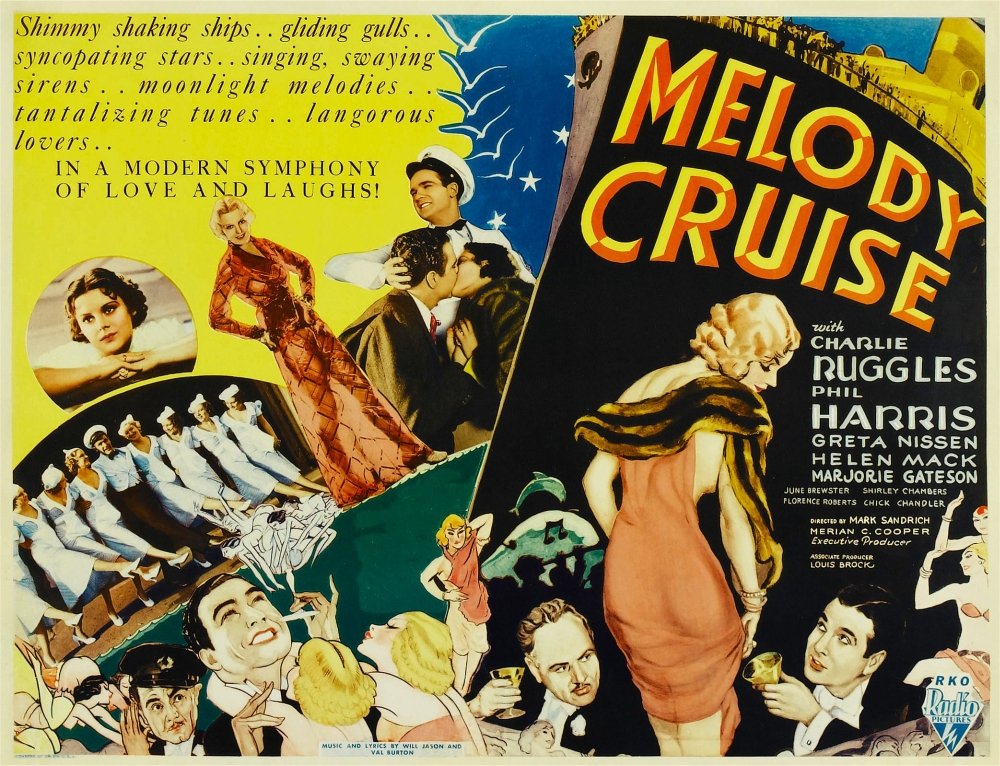
Melody Cruise (1933)

Melody Cruise is a delightful, one-of-a-kind film that’s not quite a musical (but is), not quite a romantic comedy (but is, sort of), a very Pre-Code film (which is definitely is), and a crazy blend of cinematic experimentation and sheer lunacy. For those with any interest in early ‘30s musicals, the work of director Mark Sandrich (who went on to do many of the Astaire/Rogers musicals), or who wonder what a Pre-Code comedic film looks like, this is your chance. It’s nuts, but a great deal of fun.

What most critics have pointed out over the years are the visually arresting ways Sandrich moves from one scene to another. Simple cuts or fades don’t work here. Yes, it can all can seem a bit much, but it is not only fascinating to see an American, working for a major studio (RKO), who dared to do such experimenting in a mainstream film; it is like René Clair on steroids at times. But those who stop at calling it simply experimenting or using cinematic tricks for their own sake, they are overlooking the fact that how one scene moves into another helps keep this film moving so briskly and entertainingly along.

And it often needs that kind of help moving things along. The plot is borderline ridiculous, especially by today’s standards. We have a man who is determined to never get married (you know the end already), an older man/mentor who is determined that he not get married (for his own selfish reasons), and a couple of scantily clad young ladies that somehow (!) end up in the stateroom of the older man. Then, we have sitcom like misunderstandings, etc. It’s all silly and literally incredible. But again, the film has an ace up its sleeve: while never mocking itself, it never comes close to taking itself too seriously.

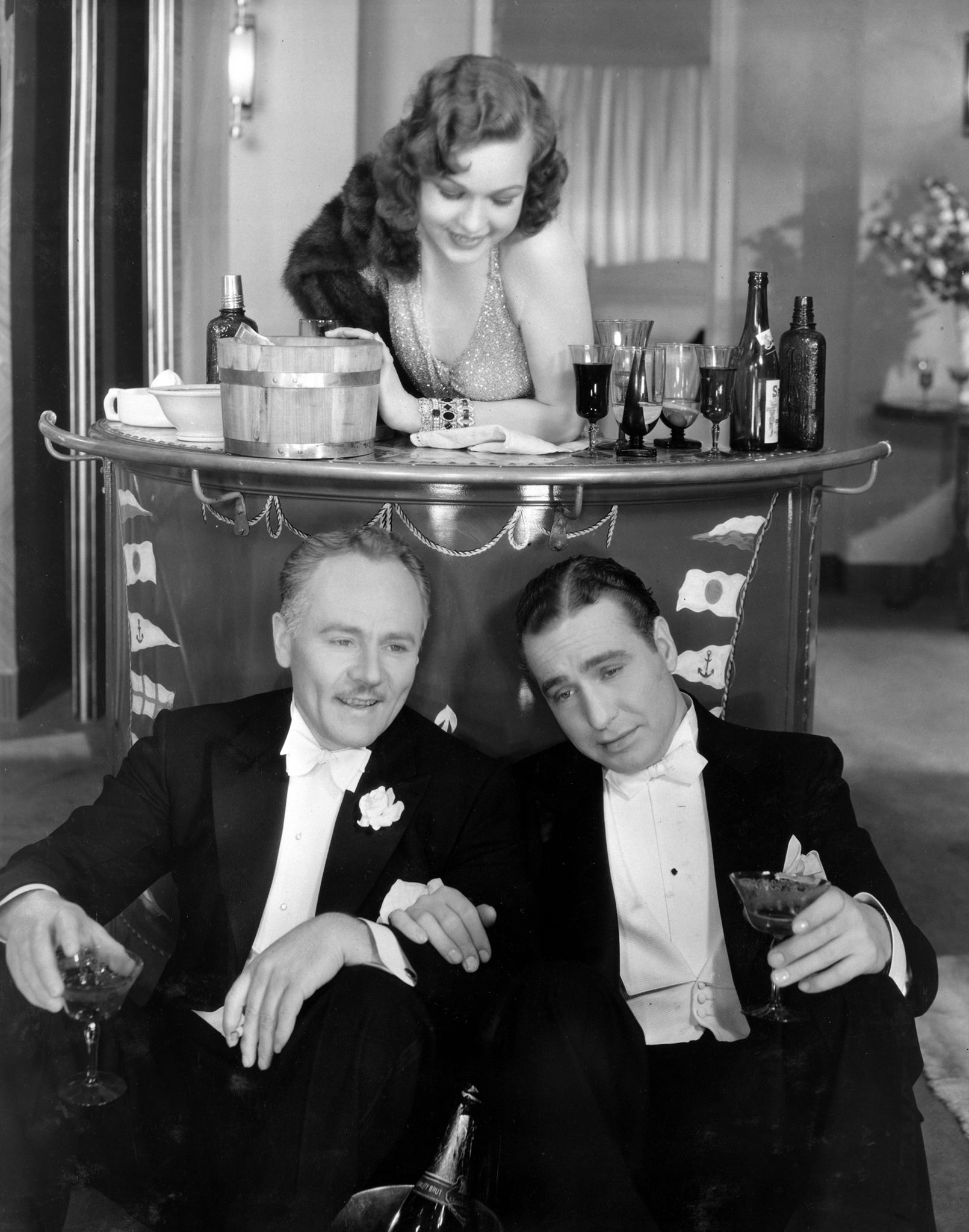
The older man is played by Charles Ruggles (above left, with Phil Harris, right), who didn’t meet a double-take and slow burn he didn’t want to adopt. He was the star of the film and was quite well known then. His facial antics don’t age well, and he comes across as silly and fussy at times, but it works. The other lead is first-time film actor Phil Harris, now pretty much forgotten except for his marriage to and long professional association with the inestimable Alice Faye. You have to swallow a bit to accept him as a leading man as he doesn’t have the look nor really the singing voice, even though he was a band singer and radio singing star for much of the rest of his life. But knowing what a big star he became later helps. The ladies are generally window dressing, except for Florence Roberts and Marjorie Gateson, who play the fussy old aunt and fussy wife with ease.

A secondary player almost stills the film, however. Chick Chandler, above, (later a star of television’s “Soldiers of Fortune” as well as a part of It’s a Mad Mad Mad Mad World (1963) liven every scene he’s in. He’s all of 5’ 9” and looks like 100 pounds dripping wet. But his introductory vaudevillian dance routine is a hoot. The introduction of a specialist actor and act in early ‘30s films is not unusual, and they often don’t work. But it does here, one, because it’s so well done, and two, because this is a crazy film where anything goes. He’s not really an actor at this point, and his overdone reactions are a bit much, but his character is great. And he sneaks in an almost unheard line directly taken from Mae West’s She Done Him Wrong, released that same year. Listen closely or you’ll miss it in the scene where he is serving dinner to the two scantily clad young ladies. Yes, it’s “Come up and see me sometime.” In the rest of the film, he is quite over the top but is a delightful character you’re glad to see when he appears.

Then there are the musical numbers, which sometimes are boringly straightforward, but which occasionally borrow from the previous year’s Love Me Tonight in their sharing of a song over time, space, and different people. That’s a tricky thing to do anywhere, but the lightness of Melody Cruise’s tone allows it to work here. There isn’t a great voice to be found, nor a great song, although “He Isn’t the Marrying Kind” is fun and actually moves the plot forward. And then there is the Busby Berkeley-type ice show, thrown in for no good reason, but again, which somehow works amidst the rest of the cinematic insanity.

The one regretful thought associated with Melody Cruise is that Mark Sandrich, while successful with his Astaire/Rogers pictures, never seemed to recover the creativity he expressed here. After all, those plots were standard and the dance numbers eschewed any kind of inventiveness beyond displaying the terpsichorean virtuosity on display. Sandrich died a very early death in 1945, and after the Astaire/Rogers film, may be best remembered today for Holiday Inn, which introduced “White Christmas” to the world. We’ll never know what kind of inventive films he might have presented us.

If you’re looking for intellectual consistency, logic, great acting, or a film that feels modern, don’t see Melody Cruise. If you’re looking for what some interesting directors were doing with music and film language at an earlier time, this is for you. Plus, it’s bonkers fun.

Posted in Film Reviews, Older Films | Tagged , , , , , , , , , , , , , , | Leave a comment

Wicked

Seeing Wicked (a.k.a. Wicked Part 1) brings up old-fashioned terms, such as “movie-movie,” “beautifully mounted,” and “lovingly produced”. All are true, and all are doubled-edged swords, meaning simply that many of the film’s great strengths are also some of its weaknesses.

But first, its many strong points. The performances are uniformly excellent, especially from the three leads. The film starts off concentrating on Ariana Grande’s Galinda/Glinda, but eventually shifts to Cynthia Erivo’s Elphaba, and this first part climaxes with a full demonstration of cinematic artistry and one great set of pipes. Oriva will probably win a Best Actress nod, and I expect she’ll win the Golden Globe for Best Actress in a musical. This is a performance that grows in expression and power—emotionally as well as vocally—throughout the film, and she is probably one of the few actresses who could conquer this role as well as she does.

That, however, is no surprise. Her turn in 2019’s Harriet alone is enough to place her in a special category. What was the surprise to this author was Ariana Grande, whom I’d only known as a singer, and a singer with a voice I wasn’t familiar with Not only does she have an easy coloratura soprano. She might be accused of channeling Kristen Chenowith, the original Glinda), but her acting is every bit the equal of Erivo’s. (The two singers have incredible vocal placement throughout.) Could there be a double nomination? Both Erivo and Grande nail every scene, and I didn’t detect a wrong note anywhere.

The fact that the two big leads are great would be enough. But the supporting roles are as solid as the leads. Michelle Yeoh (a deserved Best Actress Award for Everything Everywhere All at Once) is perfect as the strong leader that oozes matronly authority. Jonathan Bailey as Fiyero doesn’t have a voice of the two leads, but his is pleasant enough and more than does the job. He’s not a dancer, but you’d never know it. Ethan Slater plays a Munchkin with as much heart as possible, and Marissa Bode as Elphaba’s sister Messarose, while not rising to Slater’s heights as his love interest, is nevertheless very solid.

What I was slightly dreading but didn’t need to was the arrival on screen of Jeff Goldblum as the Wizard. All of that manic and undirected energy of some of his earlier performance (pick one—any one) has been internalized as charm and joy (spoiler alert: until there’s a shift). It’s a wonderful (pardon the pun) performance that also demonstrates a serviceable singing voice.

Other strong points include the dazzling world created for the film. It’s a visual wonder that dazzles without distracting, and wows while remaining of a piece with the central characters and plot. Director John M. Chu (In the Heights, Crazy Rich Asians) has balanced a nearly innumerable set of elements (performance, editing, sound, cinematography, production design) into a cinematic whole that blended into a near-perfect whole.

However…the film suffers slightly from the problem faced by Phantom of the Opera, Les Misérables, and other famous musicals with memorable scores. The problem is that instead of becoming a cinematic entity, these films become a visualization of the stage play, with full respect, even obeisance, being given to the numbers. The numbers, probably due to contractual agreements, are presented in their entirety. That works on the stage, but can be detrimental to a film. Phantom suffered greatly from it, and to a lesser extent, Les Miz. Wicked suffers less so, but the film is too long and loses some dramatic power occasionally because of it.

For example…check out this paragraph from Wikipedia about the cast album recording:

Popular” was the first musical number shot for the film.[11] Schwartz, Wells, and Oremus proposed modifying its rhythm from the stage musical version and “hip-hop[ping] it up a little bit”, but Grande insisted that the song stay true to the original.[12][13] The song features an extended ending with additional key changes.[14][15]

It’s that respect for the original that is the issue. Chu fortunately has the talent to make each elongated moment sound good and look beautiful. But the bottom line is that the film is too long by a good half-hour, and could easily have been punched up cinematically and dramatically if the director had been allowed judicious cuts. More examples: “Dancing Through Life” takes too much time to get going and goes on too long,  and even the iconic “Defying Gravity” didn’t need to be stretched out as much as it did; the ending of that song, though, almost makes it worth the wait.

According to research, the film was originally conceived for a 2016 release, and then this new version was supposed to be a 2019 release. I say that because certain elements that parents might not be wanting their children to see are present, but seem almost woke-retro and a bit stale today. Fiyero is presented as an object of admiration and even lust by both men and women, which comes across as tired and not cute in 2024. Also, and perhaps more seriously for those watching out for impressionable young ones, there is a strong blending of the genders in Oz. Women are dressed as men, men as women, and everything in between. Again, for someone like this author that believes that (dare I say it!) there are only two genders, while also acknowledging a full spectrum of expressions within those two genders, it seems like old-school progressivism in the most tired Disney style (and yes, I know it’s a Universal film).

For some, that will be the poison pill that keeps you and your young ones away. For everyone else, this is an incredibly beautiful and beautifully produced film, and only suffers from the slightest case of Famous Song Over-Respect Syndrome.

Posted in Film Reviews, Newer films | Tagged , , , , , , , , , , , , , , , , , , , | 1 Comment

La Bohème

La Bohème is a silent film from 1926 starring the luminous Lillian Gish and the overactive John Gilbert, and is directed by King Vidor (Oscar nominations for directing The Crowd, Hallelujah, The Champ, The Citadel, and War and Peace). Note: Vidor is listed in Guinness World Records as having “The Longest Career as a Film Director,” beginning with 1913’s Hurricane in Galveston and ending with 1980’s The Metaphor. He may be best known to modern audiences as the uncredited director of the sepia-colored Kansas scenes from 1939’s The Wizard of Oz. Coincidentally, Gish has the career record as an actress, beginning in 1912 and ending in 1987. Gilbert, unfortunately, was not so lucky.

Just watching the three of these legends converge is fascinating enough. Gish was working to free herself from the constricting roles she had under her mentor D.W. Griffith, and was here stretching out her acting wings making her first MGM film. Gilbert was peaking as a star and actor, having hit his height with 1925’s The Big Parade (https://wordpress.com/post/film-prof.com/747), a great silent film and the one Gilbert will likely be best remembered for. Of course, what Gilbert will be most remembered for is not one film in particular, but the ones he made with Greta Garbo, with whom he had a tempestuous and (for him) frustrating affair.

Watching early Vidor is fun, as he was clearly experimenting with the medium. There was an unexpected forward tracking shot in the picnic scene, and his use of superimposition is both striking and emotionally resonant. There is a lot of the usual silent film framing, with a static camera capturing whatever is happening in front of it. But what happens in front of those static cameras can be lovely. There is a “declaring our love” dance between Gish and Gilbert that is exhilarating and romantic as “Shall We Dance” in The King and I. But there are also close-ups as effective as those of Griffith, though there is a distinction between Gi’s soft focus and the sharp focus given to Gilbert.

The story is based on Henry Murger’s novel Scenes de la vie Bohème, which was also the basis of Puccini’s opera of the 1890s. And for more modern audiences, it is also the basis of Jonathan Larson’s Rent, which debuted on Broadway in 1996. In this film, it is wildly of the Romantic era and romantic at the same time. The story is either full of wild love and great passion, or just overly melodramatic. So is the acting, which isn’t all a bad thing.

Gish, as a silent actress, was greatly skilled in the art of silent acting, which consisted of a combination of internal emotional connection and learned gestures inherited from the theater. Gish was much more naturalistic than many of her more histrionic peers, and her acting here includes those gestures, but also includes many, many scenes of subtle, lovely work. If you look for those moments in the midst of the older fashioned acting styles, you will be well rewarded. She also has a scene where she is acting out the remainder of a play being written by Gilbert’s character that could have easily won her a Best Actress Oscar if the film had been released a year later. And if that weren’t enough, she eschewed liquids for three days before her death scene, rivaling the sacrifices that Bette Davis would make years later in Of Human Bondage.

Gilbert is more problematic, in a number of ways. He is over the top here, which may be due in part to the difference in speed from the 16 frames per second to the 24 frames per second of modern films, which has the effect of speeding things up, which doesn’t help Gilbert’s hyperactive performance. His use of gesture can be read as exhausting today, as is the habit of jumping around when he and his homies have something to celebrate. (Note: One of those homies is Edward Everett Horton, well before his career as a fey supporting player in the 1930s). But when he is still, and captured in close-up, his eyes can burn through the film. There is an intensity here that obviously helped make him the romantic follow-up to Rudolph Valentino.

Which bring us to the other reason that Gilbert is remembered. He is emblematic of those that, for one reason or another, couldn’t make the transition from silent to sound films. Unless we can exhume Louis B. Mayer’s brain and find out his thoughts, we will never quite know. The two big reasons given are that his voice didn’t sound right, or at least wasn’t consistent with his image as a romantic leading man. The second is that his melodramatic gesturing, which Gene Kelly satirized so effectively in Singin’ in the Rain, couldn’t tapped down in sound films. Rumors that Mayer had Gilbert’s voice tampered with so he could get rid of him are both understandable (from L.B’s perspective, as Gilbert was a huge expense with little to show for it) and just not true. Gilbert had a fine voice, if one not quite equal to his romantic leading man persona. https://www.youtube.com/watch?v=bbxBwDhAbEI

But Gilbert had other issues than trying to make it in talkies. His on-again, off-again romance with Garbo and his alcoholism and mental struggles conspired to lead him to an early death in 1936. Aside from the tragedy of a young person’s demise, cinema may well have lost an excellent sound era actor. Even in his silent films, Gilbert had a modern energy that rivaled that of James Cagney. He could clearly act, and act well. If that energy had been properly directed, and Gilbert had been more thoughtfully guided into a career in sound film, he might have turned into one of the great studio actors.

As the date of the film reveals, we are at the end of the silent era, and these are two of the great silent actors at the top of their game, even if that game is overly-gesticulated at times. But we are also at the relative beginning of a great directorial career with a person continuing to discover, after the successes of The Big Parade and The Crowd, what he could do with the medium. As a time capsule, it’s well worth the visit.

Posted in Film Reviews, Older Films | Tagged , , , , | Leave a comment

Gladiator II

So the big question of course is, “Are you entertained?”, which was the famous quote from the original Gladiator. For the sequel, the answer is basically yes. But being an entertaining movie is not the same as being a great one. Briefly, the film is brighter, louder, more violent (yes, really) and for all its lauded efforts to combine the film with its predecessor, shallower than the original. It’s fun, and it might end up with some technical awards at the Oscars, but I wouldn’t be in favor of a nod in any other category.

Director Ridley Scott, also director of the first Gladiator, knows how to film a battle scene and a more personal one-on-one. But this time around, the violence is both more intense and gory, as well as more ridiculous as the film progresses, sending the film at times into eye-rolling category. Deadly arrows, for instance, seem to find their way directly into the center of the victim’s chest, which is as artful visually as it is preposterous. The other problems with the violence will be addressed later.

Cinematographer John Mattieson, who shot the original, is back for this film. But the dark and moody look that worked well in the first Gladiator is replaced by alternately rich and sometime garish colors. There are moments of quieter and subtle beauty, but too many scenes have colors that pop and end up cheapening the film.

The story is a direct follow-up that simply puts us about 20 years into the future, where (serious spoiler alert ahead—be warned) the son of Maximus (Russell Crowe) and Lucilla (Connie Nielsen) faces the same gladiatorial challenges faced by his father. He is played by well-respected young actor Paul Mescal (Oscar nomination for Aftersun), who simply can’t match the power of Crowe’s presence or performance.

Sometimes it’s instructive (and yea, even entertaining) to see the differences between a film and its very similar sequel. Some may protest that a too-close comparison is beside the point and irrelevant. But the deliberate similarities between the two films here raises the issue of how well the changes work. Unfortunately, most of them don’t help the film. For instance, part of the power of the original was Maximus’s love for his wife, which was ratcheted up later when he found out about her fate. Here, young Lucius loses his wife (again, with a perfectly placed deadly arrow) right at the start. But other than the passionate kisses between the two in the first shots, we don’t really have a sense of the depth of their relationship. Plus, there are no children to mourn. Hence, the pain isn’t as deep, and his so-called “rage” isn’t as powerful.

The story itself is also not as powerful and seems to go into too many side trails. The simple and straightforward enemy in the first film was Commodus, played so wonderfully by Joaquin Phoenix, whose character was continually developed and deepened in the original film. This helped to hold the story together and built emotional momentum. Here the first enemy of Julius later becomes his friend, (another spoiler alert ahead) and even his stepdad, General Acacius, played by “The Mandalorian”s Pedro Pascal (in a serviceable performance). Between Julius’s discovery of who he was, the machinations of the Roman Senate, the switch from friend to foe for Julius, the two emperors and their plans, and the whirling dervish named D. Washington, there is a lot going on here.

Then there is the final scene, a cinematic cliché if there ever was one. Apparently, the fate of the entire empire is coming down to the showdown between Julius (having survived untold near-death experiences in the Colosseum), and Macrinus (Washington), who has succeeded in his plans to take over the leadership of all Rome, except for this pesky gladiator who happens to be Emperor Marcus Aurelius’ next-in-line. But without going into detail, it’s not just a contest between two people that happens to be hold the future of an empire in its outcome. It’s also that most tired chestnut that could have been intoned in the trailer over the fight: ‘THIS TIME IT’S PERSONAL!” The fact that the empire is at stake, and that this also a payback kind of deadly brawl, doesn’t make this a more powerful clash as much as a tired dramatic scuffle that while powerfully presented is rather silly and worn out.

To say that the film “jumps the shark” is just too easy. But really, it does. Between the CGI baboons (fiercer than anything in real life), the rhinoceros, and yes, the sharks, the creatures fought by the gladiators are so unrealistic and over-the-top that it’s hard to take these scenes seriously.

Comparing lead actor Mescal to Crowe may seem unfair as well. But since Lucius is supposed to be kind of a second coming of Maximus, comparisons are worth noting. A great deal of the power of the original film was the presence of Crowe, well known in Hollywood (L.A. Confidential, Oscar nomination for The Insider) but not yet to the public before Gladiator. He exploded on the scene with his acting talent in the film, but to me, his greatest contribution to the film was his great authority, and specifically his (non-toxic) masculinity that stood in sharp contrast to the softer masculinity of the 1990s. While Mescal is only an inch shorter than Crowe, he is slighter and projects much less personal power than Crowe, which puts the onus on others in the cast to help carry the film.

One person who not really carry the film as much as bobs and sways it around is the inestimable Denzel Washington, who simultaneously elevates and throws the film into disarray—in two ways. One is tied to his character and the gradual revealing of his character’s  dark motives and actions. The other is tied to Washington’s acting style, which is 1) his own, and 2) is more naturalistic than this grand sword-and-sandal film is able to completely assimilate. Washington is always outside of the film whenever his character is in it, which can be delightful but can also be distracting.

Mescal is a softer creature than either Crowe or Denzel, and his strong statements in conversation and his calls to action to the troops aren’t quite believable. He gives a consistent performance, but he has a sweetness and sensitivity that don’t quite match what he is asked to do or be here.

The two emperors are out of another film entirely. They are supposed to be brothers. One is ghostly and seems perverse and perverted; the other is smaller, just as ghostly, and is signaled as weak and gay (think 1932’s The Sign of the Cross and the way Charles Laughton’s Nero’s sexuality was presented, young boy included). This representation and the way the older brother describes him seem to be enough for an LBGTQ+ protest, but I haven’t heard of any at this point in time.

Thankfully, there is an actor here who seems to fit perfectly into the film, acting reasonably and with feeling, and that is Connie Nielsen as Lucila. Neilson is given a larger role than in the first film, and finds just the right note in her performance here. Her scenes, with Pascal, Mescal, or any and all guards, help ground the film when all around her go too far or just don’t quite fit into the film.

The film ultimately doesn’t quite work, but the various pieces and characters are fun to watch, even if they don’t all quite come together. If disbelief and critical thinking are suspended to a good degree, Gladiator II may well offer most viewers a wild and violent ride that will definitely take them away from the real world for a few hours. Perhaps, now, that might be enough to recommend it.

Posted in Film Reviews, Newer films | Tagged , , , , , , , , , , , , , | Leave a comment

Conclave

Quirky papal conclave facts - The Boston Globe

Conclave is a beautifully directed, stunningly gorgeous, carefully sound-designed, very well acted production, and is also an ultimate disappointment. For those that were curious but haven’t yet decided to see the film, it’s the story of the death of a pope and the machinations behind the process to elect the new one. Simple plot, and the film leads us to be more invested in the process than in the final result. The joy of the story is the push and pull of the politics of the Catholic Church leaders, and watching the actors doing the pushing and pulling.

Directed by Edward Berger, director of the highly regarded (and well-rewarded) 2022 version of All Quiet on the Western Front, Berger brings the same combination of cool detachment and occasional intensity to the proceedings here. The sound in the theater that I saw the film in had the sound level set at 11, which sometimes painfully allowed the viewer to hear every door closing loudly, every lock reminding us of the closing of a prison door (not subtle but legitimate for the film), and every step taken on the floors as the characters move from one clandestine meeting to the others.

I was raised Catholic, but I can’t account for the accuracy of procedure and costume. Other more in the know, however, say these things are generally on the nose. Sloppiness in these areas can detract, of not completely undermine, the credibility of what we are watching. But this isn’t a documentary, and the slow pace associated with Berger’s style occasionally puts the emphasis on procedural and sartorial accuracy to the expense of the drama. I’m all for a slow build, but the focus on ecclesiastical and historical specific sometimes drains the film of its accumulating power.

The film has gotten attention for its actors and its acting. It’s a stellar cast generally operating at the top of their game. Starting from the bottom of the four leads, my beloved Stanley Tucci is simply, well, Stanley Tucci. Tucci is an actor I have extolled as always lifting and improving every film he is in. Here, he brings nothing new or shaded, and it seems as if the director told him to be himself. It’s a disappointing and regrettable performance.

Isabella Rossellini, the daughter of director Roberto Rossellini and the great Ingrid Bergman, looks breathtakingly like her mother at this age, and this viewer felt as if Bergman had risen from the dead to take on this role. Fortunately, Rossellini is as excellent here as her mother would have been, and her role and her performance shake things up, even if it is ever so slightly within such a monumental and unyielding context.

Then there is John Lithgow, perfectly cast. He tends to play himself here as well, but it works. No one can express questionable sincerity as well as Lithgow, and he is just what the film needs in that role. Does he mean what he is saying? Is he plotting every moment? Does he go back and forth in intention? What, ultimately, does his character want? Part of the heart of the film is our changing view of people and their objectives, which applies more and more to all the church leaders—except Lithgow’s. We question him from the very beginning simply because of his performance, not because of anything he says or does, and that opens the door to the slow reveal of the hidden desires and covert machinations of the rest of the key players.

Lastly, and wonderfully, is the great Ralph Fiennes, who carries this film from the beginning through the labyrinthian pathways and side roads, to holding together a so-called “twist ending.” Fiennes may well win his overdue Oscar for this, and right now, I hope he does. There is a lot riding on his wide thespian shoulders, and this is easily among his best performances. We have a strong initial impression of this character, and he essentially doesn’t change. But Fiennes allows us to see cracks in his beliefs and his outward sense of calm authority. The film is ”almost” worth seeing for his work here.

The theme of certainty and uncertainty is woven throughout the film, and it works to add tension and thematic depth to the film. But the film isn’t close to Rashomon or Doubt in this area; it’s just a slightly-under-the-surface topic that breaks through every so often.

Finally, and whatever-ly, we have the so-called twist ending, which many involved in the film are now downplaying. The film has been marketed as a kind of thriller, which the slow pace and focus on (the occasionally too measured) process and ever-changing vestments tends to undercut. So when we get to the end, it doesn’t come off as powerfully as it could have. It’s presented cinematically as a “wow” moment, but we haven’t had the lead-up for that kind of wow—it’s more of an “oh…”

If you want to see the film, please don’t read the following paragraph. After all the plotting, back-stabbing, and legitimate soul-searching, we end of up a new pope that is…wait for it…intersex. Not gay, not trans, but intersex, which is as confusing at times as it is unexpected. The film presents this as a wondrous moment that brings on a new era of light and freedom, especially for women. But in 2024, it all comes off as somewhat tired and, to use a word even more tired, sadly and unworkably woke for a film released right now. Perhaps with the different director and a date before the 2020’s, the film might have had a serious punch. Now it comes off as more of a good-looking, stately, well-acted film that leads to an unexciting, surprising, but ultimately humdrum (and ho-hum) conclusion.

Posted in Film Reviews, Newer films | Leave a comment

Saturday Night

OK, what movie has dazzling cinematography, contains at least two supporting performances that could easily be nominated for Oscars and came and went so fast that almost no one saw it? Yes, if you read the title here, it’s a movie called Saturday Night.

(To those who wondered where I’ve been, I’ve been busy helping direct a stage version of Beauty and the Beast, plus traveling, plus helping with a The Sound of Music stage presentation, plus working with a dear friend on a serious musical theater production we’re creating based on an Old Testament book. Plus, you know, life.)

My dear brother, Chris who had already seen Saturday Night, convinced me it was worth the look, and he has always been right. The film is very enjoyable, if unnecessarily crude, and it fell out of my head 24 hours after seeing it.

Basically, it’s a story that condenses the first year of “Saturday Night Live” into a 90-minute series of calamities, missing persons, narcissistic fits, and producer trouble. If you’ve seen Birdman, or (The Unexpected Virtue of Ignorance), you’ll recognize the similarity in the camerawork, which features a roving camera that helped catch the energy and the attempted confluence of ideas and personalities that eventually made up the TV show. Unlike Birdman, however, there are cuts similar to most films, so it’s not quite the experiment that works. Instead, it’s a legitimate approach as part of a film to capturing the chaos of last-minute rehearsals for a show with wildly divergent personalities—and that might be replaced at the last minute by Johnny. Carson reruns.

Director Jason Reitman (Up in the Air, Juno, Ghostbusters: Afterlife, and a slew of lesser and less successful films) keeps things moving at an almost exhausting (with the exception of a not-true section that allows us to take a breath.) The language is typically rude, vulgar, suggestive, earthy, indecent, and lewd, and including a “wish I could unsee that” joke about the infamous Milton Berle that didn’t need to be addressed except in a casual verbal reference.

But…depending on one’s history with the show, it was a delight to see the various new personalities/actors playing the comic legends. Producer/writer Lorne Michaels comes off as “calm in the storm,” yet internalizing the conflicts around him. Chevy Chase comes off as a jerk, and Nicolas Braun is hysterically funny in his few moments as Andy Kaufman. Lamorne Morris (no relation to his character) comes off a whiny and borderline obnoxious Garrett Morris. Standouts are LaBelle as Michaels, and stealing the show, Matt Wood as John Belushi. If this film were successful financially, Oscar nominations would be possible for several performers. But…it’s not been, so, no.

The film is occasionally dazzling in its energy, its camerawork, and its parade of one bonkers happening one after another. But as noted, I’d pretty much forgotten it 24 hours later. Plus, it’s hard tp recommend based on its language and sexual crudeness. Definitely not for young ones, or teenagers, even.

I hope I’m wrong come Oscar time….

Posted in Film Reviews, Newer films | Tagged , , , , , , , , , , , , , , , , , , , , | Leave a comment

Twisters

Twisters

Bottom line: Twisters is the perfect movie to see in the theater if you want to just kick back and let it take you on its ride, OR it’s the perfect movie to wait to see until it hits the streaming services. Having seen it in the theater, I would vote for the latter.

Twisters has been a hit, though not the monster hit that some are declaring. (The budget was huge, and the film has made the requisite “break-even” amount of about twice that budget.) I thought it would be the perfect summer date movie with my wife. And we both thought it was “fine,” though my wife’s first comment was that it wasn’t as good as it could have been—a quick take that is as accurate as anything else I’ve read or heard.

The original Twister was a big hit back in the day (1996), and while I always thought of it as just a fine, fun ride. Later, I came to see that while it wasn’t any kind of great film, it used film language in an intelligent way, and I used several scenes in my film class for years. I was aware that the new film was being presented as a kind of “stand-alone re-do,” but was interested in seeing how they were going to deal with the background of a big hit: were there going to be a lot of inside references, would they repeat some of the storyline elements, would some of the strengths of the original find their way into the new one?

Well, yes and no. Apparently some of the clothing choices of the main actress carry echoes of Helen Hunt’s outfits in the original (TBH, who cares?). There is also a kind of love story that is bumpy, and full of ups and downs, but with very different treatments. There is a charismatic leading man, though that role is treated quite differently in the new film, and the film takes its time in telling us who that leading man actually is. And there are tornados—lots of them.

The opening is great, and as powerful as this kind of film gets. Great action, high stakes, and unexpected and even shocking events. Then the credits come in, and the film never regains the heights of its first few minutes.

Twisters has proven to be a good choice for those looking for a decent action/disaster pic, but that doesn’t make it a good film, or one that will ultimately take its place right alongside the original. It tries—God knows it tries—but while the elements of this cinematic soup seem tasty, they never gel into a consistent whole.

Daisy Edgar-Jones as Kate, in Twisters directed by Lee Isaac Chung.

Example: the lead female is the very talented Daisy Edgar-Jones (Where the Crawdads Sing, “Under the Banner of Heaven”), but her character eventually becomes LESS defined as the film progresses. She is presented as strong and smart (like Helen Hunt’s character) and has a traumatic experience in her past with a tornado (like Helen Hunt’s character). But when her not-that-terrible challenging moment comes to her, and everything is at stake (spoiler alert), this strong and capable woman whiffs it at the most important moment. Unlike the original, there is a kind of very ill-defined “love” triangle that teases in a couple of unsatisfactory directions, unlike the Bill Paxton-Helen Hunt electric give and take of the original.

The other lead is the “it” boy of the moment, Glen Powell, playing the most Powell-y character yet. Powell (the dreadful Anyone But You, and the good but greatly flawed Hit Man) digs  energetically into playing a cocky guy from the moment he explodes on the screen, which comes later in the film than you might imagine, and which then recalibrates everything that came before. Powell is a good actor whose range is at yet unexplored, but he certainly knows how to burn up a screen, and Edgar-Jones’s character Kate is simply no match for him. As noted on a recent podcast, the two actors have chemistry, but their characters strangely don’t. (Spoiler alert again: This is where the “they don’t kiss” thing comes from—a good decision.)

Anthony Ramos (In the Heights, Hamilton) is a good actor, and I can’t decide if he is just miscast here or slotted into a thankless role that has him spouting dialogue that he must have had to swallow hard to say. My guess at the moment is both, and while he is assured of a successful career, this film won’t be one of the highlights.

As in the original, the “going back home even when it’s difficult” plotline is repeated here. Fortunately the wonderful Maura Tierney is Kate’s mother, which rescues the scenes from any sense of it being a scene that just had to be included to echo the original.

One huge difference between the two films is the role of the tornado. The new film’s take on that phenomenon separates it from Twister, and ultimately weakens the film. In the original, the storms went from being scientific endeavors to being in the center of both the main relationship and a monster from Helen Hunt’s character’s past that had to be faced head-on and triumphed over. In other words, the twisters were contained and allowed to be wild and crazy occurrences but also metaphors and emotionally/romantically profound experiences.

Twisters tries to make all that happen again, but director Lee Isaac Chung (Minari—yes, that Minari!) and, I assume, the four contributing writers, continually pull away from the main characters to display the devastating destructive power of tornados, and the human and economic toll they take on communities. This pulls the central action events away from our leads and any meaning or resonances that they might have had there. Since we are told repeatedly that the weather events in the film are unprecedented, the film veers toward a climate change statement without ever stating those two words. For those who want a socio-political statement, it deliberately falls short on. For those wanting a more thorough and meaningful connection between the tornadoes and the complex lives of the main character, the film simply fails.

The one delightful surprise of the film is the appearance of “Downton Abbey” actor Harry Hadden-Paton (he played Lady Edith’s eventual husband) as a “what are you doing in this film?” British report who provides blessed comic relief while still holding onto his character. It makes no sense for his character to be in the film, and the film is all the better for it.

Of course the special effects have developed greatly in the last quarter century, and the spectacle is essential to the enjoyment of the film. But ironically, the phenomenological effects of the storms have little effect on the internal lives of the character. Ultimately, it was a fun ride with some enjoyable actors, and it all fell out of my brain just a few hours afterward.

Posted in Film Reviews, Newer films | Tagged , , , , , , , , , , , , , , , , | Leave a comment

From Prohibiting to Demanding: The Newest Unnecessary and Anti-Art Regulations from the Academy of Motion Picture Arts and Sciences

Most folks with even a cursory knowledge of American film history knows about the Hays Code. In brief: the Hays Code was implemented by the film industry in the early 1930s primarily to avoid government censorship and to attempt to rehabilitate the film industry image after a series of scandals. The guidelines were (nota bene) prohibitions; it was a list of things that should be avoided for a film to be exhibited.

Most film-goers roll our eyes now at how ridiculous the proscriptions seem to us now. The general rule was no profanity, suggestive nudity, graphic or realistic violence, sexual persuasions rape. More specifically, the code forbade:

  1. Pointed profanity—by either title or lip—this includes the words God, Lord, Jesus, Christ (unless they be used reverently in connection with proper religious ceremonies), Hell, S.O.B., damn, Gawd, and every other profane and vulgar expression however it may be spelled;
  2. Any licentious or suggestive nudity—in fact or in silhouette; and any lecherous or licentious notice thereof by other characters in the picture;
  3. The illegal traffic in drugs;
  4. Any inference of sex perversion;
  5. White slavery;
  6. Miscegenation;
  7. Sex hygiene and venereal diseases
  8. Scenes of actual childbirth—in fact or in silhouette;
  9. Children’s sex organs;
  10. Ridicule of the clergy;
  11. Willful offense to any nation, race or creed;

First instituted (by not seriously applied) in 1930, it was finally enforced in 1934 after a series of films and events, including the original Scarface, Baby Face, Freaks, and the films of the irrepressible Mae West. (This interim is known as the pre-Code era, and its film are fascinating. But that’s another story….). Film scholars are of varying opinions about its effects; some decry the limitations it imposed, while others have applauded the creative work that the restrictions forced upon the filmmakers.

We now have a new set of rules, however, for the awards race starting next year. These are limited to films wanting to be nominated for the Best Picture Oscar. But these are not prohibitions; they are demands, and they stealthily threaten the creative process as much as the Hays Code did.

There have always been rules regarding eligibility for various Academy nominations. To be considered for a nomination, films that are not in the shorts category must be at least 40 minutes or more, and must show in a “commercial motion picture theater” at least a week in some major cities. Nothing new or unusual here.

But now, there is a new form to be filled out if you want Best Picture nomination consideration. It’s called the “Representation and Inclusion Standards Entry” form, and the Academy’s new attempts at social engineering rival, if not completely surpass, the Hays Code. There are four standards listed by the Academy, and a film must meet two of them to be considered for Best Picture. The curious can read more specifically about these standards at https://www.oscars.org/awards/representation-and-inclusion-standards

But here are some of the must-haves that a producer can choose from :

  • One of the lead actors or “significant supporting actors” is from an underrepresented rated racial or ethnic group.
  • At least 30% of actors not submitted for Oscar nominations must be from at least two underrepresented groups (specifically, women, a racial or ethnic group, LGBTQ+, and people with cognitive disabilities, or who are dear or hard of hearing).
  • Main storyline or theme is about one of these groups mentioned above.

Other standards are that at least two of the creative leadership and project team members (e.g., casting director, cinematographer, composer, costume designer, etc.) must be from the underrepresented groups.

Other standards include the paid apprentices/interns and those in training or crew development, and those involved in development, marketing, publicity and distribution.

For those wondering what/who constitutes the underrepresented groups, here is what the Academy lists:

• African American / Black / African and/or Caribbean descent
• East Asian (including Chinese, Japanese, Korean, and Mongolian)
• Hispanic or Latina/e/o/x
• Indigenous Peoples (including Native American / Alaskan Native)
• Middle Eastern / North African
• Pacific Islander
• South Asian (including Bangladeshi, Bhutanese, Indian, Nepali, Pakistani, and Sri Lankan)
• Southeast Asian (including Burmese, Cambodian, Filipino, Hmong, Indonesian, Laotian, Malaysian, Mien, Singaporean, Thai, and Vietnamese)

The stated goals of the Hays Code were purported to promote traditional values and respect for the law and morality, with the hopes that the government wouldn’t come in to censor. Right needed to be seen as right, wrong as wrong, and there was no “getting away” with the breaking of the law, etc. (Again, the effects of the Code and its eventual lifting in the late 1960s, is another story.)

The new goals are ostensibly to address the Academy’s historical lack of diversity, for which the industry, and of course the entire country, is guilty. The history of the Academy in this area is deplorable, but has been representative of big business and society’s historical weaknesses. That’s an explanation, not an excuse. Officially, the rules “are designed to encourage equitable representation on and off the screen in order to better reflect the diversity of the movie-going audience.”

So much for goals of audience satisfaction, good art, artistic freedom, or successful business.

Best Actor Oscar winner Richard Dreyfuss (The Goodbye Girl, Jaws, Close Encounters of the Third Kind) has not always been the most sensitive of commentators, but I tend to agree with his opinion here: “[Film is] an art. No one should be telling me as an artist that I have to give in to the latest, most current idea of what morality is. What are we risking? Are we really risking hurting people’s feelings? You can’t legislate that,” Dreyfuss said . “You have to let life be life. I’m sorry, I don’t think there is a minority or majority in the country that has to be catered to like that.”

An unnamed (because they are intelligent and want to keep working) director said the following: “It’s completely ridiculous. I’m for diversity, but to make you cast certain types of people if you want to get nominated? That makes the whole process contrived. The person who is right for the part should get the part. Why should you be limited in your choices? But it’s the world we’re in. This is crazy.”

There are so many reasons find oneself on the spectrum of suspicious to appalled. How does one enforce this? How does one define “equitable” or “underrepresented”? How does one determine proper group representation of an individual artist? How does this affect casting, or the hiring of  qualified technical personnel? It’s been stated that The Godfather and Schindler’s List may well have not qualified for a Best Picture nomination (an award they each won) if they’d had to abide by those restrictions. Without going into specifics (because I am intelligent and don’t want to deal with the blowback), we’ve already seen the shoehorning in of the underrepresented in scenes that do not flow at all with the films that they are ostensibly “a part of”. The whole set-up would be ripe for an SNL skit if they had the nerve.

We are now in a new age of cinematic tokenism. In contrast to the Academy’s stated goals, this new approach may well end up making a mockery of its stated goals and of those it purports to include. Instead of Hays Code fear that often led to confusing motivations and identities (e.g. It Happened One Night, The Letter, A Streetcar Named Desire, The Bad Seed), we are risking substituting the enforced inclusion of actors and craftspeople that may not be the best qualified, and the forced inclusion of situations and side plots that are only there to reach for a chance at Oscar glory.

It’s not the goal of inclusion and representation that I have an issue with. Sometimes the best intentions end up saddling us with mechanisms that damage us in the long run. I applaud the progress the Academy (and even the Hollywood Foreign Press!) has made in the last few years. Many changes are long overdue.

What I object to with these new demands is the new ham-fisted (or should I say “iron-handed”) approach. Just as the Hays Code ended up being seen as the outmoded and limiting factor it was, so the new rules should be seen in the same light. It’s just that they are more dangerous than the Hays Code in its ironically draconian approach to a legitimate issue that could have/should have been addressed in any other number of ways. Unlike the Hays Code, let’s hope that it doesn’t take 30+ years to for this set of rules to disintegrate.

Posted in Film-Related Articles | Tagged , , , , , , , , , , , , , , , , | Leave a comment

Quick Takes on Four Recent Rom-Coms: Anyone But You, The Idea of You, A Family Affair, and Hit Man

I remember often telling my college film class students that they really didn’t know how wonderful romantic comedies could be, as we were then living in an age of wretched films in that genre. I emphasized that though it might seem positively prehistorical to them, the 1930s and early 1940s provide modern viewers with a treasure trove of rom-coms. While I enjoyed, in wildly varying degrees, some of the more “modern” rom-coms at the time, my favorites ended up being The Big Sick and Notting Hill. My Big Fat Greek Wedding, You’ve Got Mail (which of course is based on a better rom-com, 1940’s Shop Around the Corner), Crazy Rich Asians, and Palm Springs all merit a mention, I suppose, but I’m not sure the last two mentioned here will become anything like a classic.

In the last few months, I’ve noticed a new wave of rom-coms, and I got my hopes up, especially since the casts have been comprised of intelligent and talented actors. But to those who think that these films suggested a renaissance of GOOD rom-coms, the results are disappointing. Out of the four I’m addressing here, one is pretty terrible, two are nearly identical on paper, and the last is the best, but it contains a poison pill.

Going from least to best:

Anyone But You stars the new “it-boy” Glen Powell, who is something of a cross between the more mature Brad Pitt and Matthew McConaughey. Simply put, the movie is awful. The screenplay is unoriginal and painfully predictable, and the acting, especially on the part of Powell’s co-star Sydney Sweeney, is pretty rough.

This terrible-titled film is part of the new insurgence of R-rated comedies, which simply showcase nudity and F-bombs instead of addressing life’s and love’s issue with a modicum of maturity. (Full disclosure: I didn’t intend to see this but was visiting a relative who chose to watch it. We both regretted it). Fortunately, the name is pretty forgettable.

Bottom line: Don’t waste your time.

The next two are essentially the same film: Older Oscar-winning actress plays a character who falls into a relationship with a much younger man. The age thing aside—which is impossible to put aside when watching either film—the other complication is that one actress has the affair with a pop-rock star adored by her disapproving daughter, and the lead actress in the other film has the affair with her daughter’s much-younger boss. Neither relationship is believable, as hard as everyone tries.

The Idea of You (another dreadful and forgettable title) stars Anne Hathaway as a 40-year-old mom having a relationship with a young man half her age. Complications other than the age thing are the continued opposition of her daughter, the dark envy of apparently every young boy-band fan in the English-speaking world, and the oppressive glare of the spotlight on the two of them. The is the better of the two middle films here, but not by much. While the beginning of the relationship is a bit more plausible due to the pacing of the script and the skills of the two main actors, things descend quickly into fantasy as mom decides to go on the road with her new young love. You could drive a 14-wheeler through the gaps in logic at this point in the film. You know how it’s all going to work out, and it does, but other than watching two attractive leads do the best they can, this is not a good use of one’s time.

The other near-identical film is A Family Affair, this time a forgettable but not terrible name. It features Nicole Kidman pretending to be 50, and the young man is Zac Efron, still buff from The Iron Claw. This one kicks off the relationship with the two leads at a literally preposterous rate, with Kidman putting her head on Efron’s shoulder WAY too early, and connecting with him on a level that his character clearly doesn’t possess. Another stumbling block to connecting with the plot of the film is that Efron’s character is a total selfish jerk, and while the script wants us to believe that a more mature woman’s interest turns him into less of a jerk, it doesn’t really show that. The weight of the absurd elements that we are supposed to buy as viewers is simply too much for even these talented actors.

The only saving grace here is the wonderful Joey King (“We Were the Lucky Ones”) as the appalled daughter. She is the logical center of the film and only reason to see it.

The best of these four film, yet one with a literally fatal flaw, is the most recent Hit Man, also starring Glen Powell (Yes, the one in Twisters—he’s everywhere at the moment.) Powell is charming and smart, Adria Arjona is perfectly matched with Powell (as actors as well as their characters), and the film takes us on a journey of twists and turns that keep surprising us. Then, then…the end comes, and all the good will that we have invested into the film is supposed to carry us into the dark realities of the last few minutes.

I didn’t expect, or even want, a traditional happy/sappy ending, but the conclusion wasn’t funny to me, or even believable in the context of what has come before. Plus it’s as nihilistic and bad-taste-in-mouth as 2018’s The Favourite was to me, and I walked away morally repulsed and dismayed. The film is deft enough not to sit in its moral stench for too long, and we are supposed to carry our happy and entertaining experiences right into and onto the final scene. But I couldn’t. Yes, I get that this is based on a true story—loosely based, I imagine. I also get the whole Nietzsche thing, starting with Powell as a professor of psychology and philosophy aspect, and reaching a supposedly liberating mental and emotional place at the end.

What IS here is generally enjoyable in terms of the main actors and the trajectory of the plot. What’s NOT here is a deeper exploration of identity, a challenge to Nietzschean thought, and an imaginative ending that wrapped things up instead of blowing it up.

Posted in Film Reviews, Newer films | Tagged , , , , , , , , , , , , , , , , , , , , , , , | Leave a comment

A Quiet Place: Day One

A Quiet Place: Day One isn’t at all what one might expect based on the first two films. It is altogether different in emphasis, tone, and degree of warmth. It’s a well-crafted and well-acted prequel to the other two films, but something of surprise, or in my case, a disappointment.

Lead actress Lupito Nyong’o (Oscar for Best Supporting Actress for 12 Years a Slave—well deserved) is at the center of the film, dominating nearly every frame. I would like to say that she is at the heart of the film, but there is little heart in the film at all. Of course, the world of film always has a place for a solid, cool, incredibly intense indie-feel film with a good budget. But when you think you might get to at least enjoy relatable characters and character interaction as in the first two films, this film feels like a letdown. Nevertheless, Nyong’o gives a powerhouse if muted performance (I’m tempted to spoil as to why, but you’ll have to see the film or read about it).

I couldn’t help thinking of Martin Sheen in Apocalypse Now, Shelley Duvall in The Shining, or especially Dakota Fanning in War of the Worlds, a film that seemed to keep the young actress in a prolonged state of terror. That’s pretty much what Nyong’o is asked to do, and she does it predictably well. There is a slow character ark for her that probably worked in the script, and can work mentally for the viewer, but it’s perhaps just a bit too subtle to grab the heart. It’s a demonstration of great skill, and not many actors can handle the stillness, then the terror, and then the long close-ups the film demands of her. We respect the talent of the actress, and can at least superficially buy into her predicament pre-monster-attack. But the film makes it hard to connect with her on a deeper level.

Three other characters that could have made a difference in that regard, but don’t, are the three other key male actors. Alex Wolf  (Oppenheimer, Pig) plays Reuben, and we very quickly warm to him and suspect he will be at least the one that carries our support throughout the film. (Spoiler alert) But he is taken out early in a way that robs the film of an engaging and accessible presence. Then there is the wonderfully talented (and seemingly ageless Djimon Hounsou (Best Supporting Actor nods for Blood Diamond and In America, but perhaps best known for Gladiator and Amistad.) He appeared in a role in A Quiet Place Part II, which might have suggested a greater role for him here, but his charm and charisma are limited to just a few scenes, and he is wasted here, frustratingly so, and viewers are denied exposure to someone with a great screen presence.

Lastly, there is the confusing character of Eric, played by Joseph Quinn (“Stranger Things,” “Game of Thrones”). Eric is supposed to be a lawyer obviously traumatized by the creatures’ attack on the city. But his behavior in the first half of his performance seems so hesitant, confusing, and unfocused that it is difficult to sympathize with his ill-defined plight; I can only speculate that there is the director’s choice rather than the actor’s. Unfortunately, since we don’t really know what he is working out other than general trauma, and his behavior is difficult to connect with, the film loses yet another opportunity to draw us in emotionally. Fortunately, Eric lasts long enough to add more dimensions to his character, as the film goes on, and by the end of the film, we genuinely care for him and can relate to him. But by then, it’s too little too late.

Even the now-famous Frodo the cat (played by two cats) was not computer generated as it might seem. But that only adds to the distraction away from the main characters. The “performances” pulled out of them are so unusual and real-looking that I spent most of my time wondering if they were CG. They aren’t. But if you know that going in, it’s still a distraction in that the cat becomes the center of the film, and yes, even the heart at times, and does things that take you out of the film in awe and respect.

The monsters are many and well executed; the film certainly has more jump scares than the first, and at least as many as the second film. The sound and editing are excellent as well. There are moments that the film aspires to be a horror film as directed by Denis Villeneuve (the two Dune films, Arrival and Blade Runner 2049), but not as deftly done and certainly not as emotionally satisfying as those films. Villeneuve is not the warmest of directors, but he is visually brilliant and is an excellent craftsman. This is not as well-crafted and lacks even the minimal warmth of Villeneuve’s work, much less the relatable plot line and relationships of the previous two films.

As a stand-alone film, A Quiet Place: Day One is an interesting experimental film loosely based on the events of the two other more popular film. It may signal the appearance of a future major director in Michael Sarnoski (Pig). But for now, it’s not the entry into the franchise that most of us expected, or would be expected to enjoy.

Posted in Film Reviews, Newer films | Tagged , , , , , , , , , , , , , , , , , , , , , , , , , | Leave a comment